J. Franke – författare
Visar alla böcker från författaren J. Franke. Handla med fri frakt och snabb leverans.
4 produkter
4 produkter
Del 26 - Lecture Notes in Statistics
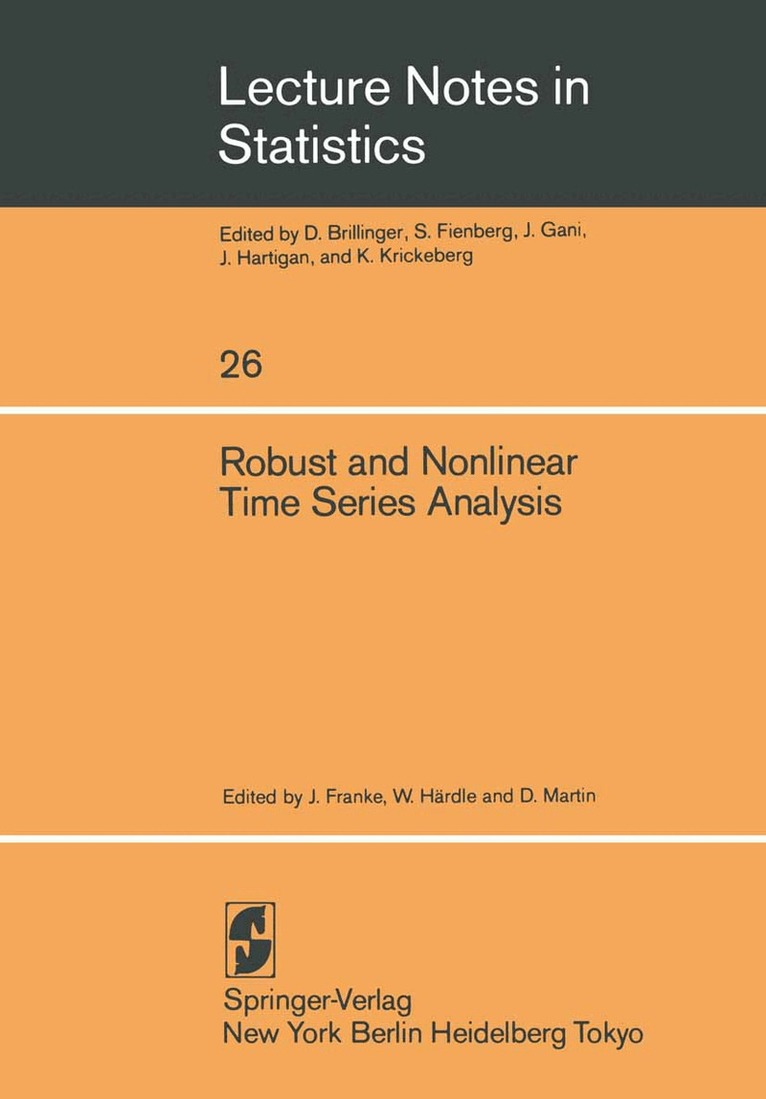
Robust and Nonlinear Time Series Analysis
Proceedings of a Workshop Organized by the Sonderforschungsbereich 123 “Stochastische Mathematische Modelle”, Heidelberg 1983
Häftad, Engelska, 1984
1 082 kr
Skickas inom 10-15 vardagar
Classical time series methods are based on the assumption that a particular stochastic process model generates the observed data. The, most commonly used assumption is that the data is a realization of a stationary Gaussian process. However, since the Gaussian assumption is a fairly stringent one, this assumption is frequently replaced by the weaker assumption that the process is wide~sense stationary and that only the mean and covariance sequence is specified. This approach of specifying the probabilistic behavior only up to "second order" has of course been extremely popular from a theoretical point of view be cause it has allowed one to treat a large variety of problems, such as prediction, filtering and smoothing, using the geometry of Hilbert spaces. While the literature abounds with a variety of optimal estimation results based on either the Gaussian assumption or the specification of second-order properties, time series workers have not always believed in the literal truth of either the Gaussian or second-order specifica tion. They have none-the-less stressed the importance of such optimali ty results, probably for two main reasons: First, the results come from a rich and very workable theory. Second, the researchers often relied on a vague belief in a kind of continuity principle according to which the results of time series inference would change only a small amount if the actual model deviated only a small amount from the assum ed model.
Del 147 - Lecture Notes in Statistics
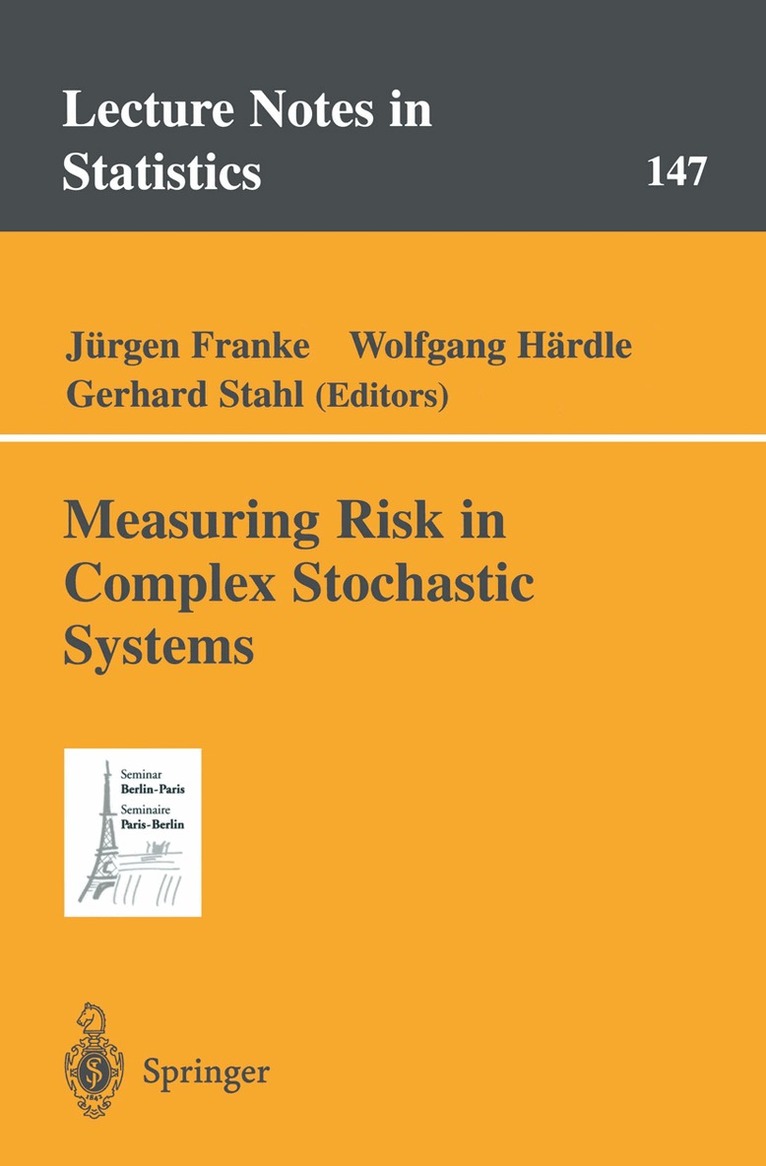
Measuring Risk in Complex Stochastic Systems
Häftad, Engelska, 2000
544 kr
Skickas inom 10-15 vardagar
This collection of articles by leading researchers will be of interest to people working in the area of mathematical finance.
E-bok
PDF, Engelska, 2012693 kr
Läs direkt efter köp
Complex dynamic processes of life and sciences generate risks that have to be taken. The need for clear and distinctive definitions of different kinds of risks, adequate methods and parsimonious models is obvious. The identification of important risk factors and the quantification of risk stemming from an interplay between many risk factors is a prerequisite for mastering the challenges of risk perception, analysis and management successfully. The increasing complexity of stochastic systems, especially in finance, have catalysed the use of advanced statistical methods for these tasks. The methodological approach to solving risk management tasks may, however, be undertaken from many different angles. A financial insti tution may focus on the risk created by the use of options and other derivatives in global financial processing, an auditor will try to evalu ate internal risk management models in detail, a mathematician may be interested in analysing the involved nonlinearities or concentrate on extreme and rare events of a complex stochastic system, whereas a statis tician may be interested in model and variable selection, practical im plementations and parsimonious modelling. An economist may think about the possible impact of risk management tools in the framework of efficient regulation of financial markets or efficient allocation of capital.
E-bok
PDF, Engelska, 20121 367 kr
Läs direkt efter köp
Classical time series methods are based on the assumption that a particular stochastic process model generates the observed data. The, most commonly used assumption is that the data is a realization of a stationary Gaussian process. However, since the Gaussian assumption is a fairly stringent one, this assumption is frequently replaced by the weaker assumption that the process is wide~sense stationary and that only the mean and covariance sequence is specified. This approach of specifying the probabilistic behavior only up to "second order" has of course been extremely popular from a theoretical point of view be cause it has allowed one to treat a large variety of problems, such as prediction, filtering and smoothing, using the geometry of Hilbert spaces. While the literature abounds with a variety of optimal estimation results based on either the Gaussian assumption or the specification of second-order properties, time series workers have not always believed in the literal truth of either the Gaussian or second-order specifica tion. They have none-the-less stressed the importance of such optimali ty results, probably for two main reasons: First, the results come from a rich and very workable theory. Second, the researchers often relied on a vague belief in a kind of continuity principle according to which the results of time series inference would change only a small amount if the actual model deviated only a small amount from the assum ed model.