J. Karger-Kocsis - Böcker
Visar alla böcker från författaren J. Karger-Kocsis. Handla med fri frakt och snabb leverans.
9 produkter
9 produkter
Polypropylene Structure, blends and composites
Volume 1 Structure and Morphology
Inbunden, Engelska, 1994
2 110 kr
Skickas inom 10-15 vardagar
Crystalline polypropylene (PP) exists in different tacticities and crystalline forms. The papers in this volume examine the structures, blends and composites of polypropylene. The first section is devoted to the structure and morphology of PP and to their changes in processing. The second section explores PP copolymers and blends with thermoplastics and eslastomers. The text also provides an overview of filled and reinforced systems with PP as matrix materials, composites, a field which may be the key to increased PP consumption in the future. This collection should appeal to anyone working on different fields of the synthesis, processing and application of plastics and thermoplastic-matrix composites.
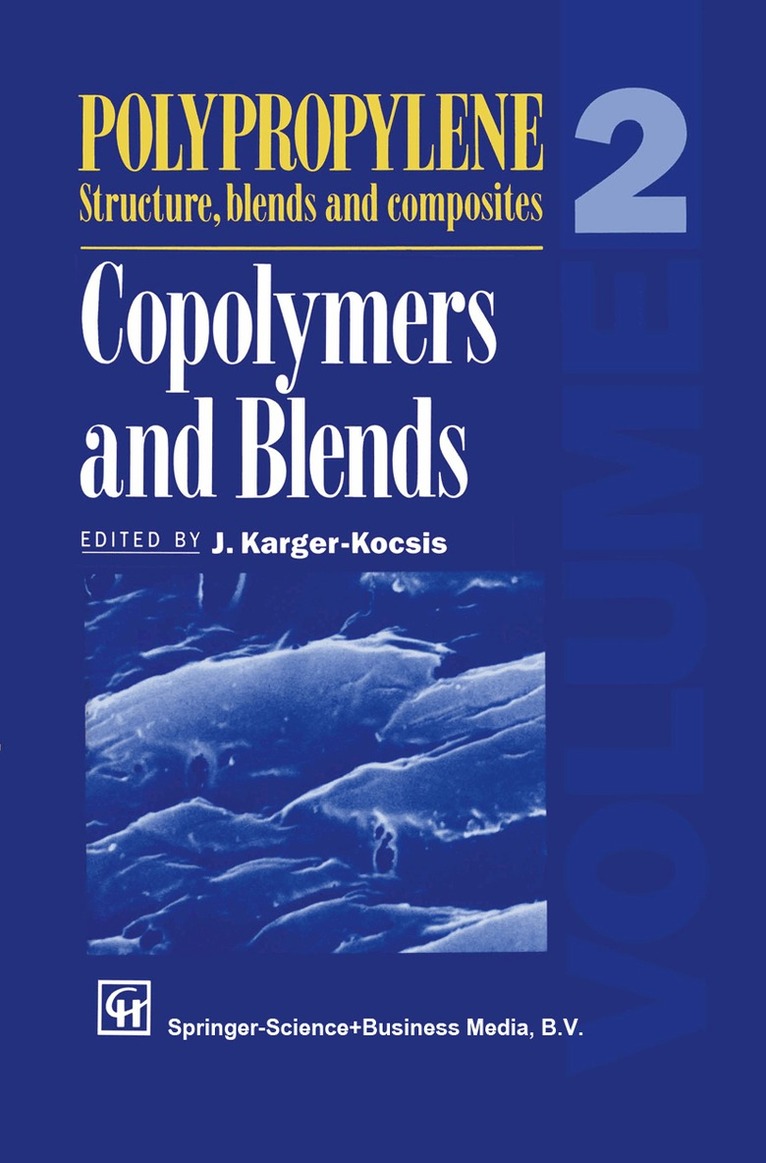
Polypropylene Structure, blends and Composites
Volume 2 Copolymers and Blends
Inbunden, Engelska, 1994
1 584 kr
Skickas inom 10-15 vardagar
This book should be of interest to graduates and researchers in composites, polymers and materials science; manufacturers of polymers, especially polypropylene; research and development laboratories in plastics industry.
2 110 kr
Skickas inom 10-15 vardagar
This book should be of interest to graduates and researchers in composites, polymers and materials science; manufacturers of polymers, especially polypropylene; research and development laboratories in plastics industry.
5 762 kr
Skickas inom 10-15 vardagar
Although polypropylene has been marketed since the 1950s, research and development in this area is still vigorous. The consumption of polypropylene over the years has been relatively high, mainly due to the steady improvement of its property profile. This book should be of interest to graduates and researchers in composites, polymers, and materials science; manufacturers of polymers, especially polypropylene; and research and development laboratories in the plastics industry.
3 162 kr
Skickas inom 10-15 vardagar
This volume reviews the present state of knowledge on the manufacturing, processing and applications of neat, modified, filled and reinforced polypropylenes at the end of the 20th century. An international group of experts surveys all important scientific and technical aspects of polypropylene (PP) in a concise manner. The book represents an updated and comprehensive report on the synthesis, processing, testing and applications of PP and related systems (modified, filled, reinforced). Each key aspect is the subject of an article for non-specialists. The articles are grouped in alphabetical format which should allow the reader to find the information needed quickly. The easy retrieval of the information is supported by a comprehensive reference guide based on key-words.
1 584 kr
Skickas inom 10-15 vardagar
Although polypropylene has been marketed since the 1950s, research and development in this area is still vigorous. The consumption of polypropylene over the years has been relatively high, mainly due to the steady improvement of its property profile. Polypropylene: Structures, Blends and Composites, in three separate volumes, reflects on the key factors which have contributed to the success of polypropylene, dealing with all aspects of structure-performance relationships relevant to thermoplastic polymers and related composites. Volume 1, Structure and Morphology, deals with polymorphism in polypropylene homo- and copolymers, where molecular and supermolecular structures are covered, and the processing-induced structure development of polypropylene, showing the interrelation between the processing-induced morphology and mechanical performance. Volume 2, Copolymers and Blends, contains comprehensive surveys of the nucleation and crystallisation behaviour of the related systems. It includes the development of morphology and its effects on rheological and mechanical properties of polypropylene-based alloys and blends and a review of polypropylene-based thermoplastic elastomers. Volume 3, Composites, gives a comprehensive overview of filled and reinforced systems with polypropylene as a matrix material, with the main emphasis on processing-structure-property-interrelationships. Chapters cover all aspects of particulate filled, chopped fibre-, fibre mat- and continuous fibre-reinforced composites. Interfacial phenomena, such as adhesion, wetting and interfacial crystallisation, are also included as important aspects of this subject.
2 110 kr
Skickas inom 10-15 vardagar
Although polypropylene has been marketed since the 1950s, research and development in this area is still vigorous. The consumption of polypropylene over the years has been relatively high, mainly due to the steady improvement of its property profile. Polypropylene: Structures, Blends and Composites, in three separate volumes, reflects on the key factors which have contributed to the success of polypropylene, dealing with all aspects of structure-performance relationships relevant to thermoplastic polymers and related composites. Volume 1, Structure and Morphology, deals with polymorphism in polypropylene homo- and copolymers, where molecular and supermolecular structures are covered, and the processing-induced structure development of polypropylene, showing the interrelation between the processing-induced morphology and mechanical performance. Volume 2, Copolymers and Blends, contains comprehensive surveys of the nucleation and crystallisation behaviour of the related systems. It includes the development of morphology and its effects on rheological and mechanical properties of polypropylene-based alloys and blends and a review of polypropylene-based thermoplastic elastomers. Volume 3, Composites, gives a comprehensive overview of filled and reinforced systems with polypropylene as a matrix material, with the main emphasis on processing-structure-property-interrelationships. Chapters cover all aspects of particulate filled, chopped fibre-, fibre mat- and continuous fibre-reinforced composites. Interfacial phenomena, such as adhesion, wetting and interfacial crystallisation, are also included as important aspects of this subject.
Polypropylene Structure, blends and composites
Volume 1 Structure and Morphology
Häftad, Engelska, 2012
2 110 kr
Skickas inom 10-15 vardagar
Although polypropylene has been marketed since the 1950s, research and development in this area is still vigorous. The consumption of polypropylene over the years has been relatively high, mainly due to the steady improvement of its property profile. Polypropylene: Structures, Blends and Composites, in three separate volumes, reflects on the key factors which have contributed to the success of polypropylene, dealing with all aspects of structure-performance relationships relevant to thermoplastic polymers and related composites. Volume 1, Structure and Morphology, deals with polymorphism in polypropylene homo- and copolymers, where molecular and supermolecular structures are covered, and the processing-induced structure development of polypropylene, showing the interrelation between the processing-induced morphology and mechanical performance. Volume 2, Copolymers and Blends, contains comprehensive surveys of the nucleation and crystallisation behaviour of the related systems. It includes the development of morphology and its effects on rheological and mechanical properties of polypropylene-based alloys and blends and a review of polypropylene-based thermoplastic elastomers. Volume 3, Composites, gives a comprehensive overview of filled and reinforced systems with polypropylene as a matrix material, with the main emphasis on processing-structure-property-interrelationships. Chapters cover all aspects of particulate filled, chopped fibre-, fibre mat- and continuous fibre-reinforced composites. Interfacial phenomena, such as adhesion, wetting and interfacial crystallisation, are also included as important aspects of this subject.
3 162 kr
Skickas inom 10-15 vardagar
My heart sank when I was approached by Dr Hastings and by Professor Briggs (Senior Editor of Materials Science and Technology and Series Editor of Polymer Science and Technology Series at Chapman & Hall, respectively) to edit a book with the provisional title Handbook of Poly propylene. My reluctance was due to the fact that my former book [1] along with that of Moore [2], issued in the meantime, seemed to cover the information demand on polypropylene and related systems. Encour aged, however, by some colleagues (the new generation of scientists and engineers needs a good reference book with easy information retrieval, and the development with metallocene catalysts deserves a new update!), I started on this venture. Having some experience with polypropylene systems and being aware of the current literature, it was easy to settle the titles for the book chapters and also to select and approach the most suitable potential contributors. Fortunately, many of my first-choice authors accepted the invitation to contribute. Like all editors of multi-author volumes, I recognize that obtaining contributors follows an S-type curve of asymptotic saturation when the number of willing contributors is plotted as a function of time. The saturation point is, however, never reached and as a consequence, Dear Reader, you will also find some topics of some relevance which are not explicitly treated in this book (but, believe me, I have considered them).