J. Scott Fraser - Böcker
Visar alla böcker från författaren J. Scott Fraser. Handla med fri frakt och snabb leverans.
3 produkter
3 produkter
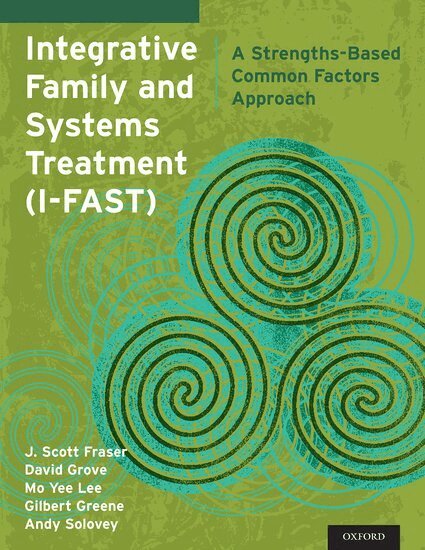
Integrative Family and Systems Treatment (I-FAST)
A Strengths-Based Common Factors Approach
Häftad, Engelska, 2014
841 kr
Skickas inom 5-8 vardagar
Funders of mental health services to youth and families have increasingly required providers to use treatments deemed to be "evidence-based." There are several evidence-based family treatment (EBFT) approaches found to be effective with the same types of presenting problems and populations. All of these EBFTs claim to be based on similar theoretical approaches and have specified treatment protocols that providers must follow to be faithful to the model. These EBFTS are expensive for agencies to establish and maintain. Many agencies that initially adopted one of these EBFTs later de-adopted it because they could not sustain it when billing Medicaid is the only way to pay for such services. Meta-analyses of treatment outcome studies have found that various theoretical approaches to therapy are effective but no one approach is more effective than any other. What accounts for client improvement is not the specific treatment approach but rather the factors they all have in common. To provide an effective, affordable, and flexible approach to family treatment the authors of this book developed and have conducted researched on an approach they call Integrative Family and Systems Treatment (I-FAST). I-FAST is a meta-model organized around the common factors to family treatment. Such a model does not require practitioners to learn a completely new way to provide treatment but rather it builds on and incorporates the clinical strengths and skills they already possess. This book is a manual for how to faithfully and flexibly provide I-FAST. A manual for a meta-model to treatment based on the common factors has never been provided. This book provides clear guidelines illustrated by cases examples for not only how to provide I-FAST but also how to teach and supervise it as well as how to integrate I-FAST with the rest of an agency's services and programs.
946 kr
Skickas inom 7-10 vardagar
Mental health professionals have long debated what makes effective psychotherapy work. Is it a specific treatment modality, or a set of common factors such as a strong therapeutic relationship? In this book, J. Scott Fraser argues that both perspectives are correct. His transtheoretical, transdiagnostic framework identifies the process of change that underlies all effective treatments. From this viewpoint, all client problems boil down to negative, recurring cycles of thought and behavior. The goal of psychotherapy is to disrupt or reverse those cycles. While successful treatment requires common factors linked with specific interventions, these components must be embedded in a therapeutic rationale that implies a direction for treatment. There are many possible amp ldquo correct amp rdquo rationales, so finding the one that best fits the client and therapist is the task of treatment planning. The book uses varied and compelling case examples, featuring different client problems and treatments, to illustrate a common process of change. Both philosophically rich and highly practical, this book helps readers understand the complexity and promise of psychotherapy.
Crisis Intervention
Using Tipping Points to Achieve Transformative Change in Therapy
Häftad, Engelska, 2025
824 kr
Skickas inom 7-10 vardagar
This book shows mental health providers how to envision crises as time-limited windows of opportunity—as tipping points clients can seize to achieve new insights and move in positive directions in their lives."It is a positive, strength-based frame for seeing crisis as an opportunity…The author skillfully brings to the fore the idea of crisis shaped in culture; a brilliant and important way to excavate through crisis as a determinant for change…This is an easy read, but profound in its content. This is a book to keep, as it will be malleable for practitioners as they develop skills and professional goals."—Doody's ReviewsAligns with APA Divisions 38 and 50. Most mental health practitioners have been taught to do risk assessments and to reduce danger to their clients and those around them. However, many providers lack a thorough understanding of the cause and nature of mental health crises and struggle to safely and successfully provide crisis intervention. Instead of seeking to return clients in crisis to their previous baseline, providers can seize the opportunity presented by crises and tip them toward rapid resolution. In Part One of the book, J. Scott Fraser outlines his Process of Change model, a clear and concrete approach to understanding crises in their proper context; engaging with clients through their values, culture, and language; honoring their goals; and breaking cycles of crisis for good. In Part Two, he shows how different types of crises—trauma, suicidality, grief, intimate partner violence, and sexual assault—reflect similar vicious cycles. Real life case studies illustrate the Process of Change model in action, demonstrating how each of those cycles can be tipped toward resolution by embracing the contextual process of change perspective.