J. Vernon Henderson – författare
Visar alla böcker från författaren J. Vernon Henderson. Handla med fri frakt och snabb leverans.
2 produkter
2 produkter
Häftad, Engelska, 2017
407 kr
Skickas inom 10-15 vardagar
Cities in Sub-Saharan Africa are experiencing rapid population growth. Yet their economic growth has not kept pace. Why? One factor might be low capital investment, due in part to Africa s relative poverty. Other regions have reached similar stages of urbanization at higher per capita GDP. This study, however, identifies a deeper reason: African cities are closed to the world. Compared with other developing cities, cities in Africa produce few goods and services for trade on regional and international markets. To grow economically as they are growing in size, Africa s cities must open their doors to the world. They need to specialize in manufacturing, along with other regionally and globally tradable goods and services. And to attract global investment in tradables production, cities must develop scale economies, which are associated with successful urban economic development in other regions.Such scale economies can arise in Africa if city and country leaders make concerted efforts to bring agglomeration effects to urban areas. Today, potential urban investors look at Africa and see crowded, disconnected, and costly cities which inspire low expectations for the scale of urban production and for returns on invested capital. How can these cities become economically dense not merely crowded? How can they acquire efficient connections and draw firms and skilled workers with a more affordable, livable urban environment?From a policy standpoint, the answer must be to address the structural problems affecting African cities. Foremost among these problems are institutional and regulatory constraints that misallocate land and labor, fragment physical development, and limit productivity. As long as African cities lack functioning land markets and regulations and early, coordinated infrastructure investments, they will remain local cities: closed to regional and global markets, trapped into producing only locally traded goods and services, and limited in their economic growth.
E-bok
PDF, Engelska, 20141 602 kr
Läs direkt efter köp
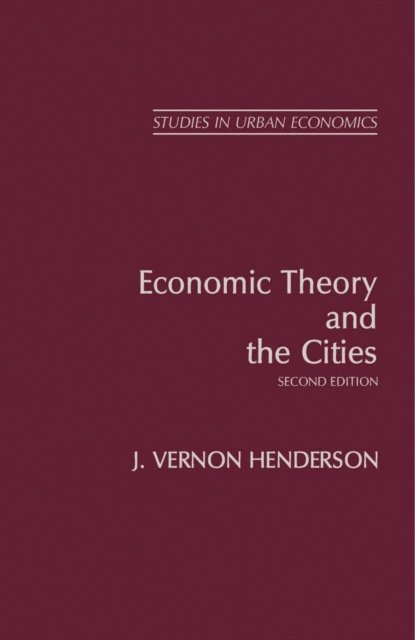
The Second Edition of Economic Theory and the Cities has been revised and expanded with both the graduate student and the practicing professional in mind. Providing a state-of-the-art synthesis of important theoretical topics in urban economics, the volume emphasizes the fundamental links between urban economics and new developments in mainstream economic theory.From the Preface: In this book I present what I believe to be the most important theoretical topics in urban economics. Since urban economics is a rather diffuse field, any presentation is necessarily selective, reflecting personal tastes and opinions. Given that, I note on what basis I chose the material that is presented and developed.First, the basic spatial model of a monocentric city is presented, since it lays the foundation for thinking about many of the topics in urban economics. The consideration of space and spatial proximity is one central feature of urban economics that distinguishes it from other branches of economics. The positive and negative externalities generated by activities locating in close spatial proximity are central to analysis of urban phenomena. However, in writing this book I have tried to maintain strong links between urban economics and recent developments in mainstream economic theory. This is reflected in the chapters that follow, which present models of aspects of the most important topics in urban economics--externalities, housing, transportation, local public finance, suburbanization, and community development. In these chapters, concepts from developments in economics over the last decade or so are woven into the traditional approaches to modeling these topics. Examples are the role of contracts in housing markets and community development; portfolio analysis in analyzing housing tenure choice and investment decisions; the time-inconsistency problem in formulating long-term economic relationships between communities, developers, and local governments; search in housing markets; and dynamic analysis in housing markets and traffic scheduling. The book ends with chapters on general equilibrium models of systems of cities, demonstrating how individual cities fit into an economy and interact with each other.This book is written both as a reference book for people in the profession and for use as a graduate text. In this edition, a strong effort has been made to present the material at a level and in a style suitable for graduate students. The edition has greatly expanded the sections on housing and local public finance so these sections could be studied profitably by a broad range of graduate students. Recommended prerequisites are an undergraduate urban economics course and a year of graduate-level microeconomic theory. It is possible that the book can be used in very advanced undergraduate courses if the students are well versed in microeconomics and are quantitatively oriented.- Focus on the basic spatial model of the monocentric city- Expanded sections on housing and local public finance- Discussion of the critical role of spatial proximity of different economic activities, such as housing, transportation, and community development