Jacopo Selva - Böcker
Visar alla böcker från författaren Jacopo Selva. Handla med fri frakt och snabb leverans.
2 produkter
2 produkter
1 544 kr
Kommande
Introduction to Volcanic Hazards Quantification describes the fundamentals of volcanic hazard quantification, which forecasts future potential intensity of volcanic activity. The book closely examines the modeling and forecasting techniques that make up Probabilistic Volcanic Hazard Analysis (PVHA). Sections introduce the fundamentals of modeling for different eruptive and non-eruptive phenomena that characterize volcanic activity, including volcanic ballistics and tephra fallout, volcanic gas dispersal, pyroclastic density currents, lava flows and lava domes, lahar and debris flows, and volcanic tsunamis. This book provides a much-needed reference on volcanic hazard quantification for those working to forecast volcanic activity as well as manage emergency preparedness.Additional content covers existing statistical tools for forecasting volcanic activity and managing uncertainties, ranging from methods adopted for both short-term forecasts and long-term models. Finally, several case studies are presented, with examples in the area of Naples, which is threatened by three active volcanoes (Mt. Vesuvius, Campi Flegrei, and Ischia), Mt Etna in Sicily, and volcanic islands such as Ischia and Vulcano in the Aeolian Islands.Introduces the physics of volcanic eruptions and eruption phenomenaExamines the statistical methods commonly used for volcanic hazardsProvides a diverse selection of case studies for volcanic hazards, including practical examples of PVHA
534 kr
Skickas inom 10-15 vardagar
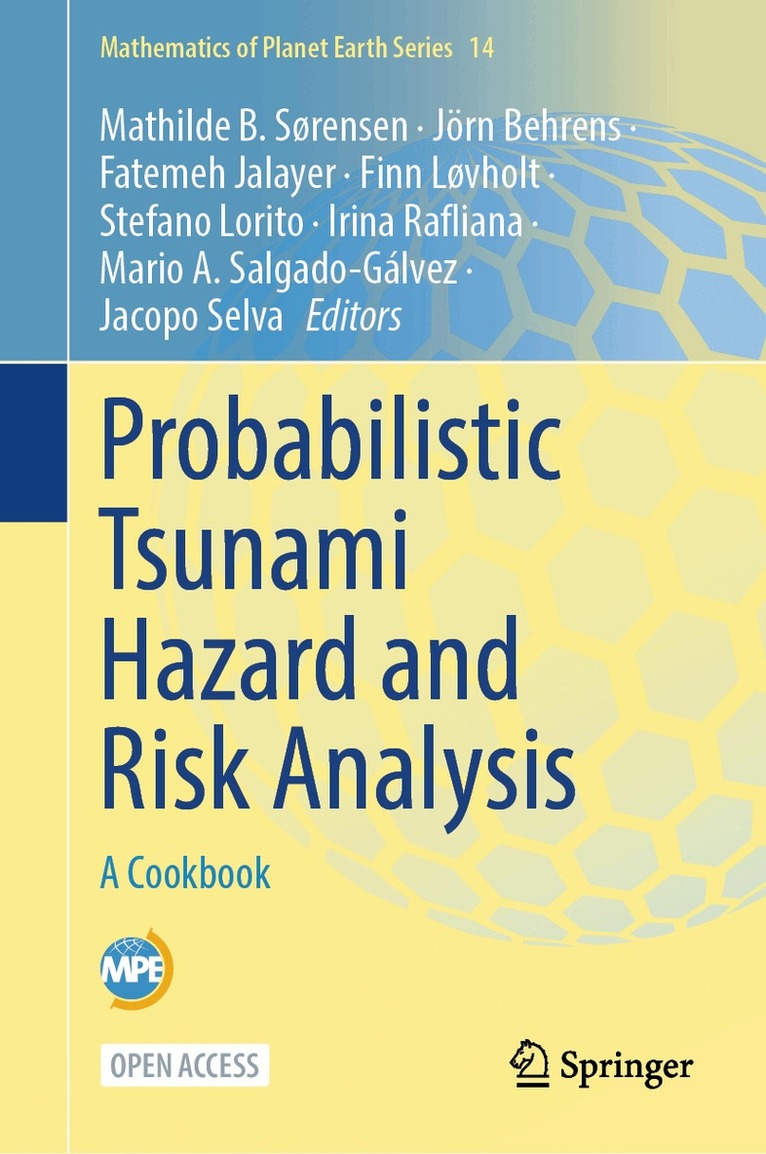
This is an open access book. Probabilistic tsunami hazard and risk assessment (abbreviated as PTHA and PTRA, respectively) has evolved quickly over the past 10 to 15 years and now forms the basis of many risk mitigation efforts. Methods are largely based on those used for probabilistic hazard and risk assessment for earthquakes. However, while seismic risk can be represented by a single workflow, tsunami risk is characterized by a number of different and cascading workflows. Funded in parts by the COST Action CA18109 AGITHAR (2019-2023), a group of more than 120 experts gathered to advance the scientific basis for PTHA and PTRA. Amongst them were over 50 volunteering to contribute to this so-called “cookbook” for PTHA and PTRA.The aim of our cookbook is to give an overview of existing methods for PTHA and PTRA, to unify the description of named workflows, and to make best practices examples available to a wider community. We use the analogy of a cookbook, because we strive to describe the ingredients, i.e., the basic building blocks of PTHA and PTRA, and give examples of good recipes, i.e., well-designed workflows for concrete application fields. Furthermore, a cookbook gives inspiration but does not necessarily standardize methods. So, while this effort aims at some standardization of methodology, it gives enough freedom to build on this knowledge to further develop the field. The book is intended for scientists, but also practitioners and decision-makers in tsunami hazard and risk mitigation.