James Frideres – författare
Visar alla böcker från författaren James Frideres. Handla med fri frakt och snabb leverans.
4 produkter
4 produkter
Häftad, Engelska, 2019
569 kr
Skickas inom 3-6 vardagar
In response to the Truth and Reconciliation Commission's report, Arrows in a Quiver provides an overview of Indigenous-settler relations, including how land is central to Indigenous identity and how the Canadian state systematically marginalizes Indigenous people. Illustrating the various "arrows in a quiver" that Indigenous people use to fight back, such as grassroots organizing, political engagement, and the courts, Frideres situates "settler colonialism" historically and explains why decolonization requires a fundamental transformation of long-standing government policy for reconciliation to occur. The historical, political, and social context provided by this text offers greater understanding and theorizes what the effective devolution of government power might look like. A comprehensive political and legal overview of Indigenous-settler relations in Canada, written at a level appropriate for post-secondary students, this book is an essential primer for understanding these key relations in Canada today. "A must-read for non-Indigenous settlers in Canada." â David McNab, co-author of Canada's First Nations: A History of Founding Peoples from Earliest Times "James Frideres has devoted his professional life to analysing this critical topic from multiple perspectives [and now, in Arrows in a Quiver,] he offers crucial insights for possible ways forward." â Arthur J. Ray, OC, FRSC, Professor Emeritus of History, University of British Columbia, and author of Aboriginal Rights Claims and the Making and Remaking of History
Inbunden, Engelska, 2019
1 385 kr
Skickas inom 3-6 vardagar
Written in an accessible style and ideal for classroom use, Arrows in a Quiver provides an overview of Indigenous-settler relations, including how land is central to Indigenous identity and how the Canadian state marginalizes Indigenous people. Illustrating the various "arrows in a quiver" that Indigenous people use to fight back, such as grassroots organizing, political engagement, and the courts, Frideres situates "settler colonialism" historically and explains why decolonization requires a fundamental transformation of long-standing government policy for reconciliation to occur. The historical, political, and social context provided by this text offers greater understanding and theorizes what the effective devolution of government power might look like. "A useful introduction to Indigenous issues, especially for post-secondary students in Canada." —Jonathan Dewar, co-editor of Cultivating Canada: Reconciliation through the Lens of Cultural Diversity
E-bok
Engelska, 2012374 kr
Läs direkt efter köp
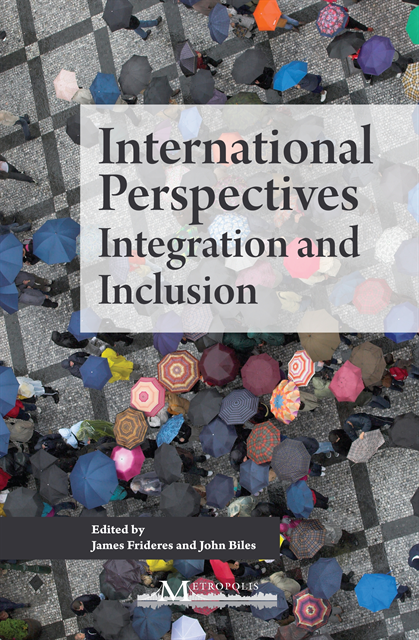
The international trend towards migration is growing rapidly and becoming increasingly complex. As the first-wave generation of migrants ages, their children and even grandchildren are reaching adulthood having spent their entire lives in the countries their families chose long ago. International Perspectives: Integration and Inclusion is a wide-ranging exploration of this new, global reality. While many countries have been, and remain, resistant to migration, the sheer volume of people moving from one country to another is forcing public policy and perceptions to change. Migrant inclusion and integration, however, remains an issue in many locales. Insightful and timely, this volume brings together contributions from various countries and levels of the migrant experience in order to consider the ways in which states can facilitate the integration and inclusion of newcomers and minorities.
E-bok
PDF, Engelska, 2012361 kr
Läs direkt efter köp
The international trend towards migration is growing rapidly and becoming increasingly complex. As the first-wave generation of migrants ages, their children and even grandchildren are reaching adulthood having spent their entire lives in the countries their families chose long ago. International Perspectives: Integration and Inclusion is a wide-ranging exploration of this new, global reality. While many countries have been, and remain, resistant to migration, the sheer volume of people moving from one country to another is forcing public policy and perceptions to change. Migrant inclusion and integration, however, remains an issue in many locales. Insightful and timely, this volume brings together contributions from various countries and levels of the migrant experience in order to consider the ways in which states can facilitate the integration and inclusion of newcomers and minorities.