James K. Peterson – författare
1 475 kr
Skickas inom 10-15 vardagar
2 068 kr
Skickas inom 10-15 vardagar
2 068 kr
Skickas inom 10-15 vardagar
2 435 kr
Skickas inom 10-15 vardagar
2 435 kr
Skickas inom 10-15 vardagar
10 911 kr
Skickas inom 10-15 vardagar
2 606 kr
Läs direkt efter köp
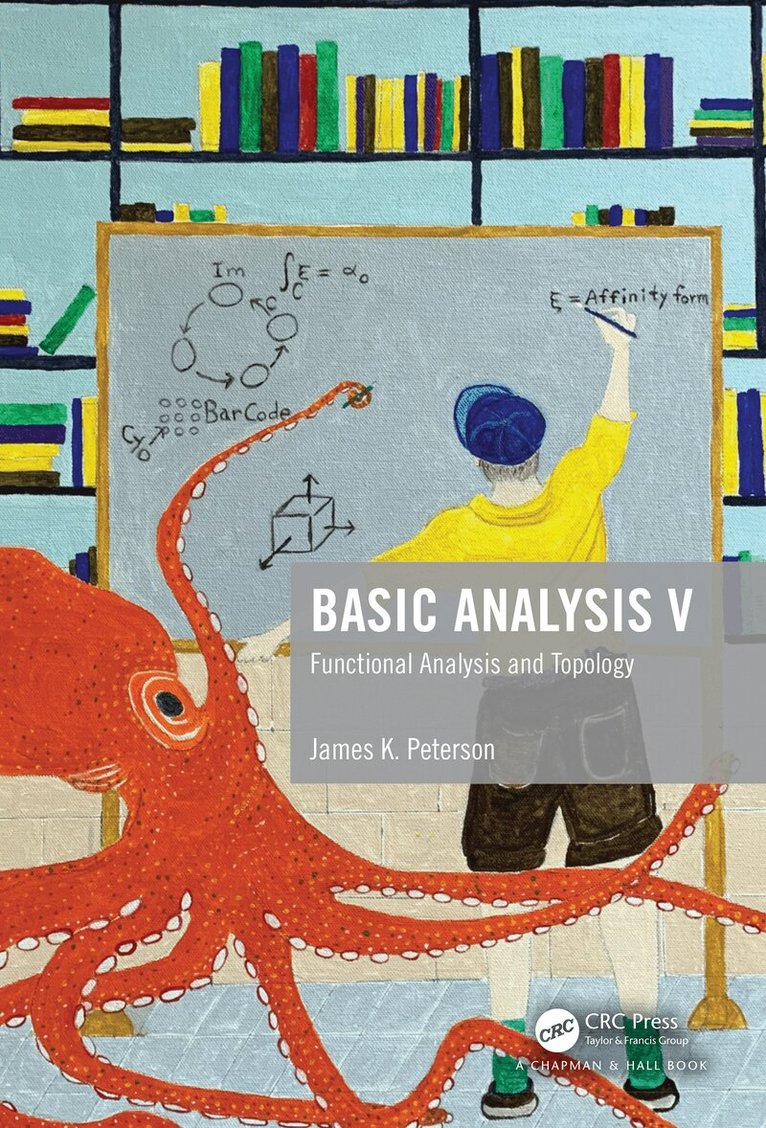
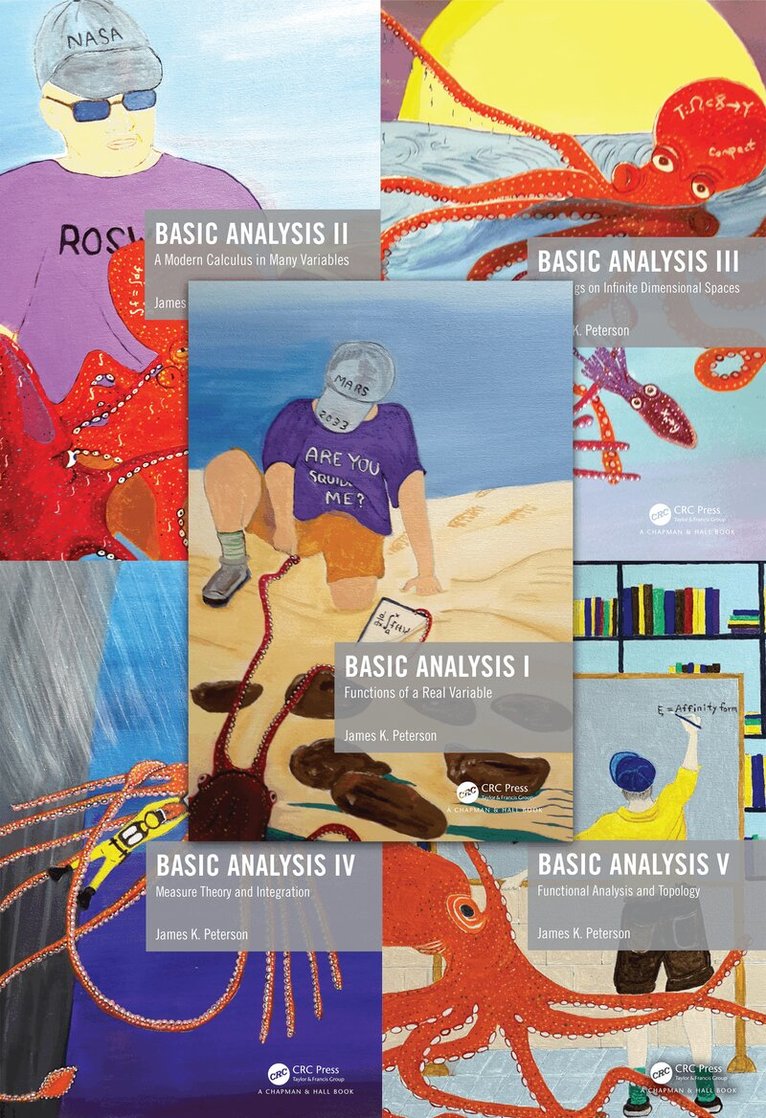
Basic Analysis V: Functional Analysis and Topology introduces graduate students in science to concepts from topology and functional analysis, both linear and nonlinear. It is the fifth book in a series designed to train interested readers how to think properly using mathematical abstractions, and how to use the tools of mathematical analysis in applications.
It is important to realize that the most difficult part of applying mathematical reasoning to a new problem domain is choosing the underlying mathematical framework to use on the problem. Once that choice is made, we have many tools we can use to solve the problem. However, a different choice would open up avenues of analysis from a different, perhaps more productive, perspective.
In this volume, the nature of these critical choices is discussed using applications involving the immune system and cognition.
Features
Develops a proof of the Jordan Canonical form to show some basic ideas in algebraic topology
Provides a thorough treatment of topological spaces, finishing with the Krein–Milman theorem
Discusses topological degree theory (Brouwer, Leray–Schauder, and Coincidence)
Carefully develops manifolds and functions on manifolds ending with Riemannian metrics
Suitable for advanced students in mathematics and associated disciplines
Can be used as a traditional textbook as well as for self-study
Author
James K. Peterson is an Emeritus Professor at the School of Mathematical and Statistical Sciences, Clemson University.
He tries hard to build interesting models of complex phenomena using a blend of mathematics, computation, and science. To this end, he has written four books on how to teach such things to biologists and cognitive scientists. These books grew out of his Calculus for Biologists courses offered to the biology majors from 2007 to 2015.
He has taught the analysis courses since he started teaching both at Clemson and at his previous post at Michigan Technological University.
In between, he spent time as a senior engineer in various aerospace firms and even did a short stint in a software development company. The problems he was exposed to were very hard, and not amenable to solution using just one approach. Using tools from many branches of mathematics, from many types of computational languages, and from first-principles analysis of natural phenomena was absolutely essential to make progress.
In both mathematical and applied areas, students often need to use advanced mathematics tools they have not learned properly. So, he has recently written a series of five books on mathematical analysis to help researchers with the problem of learning new things after they have earned their degrees and are practicing scientists. Along the way, he has also written papers in immunology, cognitive science, and neural network technology, in addition to having grants from the NSF, NASA, and the US Army.
He also likes to paint, build furniture, and write stories.
2 606 kr
Läs direkt efter köp
Basic Analysis V: Functional Analysis and Topology introduces graduate students in science to concepts from topology and functional analysis, both linear and nonlinear. It is the fifth book in a series designed to train interested readers how to think properly using mathematical abstractions, and how to use the tools of mathematical analysis in applications.
It is important to realize that the most difficult part of applying mathematical reasoning to a new problem domain is choosing the underlying mathematical framework to use on the problem. Once that choice is made, we have many tools we can use to solve the problem. However, a different choice would open up avenues of analysis from a different, perhaps more productive, perspective.
In this volume, the nature of these critical choices is discussed using applications involving the immune system and cognition.
Features
Develops a proof of the Jordan Canonical form to show some basic ideas in algebraic topology
Provides a thorough treatment of topological spaces, finishing with the Krein–Milman theorem
Discusses topological degree theory (Brouwer, Leray–Schauder, and Coincidence)
Carefully develops manifolds and functions on manifolds ending with Riemannian metrics
Suitable for advanced students in mathematics and associated disciplines
Can be used as a traditional textbook as well as for self-study
Author
James K. Peterson is an Emeritus Professor at the School of Mathematical and Statistical Sciences, Clemson University.
He tries hard to build interesting models of complex phenomena using a blend of mathematics, computation, and science. To this end, he has written four books on how to teach such things to biologists and cognitive scientists. These books grew out of his Calculus for Biologists courses offered to the biology majors from 2007 to 2015.
He has taught the analysis courses since he started teaching both at Clemson and at his previous post at Michigan Technological University.
In between, he spent time as a senior engineer in various aerospace firms and even did a short stint in a software development company. The problems he was exposed to were very hard, and not amenable to solution using just one approach. Using tools from many branches of mathematics, from many types of computational languages, and from first-principles analysis of natural phenomena was absolutely essential to make progress.
In both mathematical and applied areas, students often need to use advanced mathematics tools they have not learned properly. So, he has recently written a series of five books on mathematical analysis to help researchers with the problem of learning new things after they have earned their degrees and are practicing scientists. Along the way, he has also written papers in immunology, cognitive science, and neural network technology, in addition to having grants from the NSF, NASA, and the US Army.
He also likes to paint, build furniture, and write stories.
2 515 kr
Läs direkt efter köp
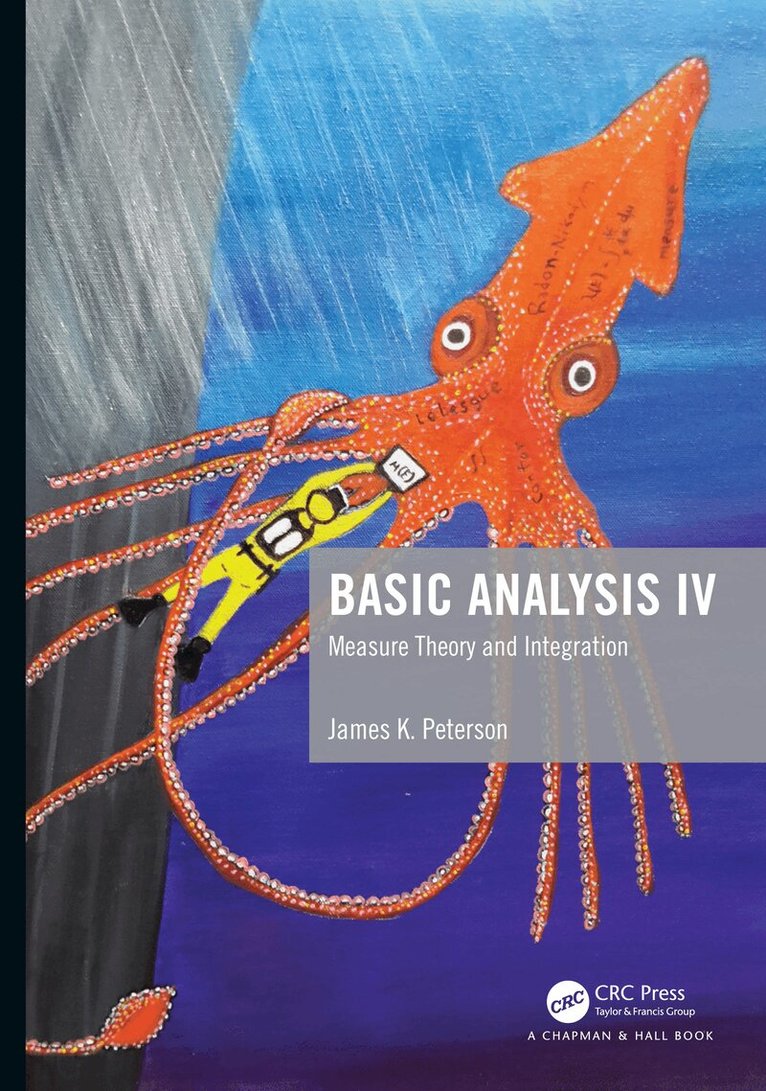
Basic Analysis IV: Measure Theory and Integration introduces students to concepts from measure theory and continues their training in the abstract way of looking at the world. This is a most important skill to have when your life''s work will involve quantitative modeling to gain insight into the real world. This text generalizes the notion of integration to a very abstract setting in a variety of ways. We generalize the notion of the length of an interval to the measure of a set and learn how to construct the usual ideas from integration using measures. We discuss carefully the many notions of convergence that measure theory provides.
Features
• Can be used as a traditional textbook as well as for self-study • Suitable for advanced students in mathematics and associated disciplines• Emphasises learning how to understand the consequences of assumptions using a variety of tools to provide the proofs of propositions
2 606 kr
Läs direkt efter köp
Basic Analysis IV: Measure Theory and Integration introduces students to concepts from measure theory and continues their training in the abstract way of looking at the world. This is a most important skill to have when your life''s work will involve quantitative modeling to gain insight into the real world. This text generalizes the notion of integration to a very abstract setting in a variety of ways. We generalize the notion of the length of an interval to the measure of a set and learn how to construct the usual ideas from integration using measures. We discuss carefully the many notions of convergence that measure theory provides.
Features
• Can be used as a traditional textbook as well as for self-study • Suitable for advanced students in mathematics and associated disciplines• Emphasises learning how to understand the consequences of assumptions using a variety of tools to provide the proofs of propositions
2 102 kr
Läs direkt efter köp
Basic Analysis III: Mappings on Infinite Dimensional Spaces is intended as a first course in abstract linear analysis. This textbook cover metric spaces, normed linear spaces and inner product spaces, along with many other deeper abstract ideas such a completeness, operators and dual spaces. These topics act as an important tool in the development of a mathematically trained scientist.
Feature:
Can be used as a traditional textbook as well as for self-study
Suitable for undergraduates in mathematics and associated disciplines
Emphasizes learning how to understand the consequences of assumptions using a variety of tools to provide the proofs of propositions
2 102 kr
Läs direkt efter köp
Basic Analysis III: Mappings on Infinite Dimensional Spaces is intended as a first course in abstract linear analysis. This textbook cover metric spaces, normed linear spaces and inner product spaces, along with many other deeper abstract ideas such a completeness, operators and dual spaces. These topics act as an important tool in the development of a mathematically trained scientist.
Feature:
Can be used as a traditional textbook as well as for self-study
Suitable for undergraduates in mathematics and associated disciplines
Emphasizes learning how to understand the consequences of assumptions using a variety of tools to provide the proofs of propositions
2 102 kr
Läs direkt efter köp
Basic Analysis II: A Modern Calculus in Many Variables focuses on differentiation in Rn and important concepts about mappings from Rn to Rm, such as the inverse and implicit function theorem and change of variable formulae for multidimensional integration. These topics converge nicely with many other important applied and theoretical areas which are no longer covered in mathematical science curricula. Although it follows on from the preceding volume, this is a self-contained book, accessible to undergraduates with a minimal grounding in analysis.
Features
Can be used as a traditional textbook as well as for self-study
Suitable for undergraduates in mathematics and associated disciplines
Emphasises learning how to understand the consequences of assumptions using a variety of tools to provide the proofs of propositions
2 028 kr
Läs direkt efter köp
Basic Analysis II: A Modern Calculus in Many Variables focuses on differentiation in Rn and important concepts about mappings from Rn to Rm, such as the inverse and implicit function theorem and change of variable formulae for multidimensional integration. These topics converge nicely with many other important applied and theoretical areas which are no longer covered in mathematical science curricula. Although it follows on from the preceding volume, this is a self-contained book, accessible to undergraduates with a minimal grounding in analysis.
Features
Can be used as a traditional textbook as well as for self-study
Suitable for undergraduates in mathematics and associated disciplines
Emphasises learning how to understand the consequences of assumptions using a variety of tools to provide the proofs of propositions
1 597 kr
Läs direkt efter köp
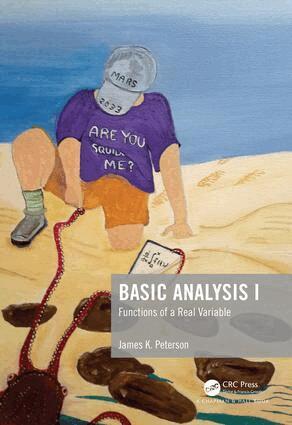
Basic Analysis I: Functions of a Real Variable is designed for students who have completed the usual calculus and ordinary differential equation sequence and a basic course in linear algebra. This is a critical course in the use of abstraction, but is just first volume in a sequence of courses which prepare students to become practicing scientists.
This book is written with the aim of balancing the theory and abstraction with clear explanations and arguments, so that students who are from a variety of different areas can follow this text and use it profitably for self-study. It can also be used as a supplementary text for anyone whose work requires that they begin to assimilate more abstract mathematical concepts as part of their professional growth.
Features
Can be used as a traditional textbook as well as for self-study
Suitable for undergraduate mathematics students, or for those in other disciplines requiring a solid grounding in abstraction
Emphasises learning how to understand the consequences of assumptions using a variety of tools to provide the proofs of propositions
1 597 kr
Läs direkt efter köp
Basic Analysis I: Functions of a Real Variable is designed for students who have completed the usual calculus and ordinary differential equation sequence and a basic course in linear algebra. This is a critical course in the use of abstraction, but is just first volume in a sequence of courses which prepare students to become practicing scientists.
This book is written with the aim of balancing the theory and abstraction with clear explanations and arguments, so that students who are from a variety of different areas can follow this text and use it profitably for self-study. It can also be used as a supplementary text for anyone whose work requires that they begin to assimilate more abstract mathematical concepts as part of their professional growth.
Features
Can be used as a traditional textbook as well as for self-study
Suitable for undergraduate mathematics students, or for those in other disciplines requiring a solid grounding in abstraction
Emphasises learning how to understand the consequences of assumptions using a variety of tools to provide the proofs of propositions
1 622 kr
Skickas inom 10-15 vardagar
1 622 kr
Skickas inom 10-15 vardagar
1 622 kr
Skickas inom 10-15 vardagar
1 622 kr
Skickas inom 10-15 vardagar
2 006 kr
Läs direkt efter köp
1 622 kr
Skickas inom 10-15 vardagar
2 049 kr
Läs direkt efter köp
1 622 kr
Skickas inom 10-15 vardagar
2 049 kr
Läs direkt efter köp
This book offers a self-study program on how mathematics, computer science and science can be profitably and seamlessly intertwined. This book focuses on two variable ODE models, both linear and nonlinear, and highlights theoretical and computational tools using MATLAB to explain their solutions. It also shows how to solve cable models using separation of variables and the Fourier Series.