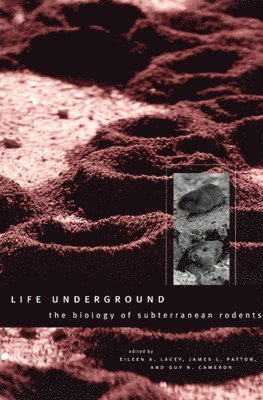
Many mammals like to dig in the dirt, but few call it home. Those that do, such as mole-rats, zokors and tuco-tucos, have developed novel adaptations to their subterranean life, including bones and muscles modified for efficient digging and ways to "see" underground without using their eyes. These unusual traits, adopted independently by unrelated groups around the world, also make subterranean rodents fascinating subjects for biologists. "Life Underground" provides the first comprehensive review of the biology of subterranean rodents. Arranged by topic rather than by taxon to facilitate cross-species comparisons, chapters cover such subjects as morphology, physiology, social behaviour, genetic variation and evolutionary diversification. Two main questions run throughtout the book. First, to what extent has subterranean life shaped the biology of these animals, leading to similar adaptations among otherwise dissimilar species? Second, how have the distinct evolutionary histories of these groups led to different solutions to the challenges posed by life underground?
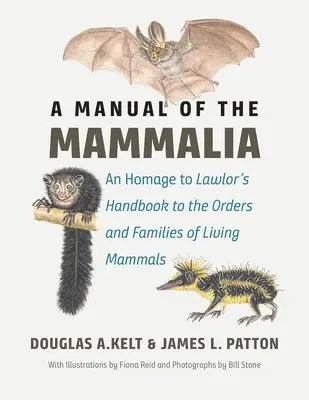
The taxonomy of recent mammals has lately undergone tremendous revision, but it has been almost four decades since the last update to Timothy E. Lawlor's acclaimed identification guide the Handbook to the Orders and Families of Living Mammals. Integrating the latest advances in research, Douglas A. Kelt and James L. Patton provide this long-overdue update in their new, wholly original work, A Manual of the Mammalia.Complemented by global range maps, high-resolution photographs of skulls and mandibles by Bill Stone, and the outstanding artwork of Fiona Reid, this book provides an overview of biological attributes of each higher taxon while highlighting key and diagnostic characters needed to identify skulls and skins of all recent mammalian orders and most families. Kelt and Patton also place taxa in their currently understood supra-familial clades, and discuss current challenges in higher mammal taxonomy. Including a comprehensive review of mammalian anatomy to provide a foundation for understanding all characters employed throughout, A Manual of the Mammalia is both a user-friendly handbook for students learning to identify higher mammal taxa and a uniquely comprehensive, up-to-date reference for mammalogists and mammal-lovers from across the globe.
Evolutionary Dynamics of the Pocket Gopher Thomomys bottae, with Emphasis on California Populations, by James L. Patton and Margaret F. Smith, offers a groundbreaking examination of one of North America’s most adaptable mammalian lineages. This study integrates morphology, genetics, and ecology to explain how pocket gophers diversified across the varied landscapes of California and the western United States. Patton and Smith analyze patterns of geographic variation, gene flow, and speciation in Thomomys bottae, showing how local ecological pressures—from soil type and vegetation to elevation and climate—shaped the evolutionary pathways of these fossorial rodents. The work emphasizes both microevolutionary processes visible in contemporary populations and the broader historical forces driving divergence across regions. More than a descriptive natural history, this volume demonstrates the methodological advances that come from combining population genetics, systematics, and field ecology. By dissecting the evolutionary dynamics of a species with wide distribution and ecological flexibility, Patton and Smith illuminate general principles of adaptation, isolation, and diversification that extend beyond gophers to broader evolutionary theory. The book stands as both a reference on Thomomys bottae and a model of integrative research, appealing to evolutionary biologists, mammalogists, and ecologists interested in how species evolve in response to environmental heterogeneity.
Oliver P. Pearson's studies on mammalian biology remain standard reading for ecologists, physiologists, taxonomists, and biogeographers. Reflecting this, the papers gathered here continue to expand our understanding of the ecology and evolution of subterranean mammals, and of ecology, taxonomy, and biogeography of Neotropical mammals, a group that was central to the latter half of Pearson's career.
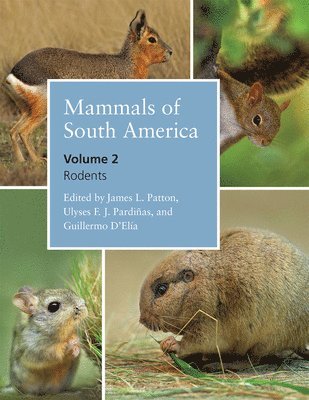
The second installment in a planned three-volume series, this book provides the first substantive review of South American rodents published in over fifty years. Increases in the reach of field research and the variety of field survey methods, the introduction of bioinformatics, and the explosion of molecular-based genetic methodologies have all contributed to the revision of many phylogenetic relationships and to a doubling of the recognized diversity of South American rodents. The largest and most diverse mammalian order on Earth-and an increasingly threatened one-Rodentia is also of great ecological importance, and Rodents is both a timely and exhaustive reference on these ubiquitous creatures. From spiny mice and guinea pigs to the oversized capybara, this book covers all native rodents of South America, the continental islands of Trinidad and Tobago, and the Caribbean Netherlands off the Venezuelan coast. It includes identification keys and descriptions of all genera and species; comments on distribution; maps of localities; discussions of subspecies; and summaries of natural, taxonomic, and nomenclatural history.Rodents also contains a detailed list of cited literature and a separate gazetteer based on confirmed identifications from museum vouchers and the published literature.