James McQueen - Böcker
Visar alla böcker från författaren James McQueen. Handla med fri frakt och snabb leverans.
7 produkter
7 produkter
345 kr
Skickas inom 3-6 vardagar
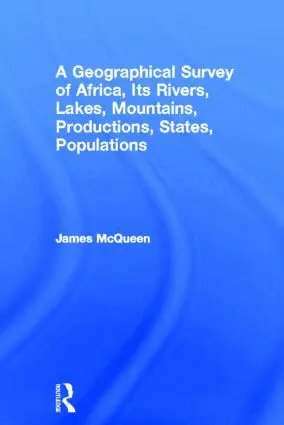
Geographical Survey of Africa, Its Rivers, Lakes, Mountains, Productions, States, Populations
Inbunden, Engelska, 1969
2 159 kr
Skickas inom 10-15 vardagar
The owner of West Indian plantations, McQueen collected extensive information from slaves which led him correctly to the conclusion that the Niger ended in the great delta of the Blight of Benin. First published in 1840.
Geographical Survey of Africa, Its Rivers, Lakes, Mountains, Productions, States, Populations
Häftad, Engelska, 2014
687 kr
Skickas inom 10-15 vardagar
The owner of West Indian plantations, McQueen collected extensive information from slaves which led him correctly to the conclusion that the Niger ended in the great delta of the Blight of Benin. First published in 1840.
Spoken Word Access Processes (SWAP)
A Special Issue of Language and Cognitive Processes
Häftad, Engelska, 2015
478 kr
Skickas inom 10-15 vardagar
Spoken word access processes are the mental processes which underlie our ability to recognise spoken words. They are the perceptual processes which take the sequence of buzzes, bursts and chirps that make up the raw speech signal and convert them into a sequence of words. This edited volume contains articles and short reports which examine these processes. These papers are based on presentations at the workshop Spoken Word Access Processes (SWAP), held in Nijmegen in May 2000. They cover the major issues that the field is now concerned with, and thus provide a snapshot of the current state of the SWAP art. Core representational issues about spoken words are addressed: the form of the representations which are used to access the mental lexicon; how phonological information is coded in the lexicon; and how morphological and semantic information about each word is stored. The main components of the lexical access process are also discussed: competition between candidate words; computation of goodness-of-fit between the signal and stored lexical knowledge; segmentation of continuous speech into words; whether there is feedback from the lexicon to earlier stages of processing; and the relationship of form-based processes to the processes responsible for deriving interpretations of utterances. This collection should be essential reading for those working in this or related areas of psycholinguistics. An introductory article is included which makes this research more accessible to students in cognitive psychology and phonetics, and to specialists in other fields of psychology and linguistics.
536 kr
Skickas inom 3-6 vardagar
590 kr
Skickas inom 3-6 vardagar
Spoken Word Access Processes (SWAP)
A Special Issue of Language and Cognitive Processes
Inbunden, Engelska, 2001
1 251 kr
Skickas inom 10-15 vardagar
Spoken word access processes are the mental processes which underlie our ability to recognise spoken words. They are the perceptual processes which take the sequence of buzzes, bursts and chirps that make up the raw speech signal and convert them into a sequence of words. This edited volume contains articles and short reports which examine these processes. These papers are based on presentations at the workshop Spoken Word Access Processes (SWAP), held in Nijmegen in May 2000. They cover the major issues that the field is now concerned with, and thus provide a snapshot of the current state of the SWAP art. Core representational issues about spoken words are addressed: the form of the representations which are used to access the mental lexicon; how phonological information is coded in the lexicon; and how morphological and semantic information about each word is stored. The main components of the lexical access process are also discussed: competition between candidate words; computation of goodness-of-fit between the signal and stored lexical knowledge; segmentation of continuous speech into words; whether there is feedback from the lexicon to earlier stages of processing; and the relationship of form-based processes to the processes responsible for deriving interpretations of utterances. This collection should be essential reading for those working in this or related areas of psycholinguistics. An introductory article is included which makes this research more accessible to students in cognitive psychology and phonetics, and to specialists in other fields of psychology and linguistics.