Jan Visser - Böcker
Visar alla böcker från författaren Jan Visser. Handla med fri frakt och snabb leverans.
4 produkter
4 produkter
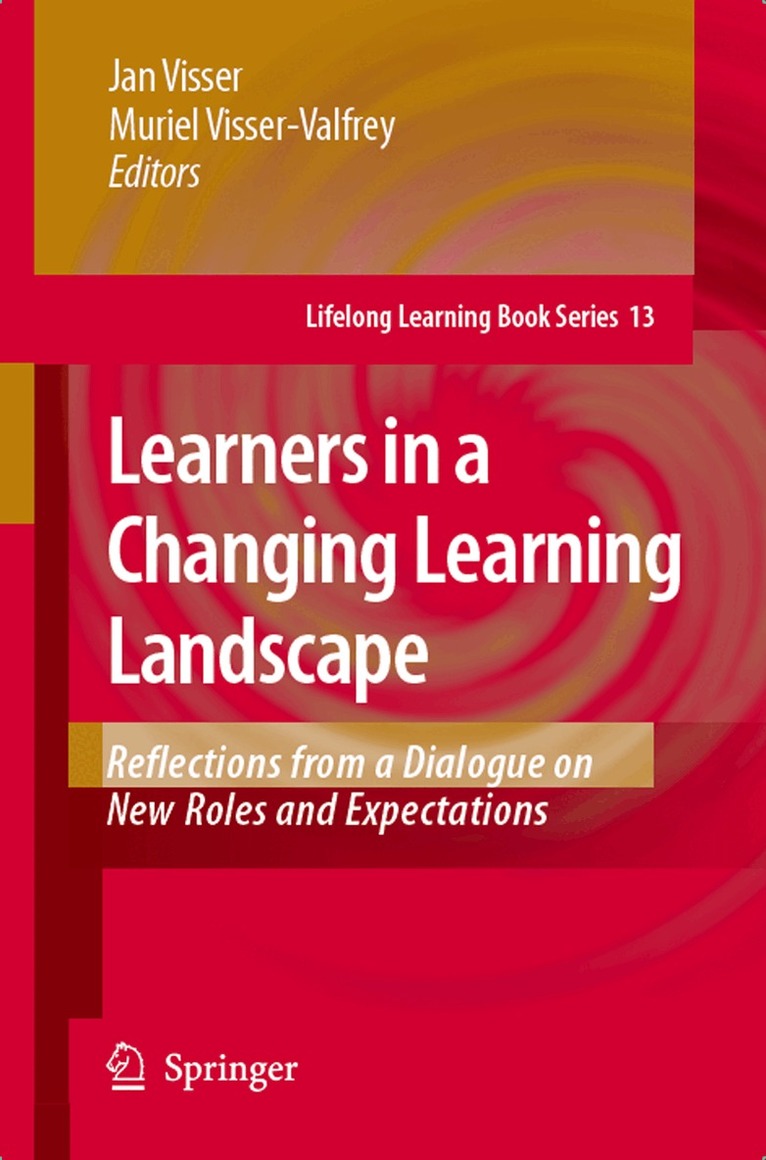
Learners in a Changing Learning Landscape
Reflections from a Dialogue on New Roles and Expectations
Inbunden, Engelska, 2008
1 548 kr
Skickas inom 10-15 vardagar
most studies aimed at improving learning focus on the instructor and the parameters of the learning environment, rather than the learner. On the other hand it was felt that ibstpi’s interest was too focused on the online learner and that broader qu- tions needed to be asked, placing the learner in the context of a hugely complex learning landscape that is only partially determined by the formal education context and deliberate processes of learning. Based on the above consideration, and while inspired by ibstpi’s initiative, the Learning Development Institute proposed to run a dedicated workshop in conju- tion with a Presidential Panel Session to be hosted by the Association for Educational Communications and Technology (AECT) at its annual convention in October 2005 in Orlando, Florida. This brought together ten individuals who initially started collaborating online. The majority of them then met face to face in Orlando at the workshop. They subsequently shared their ideas with the wider audience of attendees at the Presidential Panel Session that followed the next day. And they then took another two years to reflect further on the issues that had emerged, producing the chapters of this book.
881 kr
Skickas inom 5-8 vardagar
The quest to understand defines our humanness. Since time immemorial it has given rise to art and literature, philosophical reflection, religious practice, myths, metaphor, and allegory, as well as, in more recent history, disciplined scientific inquiry. Seeking understanding is a lifelong journey towards a goal the parameters of which change as our pursuit progresses, until, at life’s end, the goal vanishes beyond the horizon. Such is humanness. Along the way, we build, in an enduring self-transformative fashion, our mind—the scientific mind. But what is that mind?A transdisciplinary team of 21 prominent authors, from areas such as music history, psychiatry, physics, cosmology, education, astronomy, mathematics, medicine, gaming, artificial intelligence, science communication, early child development, science education, and economics, shed light on what it takes humans to build and cultivate the scientific mind along the lifespan. A decade of intercultural dialogue preceded the book. It comprised six major international Building the Scientific Mind colloquia in culturally diverse settings that spanned the entire planet. Several hundred people from different disciplines and interests—among them distinguished scientists, policy and decision makers, practitioners and thinkers—contributed to the dialogue.Building the scientific mind transforms our ‘way of being in the world.’ It is driven by the desire to understand deeply—cognitively and affectively—who we are in a world of which we are an integral part. It has great relevance for sustained human existence in the Anthropocene and profound implications for how we organize the conditions for informal and formal learning.
2 212 kr
Skickas inom 5-8 vardagar
The quest to understand defines our humanness. Since time immemorial it has given rise to art and literature, philosophical reflection, religious practice, myths, metaphor, and allegory, as well as, in more recent history, disciplined scientific inquiry. Seeking understanding is a lifelong journey towards a goal the parameters of which change as our pursuit progresses, until, at life’s end, the goal vanishes beyond the horizon. Such is humanness. Along the way, we build, in an enduring self-transformative fashion, our mind—the scientific mind. But what is that mind?A transdisciplinary team of 21 prominent authors, from areas such as music history, psychiatry, physics, cosmology, education, astronomy, mathematics, medicine, gaming, artificial intelligence, science communication, early child development, science education, and economics, shed light on what it takes humans to build and cultivate the scientific mind along the lifespan. A decade of intercultural dialogue preceded the book. It comprised six major international Building the Scientific Mind colloquia in culturally diverse settings that spanned the entire planet. Several hundred people from different disciplines and interests—among them distinguished scientists, policy and decision makers, practitioners and thinkers—contributed to the dialogue.Building the scientific mind transforms our ‘way of being in the world.’ It is driven by the desire to understand deeply—cognitively and affectively—who we are in a world of which we are an integral part. It has great relevance for sustained human existence in the Anthropocene and profound implications for how we organize the conditions for informal and formal learning.
Learners in a Changing Learning Landscape
Reflections from a Dialogue on New Roles and Expectations
Häftad, Engelska, 2010
1 548 kr
Skickas inom 10-15 vardagar
most studies aimed at improving learning focus on the instructor and the parameters of the learning environment, rather than the learner. On the other hand it was felt that ibstpi’s interest was too focused on the online learner and that broader qu- tions needed to be asked, placing the learner in the context of a hugely complex learning landscape that is only partially determined by the formal education context and deliberate processes of learning. Based on the above consideration, and while inspired by ibstpi’s initiative, the Learning Development Institute proposed to run a dedicated workshop in conju- tion with a Presidential Panel Session to be hosted by the Association for Educational Communications and Technology (AECT) at its annual convention in October 2005 in Orlando, Florida. This brought together ten individuals who initially started collaborating online. The majority of them then met face to face in Orlando at the workshop. They subsequently shared their ideas with the wider audience of attendees at the Presidential Panel Session that followed the next day. And they then took another two years to reflect further on the issues that had emerged, producing the chapters of this book.