Jane Desborough – författare
Visar alla böcker från författaren Jane Desborough. Handla med fri frakt och snabb leverans.
3 produkter
3 produkter
Inbunden, Engelska, 2020
224 kr
Skickas inom 7-10 vardagar
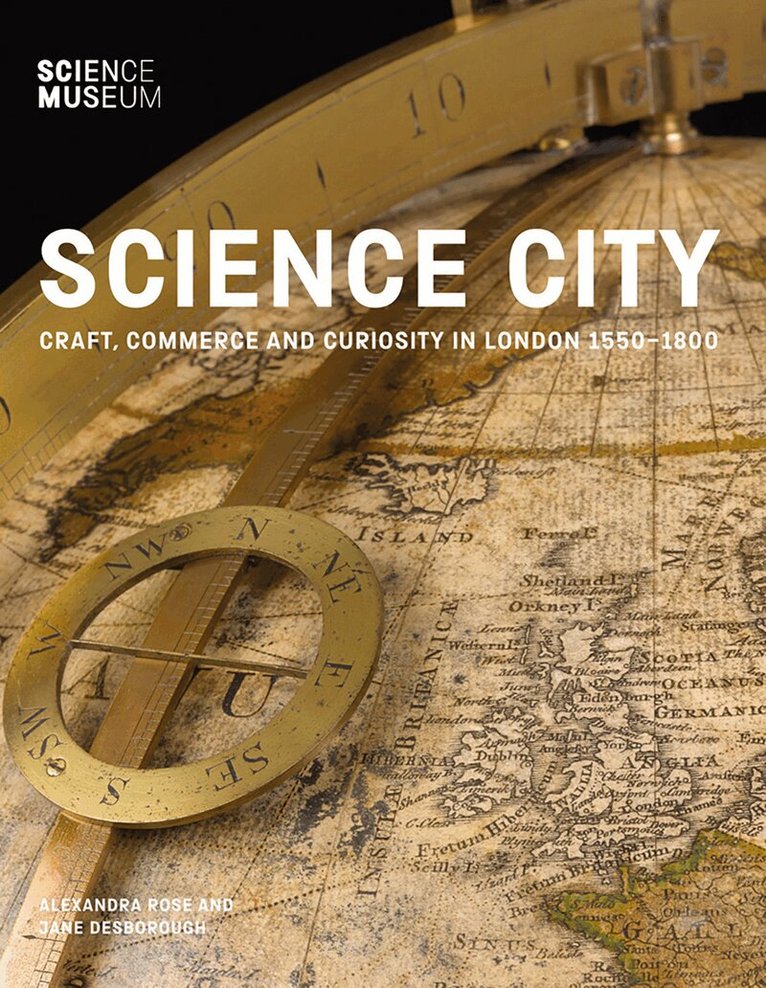
Many cities around the world could claim to have a rich scientific history. However, between 1550 and 1800, London fostered its very own particular brand of scientific enquiry and practice. Home to the world-famous Royal Society - which boasts membership from figures such as Francis Bacon and Isaac Newton - London encouraged and facilitated scientific expansion. Science City explores London as a world-leading nexus of administration for ambitious scientific projects, as well as a place to obtain exceptional scientific equipment. The story of the city is richly illustrated with objects, artefacts and maps, many of which are from the Science Museum's extraordinary collection of scientific and mathematical instruments. Science City is published to accompany a new gallery at the Science Museum, scheduled to open in the autumn of 2019.This publication accompanies a new gallery, due to open at the Science Museum in Autumn 2019. The Science Museum has 662K followers on Twitter and 174k on Instagram.
Inbunden, Engelska, 2019
1 011 kr
Skickas inom 10-15 vardagar
This book provides a reinterpretation of early modern clock and watch dials on the basis of use. Between 1550 and the emergence of a standard format in 1770, dials represented combinations of calendrical, lunar and astronomical information using multiple concentric rings, subsidiary dials and apertures. Change was gradual, but significant. Over the course of eight chapters and with reference to thirty-five exceptional images, this book unlocks the meaning embedded within these early combinations. The true significance of dial change can only be fully understood by comparing dials with printed paper sources such as almanacs, diagrams and craft pamphlets. Clock and watch makers drew on traditional communication methods, utilised different formats to generate trust in their work, and tried to be help users in different contexts. The calendar, lunar and astronomical functions were useful as a memory prompt for astrology up until the mid-late seventeenth century. After the decline ofthis practice, the three functions continued to be useful for other purposes, but eventually declined.
E-bok
Engelska, 20191 250 kr
Läs direkt efter köp
This book provides a reinterpretation of early modern clock and watch dials on the basis of use. Between 1550 and the emergence of a standard format in 1770, dials represented combinations of calendrical, lunar and astronomical information using multiple concentric rings, subsidiary dials and apertures. Change was gradual, but significant. Over the course of eight chapters and with reference to thirty-five exceptional images, this book unlocks the meaning embedded within these early combinations. The true significance of dial change can only be fully understood by comparing dials with printed paper sources such as almanacs, diagrams and craft pamphlets. Clock and watch makers drew on traditional communication methods, utilised different formats to generate trust in their work, and tried to be help users in different contexts. The calendar, lunar and astronomical functions were useful as a memory prompt for astrology up until the mid-late seventeenth century. After the decline ofthis practice, the three functions continued to be useful for other purposes, but eventually declined.