Janis van der Westhuizen - Böcker
Visar alla böcker från författaren Janis van der Westhuizen. Handla med fri frakt och snabb leverans.
2 produkter
2 produkter
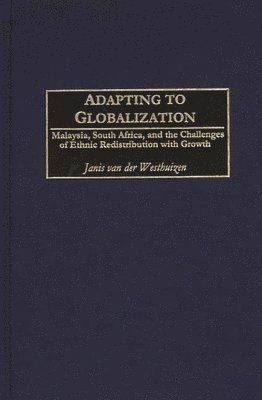
Adapting to Globalization
Malaysia, South Africa, and the Challenges of Ethnic Redistribution with Growth
Inbunden, Engelska, 2002
1 009 kr
Skickas inom 10-15 vardagar
Van der Westhuizen examines the remarkable similarity between the South African and Malaysian political economies, analyzes how Malay, Afrikaner, and African Nationalists have sought to make domestic demands for state intervention compatible with international pressures for economic liberalization, and shows what happens when they fail.Globalization poses daunting challenges to state elites in the developing world. Caught between domestic expectations for state intervention to reduce inequalities on the one hand and global neo-liberal pressures for a liberalized economy on the other, the developing world bears the brunt of globalization's socially disruptive effects. For state elites in deeply divided societies like Malaysia and South Africa, the heightened potential for ethnic polarization makes the challenge twice as large. In both, state elites have sought to mitigate such polarization by embarking upon a program of ethnic redistribution with growth, that is, advancing subjugated ethnic majorities into the middle class through state intervention without fundamentally alienating the privileged ethnic minority upon whose economic dominance the process of social advance depends.However, what happens if globalization prevents state elites from employing ethnic redistribution with growth? How do these state elites attempt to retain their legitimacy and what happens if they do not succeed? Van der Westhuizen examines these issues by showing how state elites in Malaysia and apartheid South Africa successfully pursued ethnic redistribuiton with growth during the heydays of Keynesianism and Fordism and the complexity of such a strategy in the post-Cold War, post-Fordist world of the competition state. He examines the ways in which Malaysia and South Africa have adapted to globalization by becoming competition states and the implication this process has for democratic consolidation. He provides a provocative analysis of particular interest to scholars, students, and researchers involved with development studies, international political economy, and comparative politics.
1 409 kr
Skickas inom 5-8 vardagar
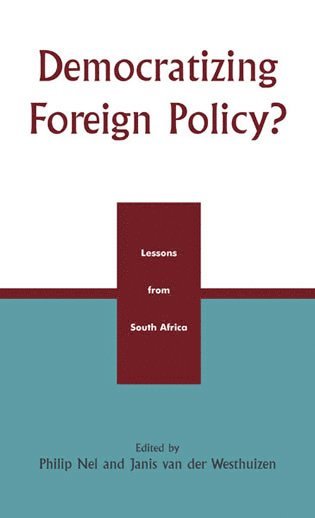
Are ordinary citizens capable of shaping foreign policy? To answer this question, fifteen established and emerging scholars use South Africa as a case study to assess the extent to which democratic consolidation can be translated into the realm of foreign policy. Contributors discuss the South African Development Community as an arena of transnational democracy, the impact of European Union trade policy, and the significance of South Africa's controversial 'arms deals' as they explore the opportunities and constraints facing recently democratized societies in the Southern Hemisphere. Democratizing Foreign Policy? Lessons from South Africa provides a broad-ranging assessment—investigating conceptual issues regarding the role of women, think tanks, civil society, labor movements, and the impact of globalization upon the process of foreign policy making—of the opportunities and challenges involved in opening the process of foreign policy making to civil society and the need to do so if the developing world is to better manage the complexities of globalization.