Janusz Lipkowski - Böcker
Visar alla böcker från författaren Janusz Lipkowski. Handla med fri frakt och snabb leverans.
4 produkter
4 produkter
2 101 kr
Skickas inom 10-15 vardagar
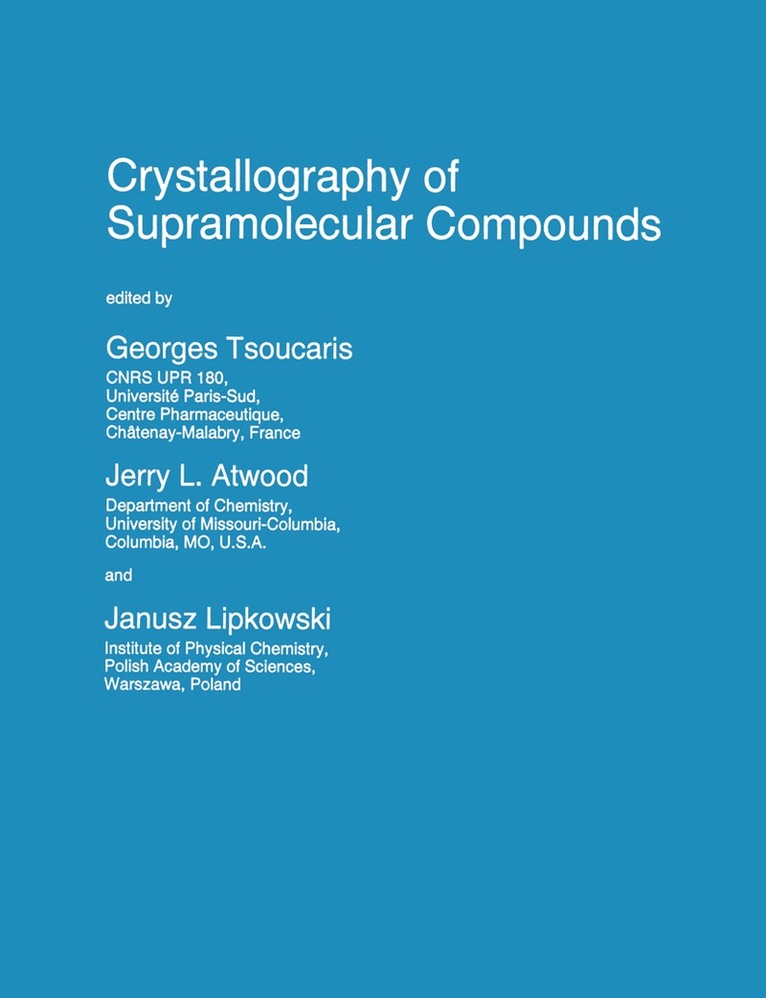
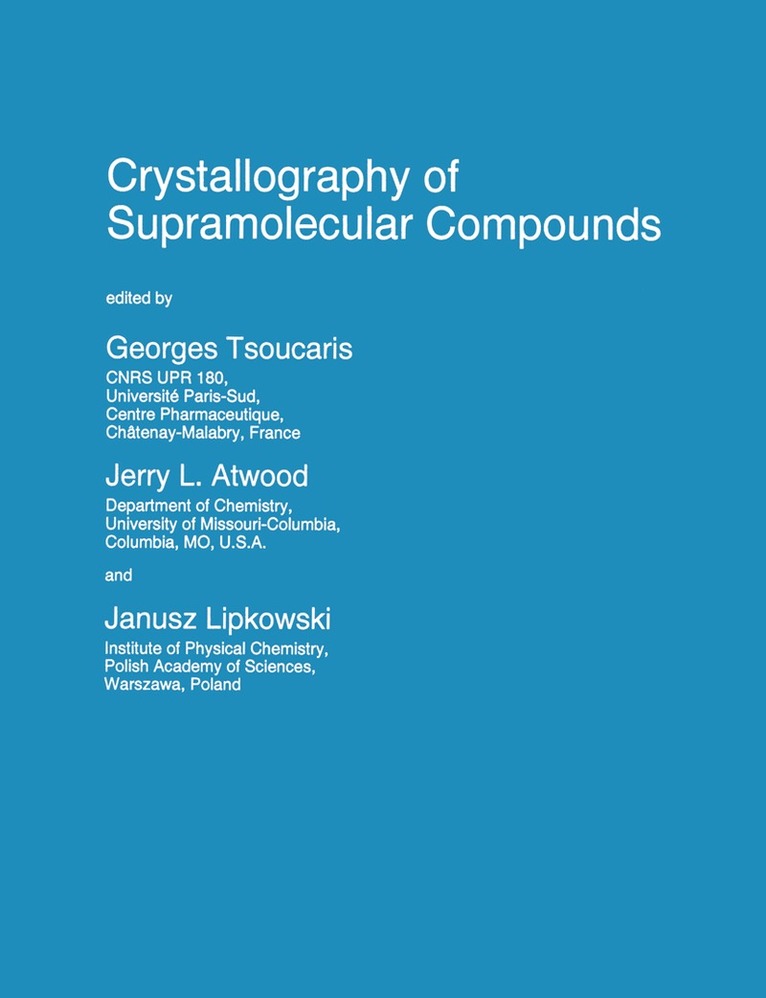
The Supramolecular Compounds refer to organised multi-molecular assemblies and associated phenomena. The stability and the properties of these compounds strongly involve structural three-dimensional (3D) information. The crystal itself can be considered as a giant supermolecule. Thus, a thorough understanding of crystal structures and crystal growth provides a unique information on the intermolecular interactions. Indeed, each crystal reflects in a particular way the recognition properties of molecules. More so, modern crystallography allows to study in detail two- or three-component crystalline solids in which the recognition processes can be seen from the structural standpoint. Crystallography of smaller and smaller single crystals, faster and faster experiments, time-resolved x-ray crystallography, are extremely potent source of physico-chemical information. The present Advanced Study Institute (A.S.I.) - which was planned five years ago as the 22nd Course of the International School of Crystallography (director: T. L. BLUNDELL), 1-11 June 1995, E.Majorana Centre, Erice, Italy - is probably the first international meeting specifically devoted to the Crystallography of Supramolecular Compounds. The presence of crystallographers, chemists and physicists enhanced the coherence of the typical sequence: Conception and Design - Synthesis - Structure and Visualisation - Properties. The interactive and interdisciplinary character of this research is central to the development of general structural models for a large spectrum of compounds: ionophores, cryptates, fullerenes, calixarenes, cyclodextrins, cyclotriveratrylenes, pillar type compounds, zeolites, hydrates, solvates and others.
Del 117 - NATO Science Series II: Mathematics, Physics and Chemistry
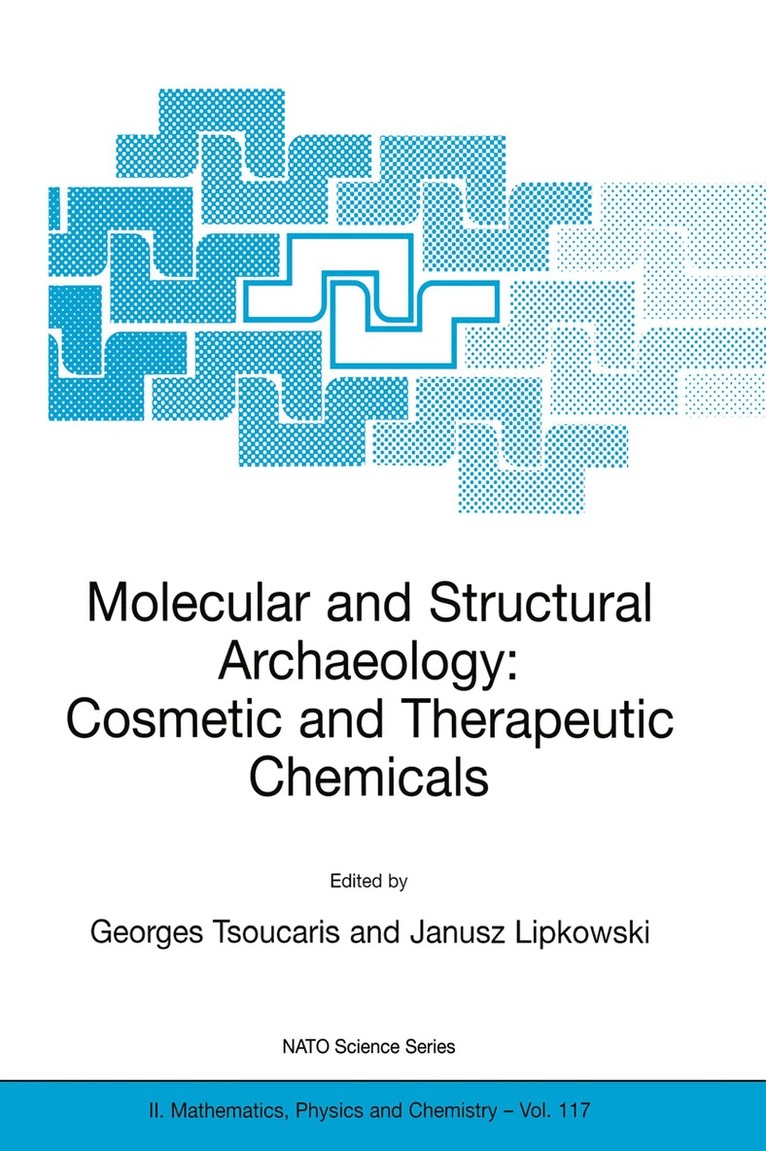
Molecular and Structural Archaeology: Cosmetic and Therapeutic Chemicals
Inbunden, Engelska, 2003
2 164 kr
Skickas inom 10-15 vardagar
This work delineates the contours of molecular and structural archaeology as an emergent interdisciplinary field based on structural analysis at the molecular level and examines novel methodologies to reconstruct the synthesis and long-term transformation of materials used in antiquity. The focus of this volume is on cosmetic and therapeutic materials. As such, it casts an entirely new light on the knowledge possessed by the ancients, based on the complete identification of complex materials and preparations found in closed vessels in ancient tombs. It appears that as early as 2000 BCE the necessary technology was available to conduct wet chemical synthesis of new compounds not known as natural products. The materials as we analyse them today have their own prior history, and disentangling the effects of extreme long-term storage forms part of the puzzle, which may possibly be resolved by means of simulation experiments.
2 164 kr
Skickas inom 10-15 vardagar
This work delineates the contours of molecular and structural archaeology as an emergent interdisciplinary field based on structural analysis at the molecular level and examines novel methodologies to reconstruct the synthesis and long-term transformation of materials used in antiquity. The focus of this volume is on cosmetic and therapeutic materials. As such, it casts an entirely new light on the knowledge possessed by the ancients, based on the complete identification of complex materials and preparations found in closed vessels in ancient tombs. It appears that as early as 2000 BCE the necessary technology was available to conduct wet chemical synthesis of new compounds not known as natural products. The materials as we analyse them today have their own prior history, and disentangling the effects of extreme long-term storage forms part of the puzzle, which may possibly be resolved by means of simulation experiments.
2 101 kr
Skickas inom 10-15 vardagar
The Supramolecular Compounds refer to organised multi-molecular assemblies and associated phenomena. The stability and the properties of these compounds strongly involve structural three-dimensional (3D) information. The crystal itself can be considered as a giant supermolecule. Thus, a thorough understanding of crystal structures and crystal growth provides a unique information on the intermolecular interactions. Indeed, each crystal reflects in a particular way the recognition properties of molecules. More so, modern crystallography allows to study in detail two- or three-component crystalline solids in which the recognition processes can be seen from the structural standpoint. Crystallography of smaller and smaller single crystals, faster and faster experiments, time-resolved x-ray crystallography, are extremely potent source of physico-chemical information. The present Advanced Study Institute (A.S.I.) - which was planned five years ago as the 22nd Course of the International School of Crystallography (director: T. L. BLUNDELL), 1-11 June 1995, E.Majorana Centre, Erice, Italy - is probably the first international meeting specifically devoted to the Crystallography of Supramolecular Compounds. The presence of crystallographers, chemists and physicists enhanced the coherence of the typical sequence: Conception and Design - Synthesis - Structure and Visualisation - Properties. The interactive and interdisciplinary character of this research is central to the development of general structural models for a large spectrum of compounds: ionophores, cryptates, fullerenes, calixarenes, cyclodextrins, cyclotriveratrylenes, pillar type compounds, zeolites, hydrates, solvates and others.