Jason W. Davidson - Böcker
Visar alla böcker från författaren Jason W. Davidson. Handla med fri frakt och snabb leverans.
5 produkter
5 produkter
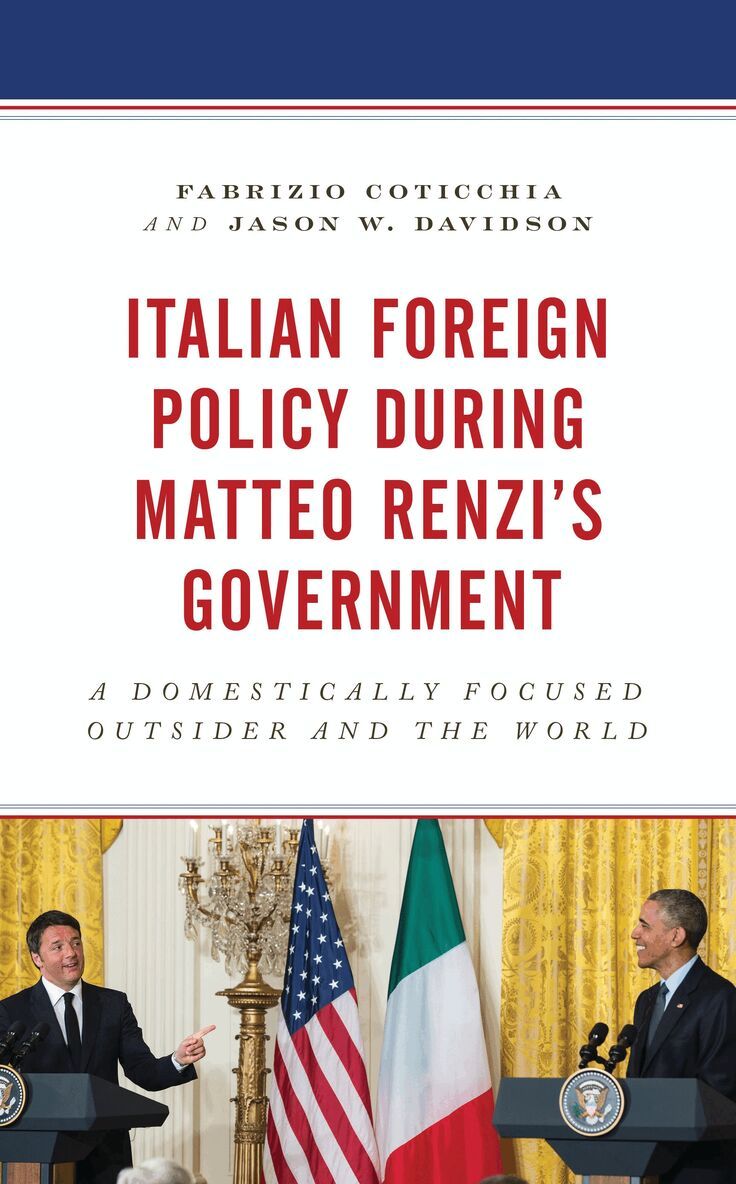
Italian Foreign Policy during Matteo Renzi's Government
A Domestically Focused Outsider and the World
Inbunden, Engelska, 2019
1 142 kr
Skickas inom 10-15 vardagar
This book sets out to explain the foreign policy of Italian Prime Minister Matteo Renzi (February 2014 to December 2016). It offers a unique analytical framework to make sense of Renzi’s foreign policy: the domestically-focused outsider. It argues that to untangle Renzi’s foreign policy one must first understand that his clear priority was enacting domestic economic and political reforms. Domestic focus means that Renzi made foreign policy decisions with a sensitivity to public opinion and party unity. The book also argues that Renzi’s status as an outsider in Italian politics—having previously served only as the mayor of Florence—provides critical insight into his foreign policy. Renzi was prone to skepticism of the establishment and dramatic, symbolic gestures rather than patient coalition building. The book applies this framework to the five most important foreign policy issues Renzi’s government faced: migration, finance and the EU, Russia, ISIL, and Libya. The book’s analysis of the cases benefits from over twenty elite interviews, including those with senior members of Renzi’s government.
1 179 kr
Skickas inom 5-8 vardagar
A challenge to long-held assumptions about the costs and benefits of America’s allies. Since the Revolutionary War, the United States has entered into dozens of alliances with international powers to protect its assets and advance its security interests. America’s Entangling Alliances offers a corrective to long-held assumptions about US foreign policy and is relevant to current public and academic debates about the costs and benefits of America’s allies. Author Jason W. Davidson examines these alliances to shed light on their nature and what they reveal about the evolution of American power. He challenges the belief that the nation resists international alliances, showing that this has been true in practice only when using a narrow definition of alliance. While there have been more alliances since World War II than before it, US presidents and Congress have viewed it in the country’s best interest to enter into a variety of security arrangements over virtually the entire course of the country’s history. By documenting thirty-four alliances—categorized as defense pacts, military coalitions, or security partnerships—Davidson finds that the US demand for allies is best explained by looking at variance in its relative power and the threats it has faced.
389 kr
Skickas inom 5-8 vardagar
A challenge to long-held assumptions about the costs and benefits of America’s allies. Since the Revolutionary War, the United States has entered into dozens of alliances with international powers to protect its assets and advance its security interests. America’s Entangling Alliances offers a corrective to long-held assumptions about US foreign policy and is relevant to current public and academic debates about the costs and benefits of America’s allies. Author Jason W. Davidson examines these alliances to shed light on their nature and what they reveal about the evolution of American power. He challenges the belief that the nation resists international alliances, showing that this has been true in practice only when using a narrow definition of alliance. While there have been more alliances since World War II than before it, US presidents and Congress have viewed it in the country’s best interest to enter into a variety of security arrangements over virtually the entire course of the country’s history. By documenting thirty-four alliances—categorized as defense pacts, military coalitions, or security partnerships—Davidson finds that the US demand for allies is best explained by looking at variance in its relative power and the threats it has faced.
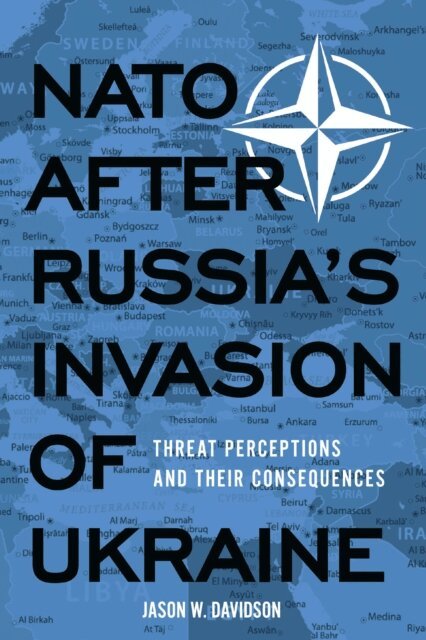
NATO After Russia's Invasion of Ukraine
Threat Perceptions and Their Consequences
Inbunden, Engelska, 2026
1 738 kr
Skickas inom 5-8 vardagar
A revealing look at differing threat perceptions in six key NATO countriesWhen Russia began its full-scale invasion of Ukraine in February 2022, analysts and policymakers highlighted the unifying shock that NATO members experienced. However even before the return of US president Donald Trump, beneath this seeming cohesion lay deep-seated differences in how member states perceive and prioritize security threats.NATO after Russia's Invasion of Ukraine analyzes the six most influential members of the alliance: the United States, the United Kingdom, France, Germany, Poland, and Italy. Through extensive interviews with current and former policymakers and a detailed examination of public statements and policies, Jason W. Davidson delivers a unique assessment of how divergent threat perceptions influence the NATO allies' major defense decisions, such as defense spending, and whether the alliance addresses each ally's most important threat and its view of NATO's most important challenges. With the rise in tumultuous geopolitical challenges posed by Russia, China, terrorism, mass refugee flows, and nationalism, this book provides the crucial context needed to navigate NATO's evolving role in international security.Davidson provides vital insights for anyone seeking to understand the complex dynamics shaping the future of NATO and transatlantic security. Policy professionals will find actionable intelligence, while scholars and students of international relations and political science will appreciate its rigorous analysis and extensive primary research.
NATO After Russia's Invasion of Ukraine
Threat Perceptions and Their Consequences
Häftad, Engelska, 2026
510 kr
Skickas
A revealing look at differing threat perceptions in six key NATO countriesWhen Russia began its full-scale invasion of Ukraine in February 2022, analysts and policymakers highlighted the unifying shock that NATO members experienced. However even before the return of US president Donald Trump, beneath this seeming cohesion lay deep-seated differences in how member states perceive and prioritize security threats.NATO after Russia's Invasion of Ukraine analyzes the six most influential members of the alliance: the United States, the United Kingdom, France, Germany, Poland, and Italy. Through extensive interviews with current and former policymakers and a detailed examination of public statements and policies, Jason W. Davidson delivers a unique assessment of how divergent threat perceptions influence the NATO allies' major defense decisions, such as defense spending, and whether the alliance addresses each ally's most important threat and its view of NATO's most important challenges. With the rise in tumultuous geopolitical challenges posed by Russia, China, terrorism, mass refugee flows, and nationalism, this book provides the crucial context needed to navigate NATO's evolving role in international security.Davidson provides vital insights for anyone seeking to understand the complex dynamics shaping the future of NATO and transatlantic security. Policy professionals will find actionable intelligence, while scholars and students of international relations and political science will appreciate its rigorous analysis and extensive primary research.