Jean Eisenstaedt – författare
Visar alla böcker från författaren Jean Eisenstaedt. Handla med fri frakt och snabb leverans.
4 produkter
4 produkter
E-bok
PDF, Engelska, 2018393 kr
Läs direkt efter köp
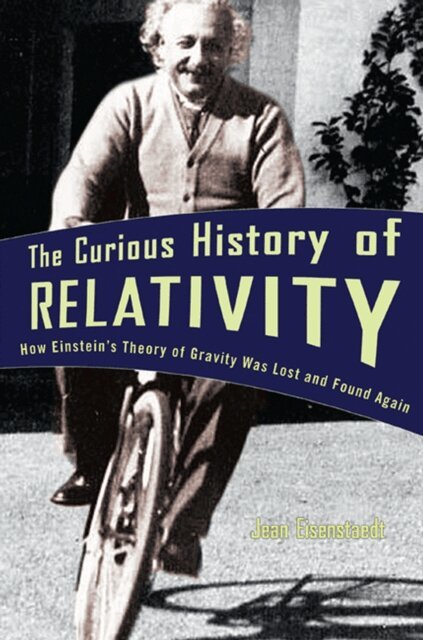
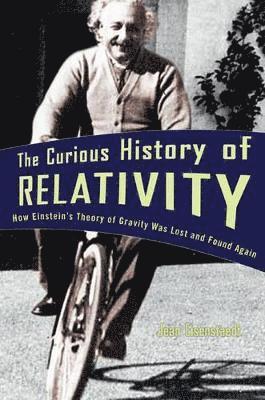
Black holes may obliterate most things that come near them, but they saved the theory of general relativity. Einstein's theory was quickly accepted as the true theory of gravity after its publication in 1915, but soon took a back seat in physics to quantum mechanics and languished for decades on the blackboards of mathematicians. Not until the existence of black holes by Stephen Hawking and Roger Penrose in the 1960s, after Einstein's death, was the theory revived. Almost one hundred years after general relativity replaced Newton's theory of gravitation, The Curious History of Relativity tells the story of both events surrounding general relativity and the techniques employed by Einstein and the relativists to construct, develop, and understand his almost impenetrable theory. Jean Eisenstaedt, one of the world's leading experts on the subject, also discusses the theory's place in the evolution of twentieth-century physics. He describes the main stages in the development of general relativity: its beginnings, its strange crossing of the desert during Einstein's lifetime while under heated criticism, and its new life from the 1960s on, when it became vital to the understanding of black holes and the observation of exotic objects, and, eventually, to the discovery of the accelerating universe. We witness Einstein's construction of his theory, as well as the work of his fascinated, discouraged, and enthusiastic colleagues--physicists, mathematicians, and astronomers. Written with flair, The Curious History of Relativity poses--and answers--the difficult questions raised by Einstein's magnificent intellectual feat.
Inbunden, Engelska, 1992
1 723 kr
Skickas inom 10-15 vardagar
Inbunden, Engelska, 2005
1 616 kr
Skickas inom 10-15 vardagar
A century ago, in 1905, Albert Einstein published, “On the Electrodynamics of M- ing Bodies,” in which the foundations were laid for the Special Theory of Relativity. Ten years later his relativistic theory of gravitation and the General Theory of Relat- ity appeared. Fifty years ago, Einstein passed away in Princeton. In the 1980s, John Stachel, then Editor of the Collected Papers of Albert Einstein, brought together a group of historians, philosophers, physicists, and mathematicians who had one thing in common: a lively interest in the history and foundations of the theories of relativity. At a meeting in 1986 at Osgood Hill, this group met for the ?rst time to discuss the prehistory, development, reception, and other aspects of relativity. It was the beginning of a valuable tradition. Since then every three or four years a meeting has been organized during which historical and foundational issues in general (and special) relativity have been discussed. Osgood Hill was followed by Luminy in 1988. Then came Johnstown (1991), Berlin (1995), Notre Dame (1999), and ?nally Amsterdam (2002), the proceedings of which are presented in this volume (supplemented with some papers from the preceding meeting). Once again these articles clearly show that an historical approach can lead to new insights into the development and elaboration of relativity. The prehistory of special relativity and an early attempt at a relativistic theory of gravitation are covered in - pers by John Stachel and Shaul Katzir, respectively.
E-bok
PDF, Engelska, 20062 049 kr
Läs direkt efter köp
A century ago, in 1905, Albert Einstein published, “On the Electrodynamics of M- ing Bodies,” in which the foundations were laid for the Special Theory of Relativity. Ten years later his relativistic theory of gravitation and the General Theory of Relat- ity appeared. Fifty years ago, Einstein passed away in Princeton. In the 1980s, John Stachel, then Editor of the Collected Papers of Albert Einstein, brought together a group of historians, philosophers, physicists, and mathematicians who had one thing in common: a lively interest in the history and foundations of the theories of relativity. At a meeting in 1986 at Osgood Hill, this group met for the ?rst time to discuss the prehistory, development, reception, and other aspects of relativity. It was the beginning of a valuable tradition. Since then every three or four years a meeting has been organized during which historical and foundational issues in general (and special) relativity have been discussed. Osgood Hill was followed by Luminy in 1988. Then came Johnstown (1991), Berlin (1995), Notre Dame (1999), and ?nally Amsterdam (2002), the proceedings of which are presented in this volume (supplemented with some papers from the preceding meeting). Once again these articles clearly show that an historical approach can lead to new insights into the development and elaboration of relativity. The prehistory of special relativity and an early attempt at a relativistic theory of gravitation are covered in - pers by John Stachel and Shaul Katzir, respectively.