Jean G. Harrell – författare
Visar alla böcker från författaren Jean G. Harrell. Handla med fri frakt och snabb leverans.
3 produkter
3 produkter
Häftad, Engelska, 1992
495 kr
Skickas inom 5-8 vardagar
The crisis or "death" of philosophy currently identified both within and outside professional circles is commonly attributed to the failure to find universals in metaphysics, epistemology, and, most obviously, in valuational judgment. Profundity concentrates on an assumption uniformly upheld in the theory of value, that all human values are contextually dependent. Harrell contends, to the contrary, that there exists one major value that is universal to humans, regardless of context. That value is profundity, or depth.Considering how "profundity" is used in our language leads Harrell to identify two fundamental sensory patterns that are common to all human life at its origin—an auditory pattern that is first experienced before birth and a visual one that is experienced immediately after birth. From analysis of these patterns as they recur in music and the visual arts, Harrell moves on to discuss their related manifestations in religious doctrine, ceremony, and experience and also in works of literature. Overall her theory entails a radical revamping of the concept of creativity, since no artist can create profundity as a universal value, and provides the first full-scale treatment of profundity in the history of Western philosophy.
E-bok
PDF, Engelska, 1986849 kr
Läs direkt efter köp
Inbunden, Engelska, 1986
422 kr
Tillfälligt slut
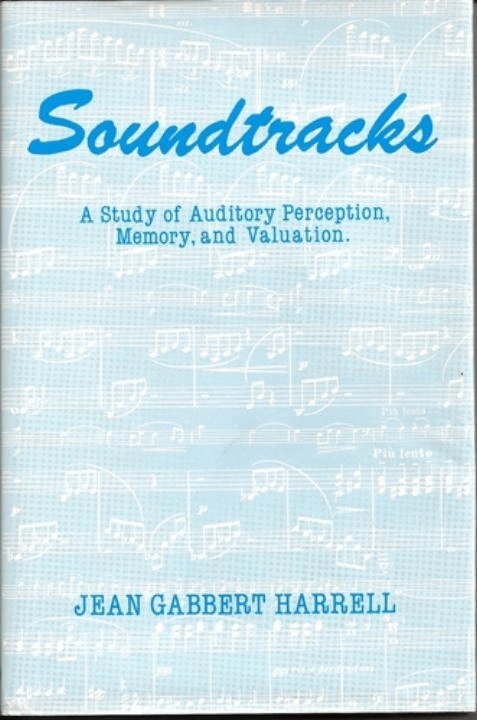
Jean Gabbert Harrell argues persuasively in her book, "Soundtracks", that aesthetic theories have often been deficient because they have tried to be too inclusive. That is, the experience of music is profoundly different from that of painting, for instance, and that it is wrong to compare them. Her reasoning for this viewpoint is based in part on a recognition that auditory perception is fully developed in humans prior to either visual or significant tactual perception, bringing a genetic, developmental aspect to her discussion. In its genetic orientation toward sensory development and its concentration exclusively on auditory perception, "Soundtracks" provides an argument against the relativism of aesthetic judgement in auditory art that has never before been suggested.