Jean J. Gabszewicz - Böcker
Visar alla böcker från författaren Jean J. Gabszewicz. Handla med fri frakt och snabb leverans.
4 produkter
4 produkter
1 322 kr
Skickas inom 5-8 vardagar
Perfect competition provides the model of a frictionless economy, in which price-setting economic agents behave independently of each other, abandoning to the market the coordination of their individual decisions. The implications of this model are extensively presented in the traditional price theory textbooks. Imperfect competition is the paradigm that develops as soon as economic agents interact in a conscious manner, which is the rule when competition takes place amongst a restricted number of agents. In this system, agents act strategically, taking into account the impact of their decisions on competitors' behaviour and on the price mechanism. Such situations commonly arise when firms differentiate their products, erect strategic entry barriers, or exploit the imperfect information of their customers about the price or characteristics of their product. This book explores the theoretical richness of these economic contexts, using some basic tools of game theory. Designed as an ancillary text for graduate students, it not only summarizes the historic contributions made by economic theorists such as Cournot and Edgeworth, but also makes accessible many of the most recent developments in the same field.
Strategic Multilateral Exchange
General Equilibrium with Imperfect Competition
Inbunden, Engelska, 2002
1 770 kr
Skickas inom 7-10 vardagar
Jean Gabszewicz's new book is devoted to the study of strategic multilateral exchange. Contrary to the classical competitive paradigm in which agents are assumed to behave as price takers, here traders are allowed to consciously behave as strategic agents who aim to influence trade to their own advantage. This is usually done in oligopoly theory using a partial equilibrium approach while in this case a system of interrelated markets is considered. Primarily, the book discusses the game-theoretic concept of core and the relationship between core and the set of price allocations in economies embodying significant traders is explored. The author goes on to adopt a non-cooperative approach building on the concept of Nash equilibrium.Strategic Multilateral Exchange will be welcomed by academics, advanced research scholars and doctoral students with an interest in economic theory, microeconomic theory and general equilibrium. It will also appeal to mathematical economists with an orientation in mathematical economics and game theory.
Del 102 - The International Library of Critical Writings in Economics series
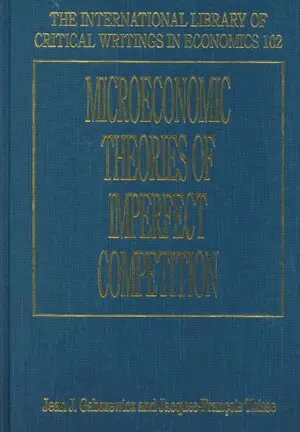
Microeconomic Theories of Imperfect Competition: Old Problems and New Perspectives
Inbunden, Engelska, 1999
6 643 kr
Skickas inom 7-10 vardagar
Microeconomic Theories of Imperfect Competition: Old Problems and New Perspectives is an authoritative collection of readings which, together with a new, original introductory essay by the editors, provides a broad overview of the major theoretical concepts in the field.This collection includes published papers on industry size: quantity and price competition, entry barriers, product differentiation, incomplete information, general equilibrium with imperfect competition.This book will be essential reading both for those seeking an introduction to the subject and those seeking a new perspective.
933 kr
Skickas inom 10-15 vardagar
This book provides a comprehensive exploration of product differentiation, blending insights from industrial organization, spatial economics, and game theory. In modern economies, nearly every product—from consumer electronics to household goods—comes in multiple variants, reflecting firms' strategic efforts to differentiate their offerings. But why do firms differentiate their products? How do they set prices for these variants? And does this process lead to an efficient market outcome?It examines both horizontal and vertical differentiation, investigating how firms compete not only on price but also on product characteristics such as location, quality, and perceived value. Special attention is given to the role of network effects, industry structure, and monopolistic competition, shedding light on how differentiation influences market dynamics.Key topics include:The historical evolution of product differentiation theories and recent advances in the field.The spatial metaphor of a differentiated industry and the structure of demand.Horizontal differentiation models, including Hotelling’s framework and political science analogies.Vertical differentiation and the role of quality, production costs, and regulatory standards.The impact of network effects on pricing, market equilibria, and two-sided markets.Monopolistic competition and its implications for excess capacity and market efficiency.With rigorous theoretical models and real-world applications, this book is essential reading for economists, researchers, and students seeking to understand the fundamental mechanisms shaping modern industrial competition.