Jean-Paul Demoule – författare
Visar alla böcker från författaren Jean-Paul Demoule. Handla med fri frakt och snabb leverans.
7 produkter
7 produkter
Inbunden, Engelska, 2023
1 259 kr
Skickas inom 5-8 vardagar
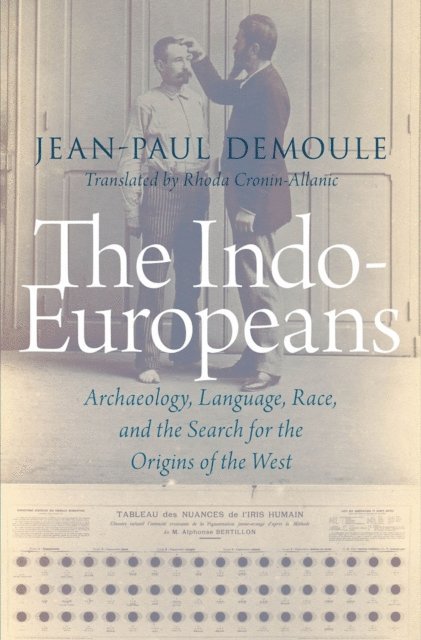
The existence of an Indo-European linguistic family, allowing for the fact that several languages widely dispersed across Eurasia share numerous traits, has been demonstrated for several centuries now. But the underlying factors for this shared heritage have been fiercely debated by linguists, historians, archaeologists, and anthropologists. The leading theory, of which countless variations exist, argues that this similarity is best explained by the existence, at one given point in time and space, of a common language and corresponding population. This ancient, prehistoric, population would then have diffused across Eurasia, eventually leading to the variation observed in historical and modern times. The Indo-Europeans: Archaeology, Language, Race, and the Search for the Origins of the West argues that despite its acceptance and use by most researchers from different disciplines, such a model is inherently flawed. This book describes how, beginning in the late eighteenth century, Europeans began a quest for a supposed original homeland, from which a small conquering people would one day spread out, bringing their language to Europe and parts of Asia (India, Iran, Afghanistan). This quest was often closely tied to ideological preoccupations and it was in its name that the Nazi leadership, claiming for the Germans the status of the purest Indo-Europeans (or Aryans), waged genocide. The last part of the book summarizes the current state of knowledge and current hypotheses in the fields of linguistics, archaeology, comparative mythology, and genetics. The culmination of three decades of research, this book offers a sweeping survey of the historiography of the Indo-European debate and poses a devastating challenge to the Indo-European origin story at its roots.
E-bok
PDF, Engelska, 2023346 kr
Läs direkt efter köp
The existence of an Indo-European linguistic family, allowing for the fact that several languages widely dispersed across Eurasia share numerous traits, has been demonstrated for several centuries now. But the underlying factors for this shared heritage have been fiercely debated by linguists, historians, archaeologists, and anthropologists. The leading theory, of which countless variations exist, argues that this similarity is best explained by the existence, at one given point in time and space, of a common language and corresponding population. This ancient, prehistoric, population would then have diffused across Eurasia, eventually leading to the variation observed in historical and modern times. The Indo-Europeans: Archaeology, Language, Race, and the Search for the Origins of the West argues that despite its acceptance and use by most researchers from different disciplines, such a model is inherently flawed. This book describes how, beginning in the late eighteenth century, Europeans began a quest for a supposed original homeland, from which a small conquering people would one day spread out, bringing their language to Europe and parts of Asia (India, Iran, Afghanistan). This quest was often closely tied to ideological preoccupations and it was in its name that the Nazi leadership, claiming for the Germans the status of the purest Indo-Europeans (or Aryans), waged genocide. The last part of the book summarizes the current state of knowledge and current hypotheses in the fields of linguistics, archaeology, comparative mythology, and genetics. The culmination of three decades of research, this book offers a sweeping survey of the historiography of the Indo-European debate and poses a devastating challenge to the Indo-European origin story at its roots.
E-bok
Engelska, 2023346 kr
Läs direkt efter köp
The existence of an Indo-European linguistic family, allowing for the fact that several languages widely dispersed across Eurasia share numerous traits, has been demonstrated for several centuries now. But the underlying factors for this shared heritage have been fiercely debated by linguists, historians, archaeologists, and anthropologists. The leading theory, of which countless variations exist, argues that this similarity is best explained by the existence, at one given point in time and space, of a common language and corresponding population. This ancient, prehistoric, population would then have diffused across Eurasia, eventually leading to the variation observed in historical and modern times. The Indo-Europeans: Archaeology, Language, Race, and the Search for the Origins of the West argues that despite its acceptance and use by most researchers from different disciplines, such a model is inherently flawed. This book describes how, beginning in the late eighteenth century, Europeans began a quest for a supposed original homeland, from which a small conquering people would one day spread out, bringing their language to Europe and parts of Asia (India, Iran, Afghanistan). This quest was often closely tied to ideological preoccupations and it was in its name that the Nazi leadership, claiming for the Germans the status of the purest Indo-Europeans (or Aryans), waged genocide. The last part of the book summarizes the current state of knowledge and current hypotheses in the fields of linguistics, archaeology, comparative mythology, and genetics. The culmination of three decades of research, this book offers a sweeping survey of the historiography of the Indo-European debate and poses a devastating challenge to the Indo-European origin story at its roots.
Häftad, Engelska, 2023
494 kr
Skickas
The existence of an Indo-European linguistic family, allowing for the fact that several languages widely dispersed across Eurasia share numerous traits, has been demonstrated for several centuries now. But the underlying factors for this shared heritage have been fiercely debated by linguists, historians, archaeologists, and anthropologists. The leading theory, of which countless variations exist, argues that this similarity is best explained by the existence, at one given point in time and space, of a common language and corresponding population. This ancient, prehistoric, population would then have diffused across Eurasia, eventually leading to the variation observed in historical and modern times. The Indo-Europeans: Archaeology, Language, Race, and the Search for the Origins of the West argues that despite its acceptance and use by most researchers from different disciplines, such a model is inherently flawed. This book describes how, beginning in the late eighteenth century, Europeans began a quest for a supposed original homeland, from which a small conquering people would one day spread out, bringing their language to Europe and parts of Asia (India, Iran, Afghanistan). This quest was often closely tied to ideological preoccupations and it was in its name that the Nazi leadership, claiming for the Germans the status of the purest Indo-Europeans (or Aryans), waged genocide. The last part of the book summarizes the current state of knowledge and current hypotheses in the fields of linguistics, archaeology, comparative mythology, and genetics. The culmination of three decades of research, this book offers a sweeping survey of the historiography of the Indo-European debate and poses a devastating challenge to the Indo-European origin story at its roots.
Inbunden, Engelska, 2022
664 kr
Skickas inom 5-8 vardagar
Between 1978 and 1981, Sophie Calle went on a clandestine exploration of the then abandoned Hôtel du Palais d'Orsay. She selected room 501 as her home and without any pre-established method, set about photographing the abandoned hotel over 5 years. As she explored, she picked up items she found: room numbers, customer reception cards, old telephones, diaries, messages addressed to a certain “Oddo” and more besides. What happened to room 501? More than 40 years later it has disappeared and an elevator has taken its place. At the invitation of Donatien Grau, the Musée d’Orsay curator, Sophie Calle returned, equipped with a flashlight, to explore the site again during the lockdown period. She hunted down the ghosts of the Palais d'Orsay, now connected to the present by the visitors that had also deserted the museum. The work reconstructs the artist’s archive of photography, letters, invoices and other daily items which bring a forgotten past back to life. To provide commentary on her discoveries, Sophie Calle called upon the archaeologist Jean-Paul Demoule, who writes a series of texts combining fact and fiction. All this evidence has been assembled together to create an objet d’art which resembles an investigation notebook.
Häftad, Franska, 2014
438 kr
Skickas inom 3-6 vardagar
E-bok
Franska, 2014149 kr
Läs direkt efter köp
On connaît le jeu du « cadavre exquis », qui consiste à faire un dessin, puis à plier la feuille en n’en laissant dépasser qu’un fragment, à partir duquel le joueur suivant improvise son propre dessin... Les quatre auteurs de ce livre, en reprenant le principe, l’ont adapté à la description d’une planète plausible et des diverses formes de vie susceptibles d’y apparaître et de s’y développer. Quelle espèce extraterrestre le hasard et les lois de l’évolution vont-ils produire ? Cette « exquise planète », inventée en restant autant que faire se peut dans le champ du possible par un astrophysicien, un paléontologue et un archéologue, ne ressemble guère à la Terre, si ce n’est par l’inépuisable inventivité de ses espèces, et pourtant elle aurait pu être la nôtre si le hasard en avait décidé ainsi. Et elle prend un relief bien particulier quand un écrivain de science-fiction, Pierre Bordage, prenant le relais final, vient enrichir les descriptions scientifiques et factuelles d’un souffle épique qui efface la frontière commodément tracée entre science et fiction. Pierre Bordage, auteur de science-fiction, s’intéresse à tous les genres du domaine. Spécialiste du « space opera » (Les Guerriers du silence, Abzalon, Griots célestes), il ne néglige ni le « postapocalyptique » (Le Feu de Dieu), ni la « fantasy historique » (L’Enjomineur), l’anticipation (Wang), l’uchronie (cycle de Ceux qui sauront) ou la « fantaisie » (Les Fables de l’Humpur). Jean-Paul Demoule, archéologue, professeur de protohistoire européenne à l’université Paris-I et membre de l’Institut universitaire de France, a présidé l’Institut national de recherches archéologiques préventives (INRAP). Il est l’auteur de nombreux ouvrages, dont On a retrouvé l’histoire de France. Roland Lehoucq, astrophysicien au CEA dans le domaine de la topologie cosmique, s’est fait une spécialité de vulgariser la science à partir d’ouvrages de fiction (La Science-Fiction sous les feux de la science, D’où viennent les pouvoirs de Superman ?). Il tient la rubrique « Scientifiction » dans la revue Bifrost. Jean-Sébastien Steyer, paléontologue au CNRS rattaché au Muséum national d’histoire naturelle, signe des rubriques liant la science et l’imaginaire dans les revues Pour la science et Espèces. Il est l’auteur de La Terre avant les dinosaures.