Jeffery J. Mondak – författare
Visar alla böcker från författaren Jeffery J. Mondak. Handla med fri frakt och snabb leverans.
3 produkter
3 produkter
361 kr
Skickas inom 7-10 vardagar
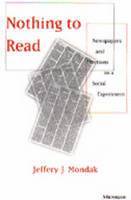
How important are local newspapers for disseminating information during election campaigns? A large body of literature theorizes that they should have very little effect on political behavior since the electorate is largely immune to any media influence. To what lengths would the average citizen go to obtain information about candidates should a media source suddenly be suspended during an election? Most of the literature argues that the average citizen would not seek out any additional information to supplement what they passively acquire. A newspaper strike in Pittsburgh during the 1992 elections afforded Jeffery J. Mondak an unparalleled opportunity to test these assumptions--and to prove them both wrong. Nothing to Read compares the information gathering and voting behavior of residents in Pittsburgh and Cleveland during the 1992 campaign season. Comparable in demographics and political behavior, the only significant difference between the two cities was the availability of local newspapers. Using a research design that combines elements of the opinion survey and the laboratory experiment, the author exploited this situation to produce an unusually sound and thorough examination of media effects on voters. The results are startling. First and foremost, Nothing to Read reasserts the role of the newspaper in the dissemination of information acquisition. It is the only media source that can rival television in the electoral arena, and it is often more important to voters as a source for local information, including information about U.S. House races. Nothing to Read also shows that voters are more active in seeking out information than typically postulated. Indeed, many voters even differentiate between media sources for information about Senate and House contests and sources for the presidential campaign. Within limits, the electorate is clearly not a passive news audience. Nothing to Read provides a wealth of information on such related topics as the relationship between partisanship and media influence, the interplay between media exposure and interpersonal political conversations and other social interaction, and newspapers' effect on coattail voting. A unique book, Mondak's important study lays a solid foundation for all future work on the relationship between American media and politics. Jeffery J. Mondak is Associate Professor of Political Science, University of Pittsburgh.
325 kr
Skickas inom 7-10 vardagar
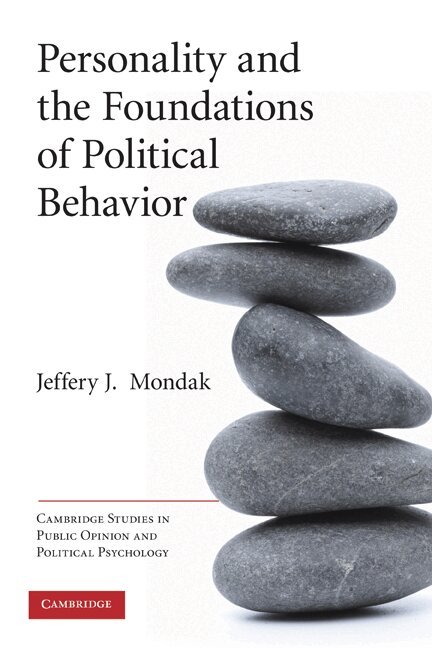
Personality and the Foundations of Political Behavior is the first study in more than 30 years to investigate the broad significance of personality traits for mass political behavior. Drawing on the Big Five personality trait framework, Jeffery J. Mondak argues that attention to personality provides a valuable means to integrate biological and environmental influences in rich, nuanced theories and empirical tests of the antecedents of political behavior. Development of such holistic accounts is critical, Mondak contends, if inquiry is to move beyond simple 'blank slate' environmental depictions of political engagement. Analyses examining multiple facets of political information, political attitudes and participation reveal that the Big Five trait dimensions - openness to experience, conscientiousness, extraversion, agreeableness and emotional stability - produce both direct and indirect effects on a wide range of political phenomena.
583 kr
Skickas inom 7-10 vardagar
Personality and the Foundations of Political Behavior is the first study in more than 30 years to investigate the broad significance of personality traits for mass political behavior. Drawing on the Big Five personality trait framework, Jeffery J. Mondak argues that attention to personality provides a valuable means to integrate biological and environmental influences in rich, nuanced theories and empirical tests of the antecedents of political behavior. Development of such holistic accounts is critical, Mondak contends, if inquiry is to move beyond simple 'blank slate' environmental depictions of political engagement. Analyses examining multiple facets of political information, political attitudes and participation reveal that the Big Five trait dimensions - openness to experience, conscientiousness, extraversion, agreeableness and emotional stability - produce both direct and indirect effects on a wide range of political phenomena.