Jennie Weiner – författare
Visar alla böcker från författaren Jennie Weiner. Handla med fri frakt och snabb leverans.
4 produkter
4 produkter
Häftad, Engelska, 2023
379 kr
Skickas inom 5-8 vardagar
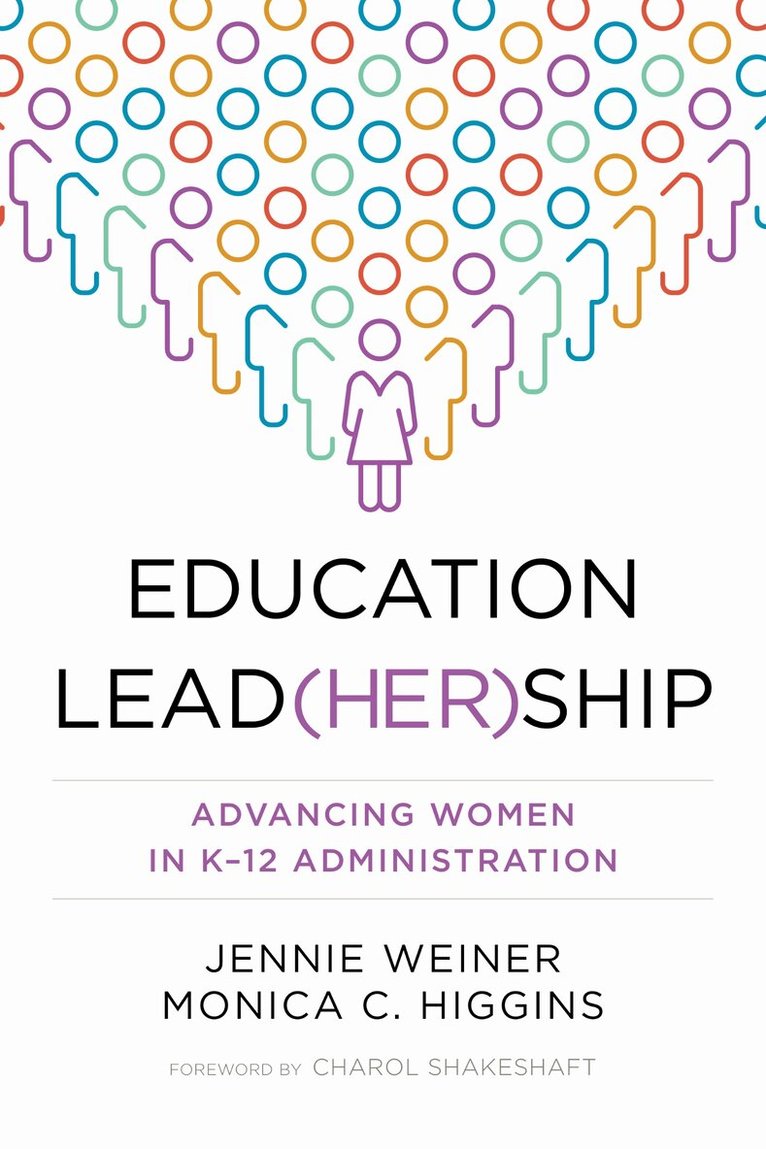
An incisive account on the underrepresentation of women, especially women of color, in positions of leadership in K–12 schools and how to correct this bias.Educational Lead(her)ship exposes the systemic obstacles that impede the professional advancement of women in K–12 education and offers readers the tools to recognize and combat these inequities. In this rousing work, educational leadership scholars Jennie Weiner and Monica Higgins investigate patterns of gender bias in the profession, prompted by the observation that, although the great majority of classroom educators are women, disproportionately few women inhabit leadership positions such as principal, superintendent, or school administrator.Through candid interviews with more than 200 women educational leaders, Weiner and Higgins pinpoint implicit and explicit means of repression and highlight the resources that these leaders have marshaled to punch through systemic barriers. The interviewees recount the many forms of sexism and racism they have confronted in the workplace, including microaggressions, stereotypes about women's work, and the expectation of uncompensated emotional labor.Taking aim at the widespread gender and racial discrimination in school systems, Weiner and Higgins identify paths to empowerment for women in education. They advocate solidarity, collective action, and leveraging networks of allies to push for the re-engineering of our educational organizations, environments, and cultures to sow a more balanced and equitable leadership landscape.
E-bok
Engelska, 2023484 kr
Läs direkt efter köp
2025 Society of Professors of Education Outstanding Book Honorable Mention An incisive account on the underrepresentation of women, especially women of color, in positions of leadership in K–12 schools and how to correct this bias. Education Lead(her)ship exposes the systemic obstacles that impede the professional advancement of women in K–12 education and offers readers the tools to recognize and combat these inequities. In this rousing work, educational leadership scholars Jennie Weiner and Monica Higgins investigate patterns of gender bias in the profession, prompted by the observation that, although the great majority of classroom educators are women, disproportionately few women inhabit leadership positions such as principal, superintendent, or school administrator. Through candid interviews with more than 200 women educational leaders, Weiner and Higgins pinpoint implicit and explicit means of repression and highlight the resources that these leaders have marshaled to punch through systemic barriers. The interviewees recount the many forms of sexism and racism they have confronted in the workplace, including microaggressions, stereotypes about women's work, and the expectation of uncompensated emotional labor. Taking aim at the widespread gender and racial discrimination in school systems, Weiner and Higgins identify paths to empowerment for women in education. They advocate solidarity, collective action, and leveraging networks of allies to push for the re-engineering of our educational organizations, environments, and cultures to sow a more balanced and equitable leadership landscape.
E-bok
PDF, Engelska, 2023471 kr
Läs direkt efter köp
2025 Society of Professors of Education Outstanding Book Honorable MentionAn incisive account on the underrepresentation of women, especially women of color, in positions of leadership in K–12 schools and how to correct this bias. Education Lead(her)ship exposes the systemic obstacles that impede the professional advancement of women in K–12 education and offers readers the tools to recognize and combat these inequities. In this rousing work, educational leadership scholars Jennie Weiner and Monica Higgins investigate patterns of gender bias in the profession, prompted by the observation that, although the great majority of classroom educators are women, disproportionately few women inhabit leadership positions such as principal, superintendent, or school administrator. Through candid interviews with more than 200 women educational leaders, Weiner and Higgins pinpoint implicit and explicit means of repression and highlight the resources that these leaders have marshaled to punch through systemic barriers. The interviewees recount the many forms of sexism and racism they have confronted in the workplace, including microaggressions, stereotypes about women's work, and the expectation of uncompensated emotional labor. Taking aim at the widespread gender and racial discrimination in school systems, Weiner and Higgins identify paths to empowerment for women in education. They advocate solidarity, collective action, and leveraging networks of allies to push for the re-engineering of our educational organizations, environments, and cultures to sow a more balanced and equitable leadership landscape.
Inbunden, Engelska, 2026
5 687 kr
Kommande
This handbook reflects and represents the established and expanding knowledge base in the field of educational change as embodied in publishing outlets like Springer’s Journal of Educational Change, the AERA Educational Change Special Interest Group, The AERA Teacher and Teacher Education Division, the British Educational Leadership and Management Association, and the International Congress of School Effectiveness and Improvement. The work captures the changing and more inclusive and critical nature of the field. This involves responding to calls for traditionally marginalised and minoritized groups, regions and issues to be centred and uplifted in the field and in practice.The Handbook includes classic, contemporary, and cutting-edge contributions to the field of educational change. It offers rigorous scholarly work written in a style that is accessible to researchers, academics, educational leaders, and policymakers who are drawn to evidence-based and theoretically informed approaches. Contents are inclusive in authorship and focus, representative of different fields such as leadership, policy, curriculum, pedagogy, equity, and diversity, inclusive of diverse and sometimes competing perspectives, and attentive to international range and scope of contribution.This is a time when there is turnover of generations in the field of educational change, with many of the founders now having passed away or holding senior Emeritus status. It is a time of emerging scholarship among mid-career academics and evolving research among new generations of graduate students that call for familiarity with established canons of educational change, and a growing field of intellectual, cultural, and global diversity. This Third handbook is written at this generational tipping point in the academic field, at a time when global knowledge and understanding of educational change is more accessible and abundant, and in a moment of great controversy regarding future directions of educational change in relation to a rapidly changing world.