J.H. van Lint – författare
Visar alla böcker från författaren J.H. van Lint. Handla med fri frakt och snabb leverans.
7 produkter
7 produkter
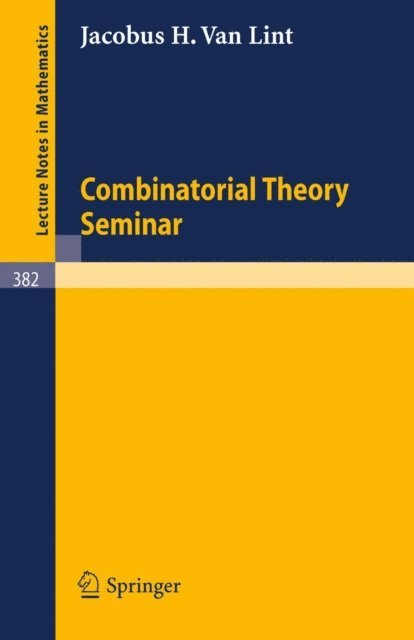
Del 382 - Lecture Notes in Mathematics
Combinatorial Theory Seminar Eindhoven University of Technology
Häftad, Engelska, 1974
278 kr
Skickas inom 10-15 vardagar
E-bok
PDF, Engelska, 2006351 kr
Läs direkt efter köp
Del 86 - Graduate Texts in Mathematics
Introduction to Coding Theory
Inbunden, Engelska, 1998
1 307 kr
Skickas inom 10-15 vardagar
It is gratifying that this textbook is still sufficiently popular to warrant a third edition. I have used the opportunity to improve and enlarge the book. When the second edition was prepared, only two pages on algebraic geometry codes were added. These have now been removed and replaced by a relatively long chapter on this subject. Although it is still only an introduction, the chapter requires more mathematical background of the reader than the remainder of this book. One of the very interesting recent developments concerns binary codes defined by using codes over the alphabet 7l.4• There is so much interest in this area that a chapter on the essentials was added. Knowledge of this chapter will allow the reader to study recent literature on 7l. -codes. 4 Furthermore, some material has been added that appeared in my Springer Lec ture Notes 201, but was not included in earlier editions of this book, e. g. Generalized Reed-Solomon Codes and Generalized Reed-Muller Codes. In Chapter 2,a section on "Coding Gain" ( the engineer's justification for using error-correcting codes) was added. For the author, preparing this third edition was a most welcome return to mathematics after seven years of administration. For valuable discussions on the new material, I thank C.P.l.M.Baggen, I. M.Duursma, H.D.L.Hollmann, H. C. A. van Tilborg, and R. M. Wilson. A special word of thanks to R. A. Pellikaan for his assistance with Chapter 10.
E-bok
PDF, Engelska, 20121 138 kr
Läs direkt efter köp
It is gratifying that this textbook is still sufficiently popular to warrant a third edition. I have used the opportunity to improve and enlarge the book. When the second edition was prepared, only two pages on algebraic geometry codes were added. These have now been removed and replaced by a relatively long chapter on this subject. Although it is still only an introduction, the chapter requires more mathematical background of the reader than the remainder of this book. One of the very interesting recent developments concerns binary codes defined by using codes over the alphabet 7l.4• There is so much interest in this area that a chapter on the essentials was added. Knowledge of this chapter will allow the reader to study recent literature on 7l. -codes. 4 Furthermore, some material has been added that appeared in my Springer Lec ture Notes 201, but was not included in earlier editions of this book, e. g. Generalized Reed-Solomon Codes and Generalized Reed-Muller Codes. In Chapter 2,a section on "Coding Gain" ( the engineer''s justification for using error-correcting codes) was added. For the author, preparing this third edition was a most welcome return to mathematics after seven years of administration. For valuable discussions on the new material, I thank C.P.l.M.Baggen, I. M.Duursma, H.D.L.Hollmann, H. C. A. van Tilborg, and R. M. Wilson. A special word of thanks to R. A. Pellikaan for his assistance with Chapter 10.
Del 86 - Graduate Texts in Mathematics
Introduction to Coding Theory
Häftad, Engelska, 2012
930 kr
Skickas inom 10-15 vardagar
It is gratifying that this textbook is still sufficiently popular to warrant a third edition. I have used the opportunity to improve and enlarge the book. When the second edition was prepared, only two pages on algebraic geometry codes were added. These have now been removed and replaced by a relatively long chapter on this subject. Although it is still only an introduction, the chapter requires more mathematical background of the reader than the remainder of this book. One of the very interesting recent developments concerns binary codes defined by using codes over the alphabet 7l.4• There is so much interest in this area that a chapter on the essentials was added. Knowledge of this chapter will allow the reader to study recent literature on 7l. -codes. 4 Furthermore, some material has been added that appeared in my Springer Lec ture Notes 201, but was not included in earlier editions of this book, e. g. Generalized Reed-Solomon Codes and Generalized Reed-Muller Codes. In Chapter 2,a section on "Coding Gain" ( the engineer's justification for using error-correcting codes) was added. For the author, preparing this third edition was a most welcome return to mathematics after seven years of administration. For valuable discussions on the new material, I thank C.P.l.M.Baggen, I. M.Duursma, H.D.L.Hollmann, H. C. A. van Tilborg, and R. M. Wilson. A special word of thanks to R. A. Pellikaan for his assistance with Chapter 10.
E-bok
PDF, Engelska, 20121 100 kr
Läs direkt efter köp
The first edition of this book was conceived in 1981 as an alternative to outdated, oversized, or overly specialized textbooks in this area of discrete mathematics-a field that is still growing in importance as the need for mathematicians and computer scientists in industry continues to grow. The body of the book consists of two parts: a rigorous, mathematically oriented first course in coding theory followed by introductions to special topics. The second edition has been largely expanded and revised. The main editions in the second edition are: (1) a long section on the binary Golay code; (2) a section on Kerdock codes; (3) a treatment of the Van Lint-Wilson bound for the minimum distance of cyclic codes; (4) a section on binary cyclic codes of even length; (5) an introduction to algebraic geometry codes. Eindhoven J. H. VAN LINT November 1991 Preface to the First Edition Coding theory is still a young subject. One can safely say that it was born in 1948. It is not surprising that it has not yet become a fixed topic in the curriculum of most universities. On the other hand, it is obvious that discrete mathematics is rapidly growing in importance. The growing need for mathe maticians and computer scientists in industry will lead to an increase in courses offered in the area of discrete mathematics. One of the most suitable and fascinating is, indeed, coding theory.
E-bok
PDF, Engelska, 20121 140 kr
Läs direkt efter köp
Combinatorics has come of age. It had its beginnings in a number of puzzles which have still not lost their charm. Among these are EULER''S problem of the 36 officers and the KONIGSBERG bridge problem, BACHET''s problem of the weights, and the Reverend T.P. KIRKMAN''S problem of the schoolgirls. Many of the topics treated in ROUSE BALL''S Recreational Mathe matics belong to combinatorial theory. All of this has now changed. The solution of the puzzles has led to a large and sophisticated theory with many complex ramifications. And it seems probable that the four color problem will only be solved in terms of as yet undiscovered deep results in graph theory. Combinatorics and the theory of numbers have much in common. In both theories there are many prob lems which are easy to state in terms understandable by the layman, but whose solution depends on complicated and abstruse methods. And there are now interconnections between these theories in terms of which each enriches the other. Combinatorics includes a diversity of topics which do however have interrelations in superficially unexpected ways. The instructional lectures included in these proceedings have been divided into six major areas: 1. Theory of designs; 2. Graph theory; 3. Combinatorial group theory; 4. Finite geometry; 5. Foundations, partitions and combinatorial geometry; 6. Coding theory. They are designed to give an overview of the classical foundations of the subjects treated and also some indication of the present frontiers of research.