Joan Sallis – författare
1 653 kr
Skickas inom 10-15 vardagar
473 kr
Skickas inom 10-15 vardagar
556 kr
Läs direkt efter köp
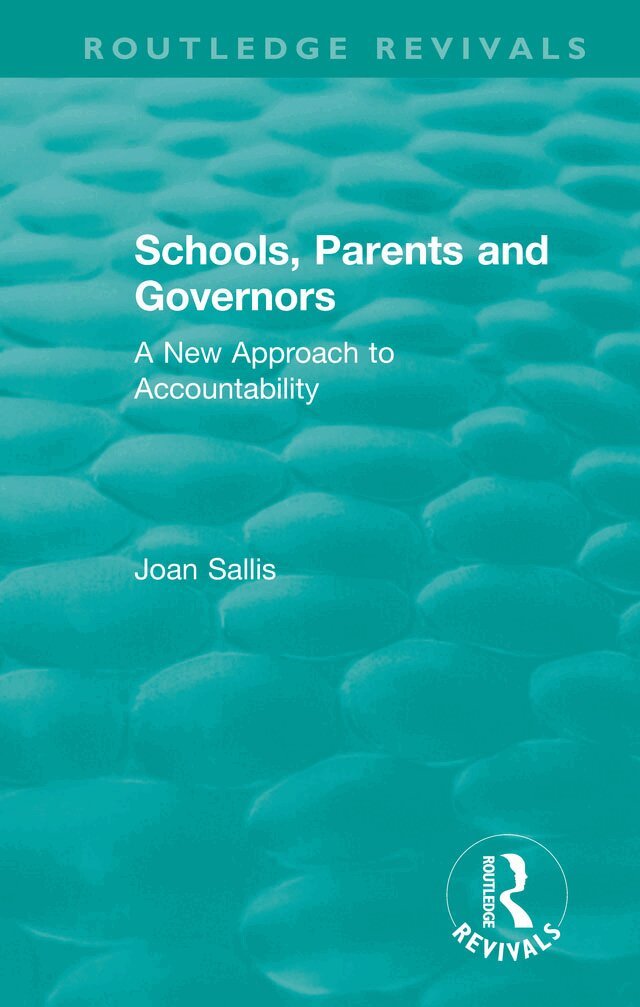
Originally published in 1988, this book was an up to the minute account of the way in which recent government initiatives, including the 1986 Act, would affect accountability and the quest for greater partnership between schools and parents.
It pinpoints the central issues of the current debates at the time in a lucid and highly readable way, asking how public commitment to education can be created and sustained, how minimum standards can be reconciled with local variety and freedom, how choice for parents can be reconciled with equal opportunity for children, how less confident and articulate parents can become involved and how a sense of common purpose can be fostered among the confident minority. The book provided an up-to-date assessment of progress in parental involvement; an account of the recent movement here and overseas; and a detailed working guide to the development of school government under the 1986 Act and beyond.
While providing an important critique of the consumerist approach to education, the author argues the case, illustrated with practical examples, for a new approach emphasising partnership, mutual accountability, better communication, more open habits be LEAs and more democratic practices within schools, involving staff, governors and parents.
536 kr
Läs direkt efter köp
Originally published in 1988, this book was an up to the minute account of the way in which recent government initiatives, including the 1986 Act, would affect accountability and the quest for greater partnership between schools and parents.
It pinpoints the central issues of the current debates at the time in a lucid and highly readable way, asking how public commitment to education can be created and sustained, how minimum standards can be reconciled with local variety and freedom, how choice for parents can be reconciled with equal opportunity for children, how less confident and articulate parents can become involved and how a sense of common purpose can be fostered among the confident minority. The book provided an up-to-date assessment of progress in parental involvement; an account of the recent movement here and overseas; and a detailed working guide to the development of school government under the 1986 Act and beyond.
While providing an important critique of the consumerist approach to education, the author argues the case, illustrated with practical examples, for a new approach emphasising partnership, mutual accountability, better communication, more open habits be LEAs and more democratic practices within schools, involving staff, governors and parents.
318 kr
Skickas inom 10-15 vardagar
313 kr
Skickas inom 5-8 vardagar
327 kr
Läs direkt efter köp
Second edition, brought up to date in Spring 2000, and fully revised with additional information to cover new regulations. Often referred to as ''required reading'' for school governors since its original publication,
Joan Sallis'' down-to-earth approach ensures that it is the most relevant introduction to working practices for new and recently appointed governors. School governors are overwhelmed with instructions on what they have to do. This book is different - it concentrates on helping them to do it. It gives governors a survival kit based on a clearer understanding of their role. This includes guidance on boundaries, better management of sensitive relationships, and knowledge of those rules and good practices which make for better teamwork.
Joan Sallis is nationally known and respected for her writing and lecturing on school government and her weekly advice column in the TES. Above all, she is known for treating difficult issues with humanity and humour in everyday language. In 1996 she was awarded the OBE for services to education.
In her role as the national president of the Campaign for State Education and as a consultant working with and on behalf of school governors for many years, Joan believes passionately that a better partnership between schools and their users offers the only hope for better funded and respected state education. She has been a governor of her local comprehensive school for many years.