Joan Woodward - Böcker
Visar alla böcker från författaren Joan Woodward. Handla med fri frakt och snabb leverans.
3 produkter
3 produkter
1 682 kr
Skickas inom 7-10 vardagar
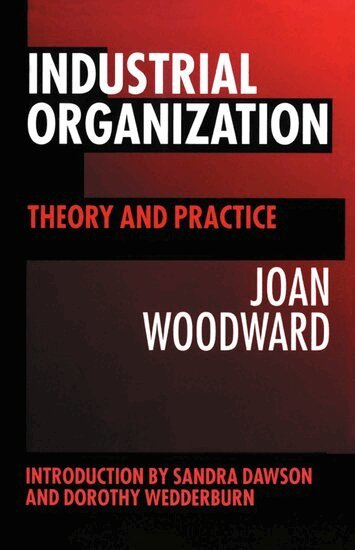
This book has rightly been described as a "classic" in the history of organizational theory. First published in 1965 it was then compared in significance to the Hawthorne studies; it was a major contribution to the devlopment of contingency theory and our understanding of the relationship between technology and organizations.The book stood in marked contrast to the traditions of scientific management. Combining detailed empirical research and a pioneering analytical framework it suggested that technology and production systems played acrucial role in shaping effective organizational structures. In doing so Woodward offered lasting insights into issues of levels of hierarchy and spans of management control - issues that today might be discussed in terms of "delayering" and "process re-engineering".Not surprisingly Woodward's work was a springboard for much subsequent research and many of her specific observations have been widely debated and challenged. Yet, as Sandra Dawson and Dorothy Wedderburn write in their Introduction, "the main thesis of the book is well known...however, this is a book where to know its main thesis is no substitute for reading the book itself. Joan Woodward's ideas remain one of the cornerstones of our knowledge of our organizations."
318 kr
Skickas inom 5-8 vardagar
'There is no doubt a greater awareness now of the significance of twin loss than there was ten years ago. I think that this is largely due to a big increase in articles, radio and television programmes as well as the spread of the Network. The well-known researcher Nancy Segal in the USA has, through her many books, added knowledge to our understanding of twin relationships as well as twin loss. She believes the loss to be highly significant and queries whether for some lone twins it is greater even than that of the loss of a spouse (Segal 2000). Others have written autobiographical material about their loss (Jones 1987; Farmer 1988). In spite of this, there is still ignorance. At a recent book launch for the publication of a book about the loss of a twin through drug taking (Burton-Phillips 2007) someone in the field of education said to a few of us from the Network, that she did not see how a twin who lost their twin at birth could possibly be affected. She asked, 'How would the surviving twin know?'I asked her to imagine how she might feel if told during her childhood that she had been born a twin, but due to her taking all the food' during the pregnancy, her twin had not survived. I suggested that perhaps worse, she might have had her parents make it clear that they wished her twin had been the one to live. Less dramatically, she was asked how she might feel missing someone all her life who 'should have been there' to share it. This question was put by a lone twin who added that she had also had surviving twins born to the family to watch growing up as a pair, while she was without her twin sister. The educationist was honest and said she had never thought of those things before and then freely admitted our comments made her think again' - Joan Woodward, Author.
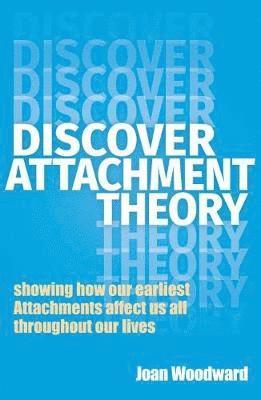
Discover Attachment Theory
Showing How Our Earliest Attachments Affect Us All Throughout Our Lives
Häftad, Engelska, 2019
193 kr
Skickas inom 5-8 vardagar
Written in straightforward language, and accessible to the average reader, Discover Attachment Theory is the first of a series of short books which will show how Attachment Theory can be relevant to everybody. Thirty years ago, Joan Woodward coined the phrase `Neurotic Solutions' as a way of describing how we all develop our highly individual `sense of self' as a result of how we respond to our Attachment experiences from birth onwards. In the intervening years, and through her work as a psychotherapist, Woodward became interested in the people who have deeply rooted patterns of thinking, feeling and behaving which come from their `sense of self.' These patterns of behaviour often cause them severe suffering, but they find it too painful and difficult to change. This book outlines what she has learnt. Woodward's purpose is to enable readers to understand and think about the process of `Neurotic Solutions' and to apply what they learn to the ways they relate to themselves and to others. This short book gives her enlightening and highly readable thoughts on `Neurotic Solutions,' updating and clarifying her previous work.