
JoaquA-n SA!nchez-Soriano – författare
992 kr
Läs direkt efter köp
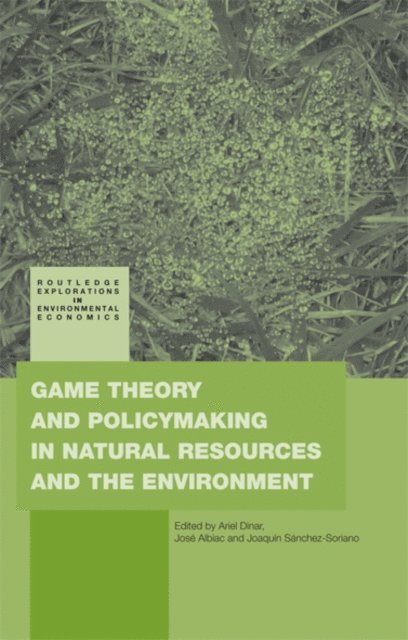
Game Theory has become one of the main analytical tools for addressing strategic issues in the field of economics and is increasing its influence in other fields of social sciences. With the increased level of extraction of natural resources and pollution of environments, game theory gains its place in the literature and it is more and more seen as a tool for policy makers and not only for theoreticians.
The book is structured into four parts dealing with the management of natural resources, the negotiation aspects of water management, water allocation through pricing and markets, and how conflicts and regulation shape the management of the environment. The first part explores game theory concepts applied to fisheries and grazing lands, which are two important natural resources. In the next two parts, several game theory methodologies are considered in the negotiation approach to water management and approaches to water pricing and markets. The last section looks at environmental protection as the end process of the interplay between conflict and regulation.
This book includes chapters by experts from developing and developed countries that apply game theory to actual issues in natural resources and the environment. As such the book is extremely useful for graduate students and technical experts interested in the sustainable management of natural resource and the environment. It is also relevant to all Game Theory and Environmental Economics students.
957 kr
Läs direkt efter köp
Game Theory has become one of the main analytical tools for addressing strategic issues in the field of economics and is increasing its influence in other fields of social sciences. With the increased level of extraction of natural resources and pollution of environments, game theory gains its place in the literature and it is more and more seen as a tool for policy makers and not only for theoreticians.
The book is structured into four parts dealing with the management of natural resources, the negotiation aspects of water management, water allocation through pricing and markets, and how conflicts and regulation shape the management of the environment. The first part explores game theory concepts applied to fisheries and grazing lands, which are two important natural resources. In the next two parts, several game theory methodologies are considered in the negotiation approach to water management and approaches to water pricing and markets. The last section looks at environmental protection as the end process of the interplay between conflict and regulation.
This book includes chapters by experts from developing and developed countries that apply game theory to actual issues in natural resources and the environment. As such the book is extremely useful for graduate students and technical experts interested in the sustainable management of natural resource and the environment. It is also relevant to all Game Theory and Environmental Economics students.
1 328 kr
Läs direkt efter köp
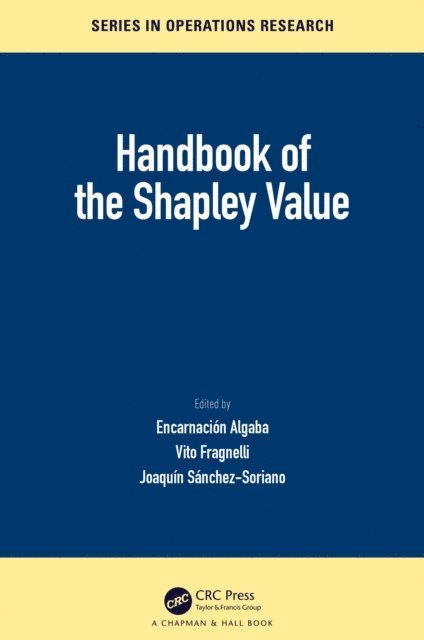
Handbook of the Shapley Value contains 24 chapters and a foreword written by Alvin E. Roth, who was awarded the Nobel Memorial Prize in Economic Sciences jointly with Lloyd Shapley in 2012. The purpose of the book is to highlight a range of relevant insights into the Shapley value. Every chapter has been written to honor Lloyd Shapley, who introduced this fascinating value in 1953.
The first chapter, by William Thomson, places the Shapley value in the broader context of the theory of cooperative games, and briefly introduces each of the individual contributions to the volume. This is followed by a further contribution from the editors of the volume, which serves to introduce the more significant features of the Shapley value. The rest of the chapters in the book deal with different theoretical or applied aspects inspired by this interesting value and have been contributed specifically for this volume by leading experts in the area of Game Theory.
Chapters 3 through to 10 are more focused on theoretical aspects of the Shapley value, Chapters 11 to 15 are related to both theoretical and applied areas. Finally, from Chapter 16 to Chapter 24, more attention is paid to applications of the Shapley value to different problems encountered across a diverse range of fields. As expressed by William Thomson in the Introduction to the book, "The chapters contribute to the subject in several dimensions: Mathematical foundations; axiomatic foundations; computations; applications to special classes of games; power indices; applications to enriched classes of games; applications to concretely specified allocation problems: an ever-widening range, mapping allocation problems into games or implementation."
Nowadays, the Shapley value continues to be as appealing as when it was first introduced in 1953, or perhaps even more so now that its potential is supported by the quantity and quality of the available results. This volume collects a large amount of work that definitively demonstrates that the Shapley value provides answers and solutions to a wide variety of problems.
1 282 kr
Läs direkt efter köp
Handbook of the Shapley Value contains 24 chapters and a foreword written by Alvin E. Roth, who was awarded the Nobel Memorial Prize in Economic Sciences jointly with Lloyd Shapley in 2012. The purpose of the book is to highlight a range of relevant insights into the Shapley value. Every chapter has been written to honor Lloyd Shapley, who introduced this fascinating value in 1953.
The first chapter, by William Thomson, places the Shapley value in the broader context of the theory of cooperative games, and briefly introduces each of the individual contributions to the volume. This is followed by a further contribution from the editors of the volume, which serves to introduce the more significant features of the Shapley value. The rest of the chapters in the book deal with different theoretical or applied aspects inspired by this interesting value and have been contributed specifically for this volume by leading experts in the area of Game Theory.
Chapters 3 through to 10 are more focused on theoretical aspects of the Shapley value, Chapters 11 to 15 are related to both theoretical and applied areas. Finally, from Chapter 16 to Chapter 24, more attention is paid to applications of the Shapley value to different problems encountered across a diverse range of fields. As expressed by William Thomson in the Introduction to the book, "The chapters contribute to the subject in several dimensions: Mathematical foundations; axiomatic foundations; computations; applications to special classes of games; power indices; applications to enriched classes of games; applications to concretely specified allocation problems: an ever-widening range, mapping allocation problems into games or implementation."
Nowadays, the Shapley value continues to be as appealing as when it was first introduced in 1953, or perhaps even more so now that its potential is supported by the quantity and quality of the available results. This volume collects a large amount of work that definitively demonstrates that the Shapley value provides answers and solutions to a wide variety of problems.