Joel Merker – författare
Visar alla böcker från författaren Joel Merker. Handla med fri frakt och snabb leverans.
4 produkter
4 produkter
E-bok
PDF, Franska, 2010572 kr
Läs direkt efter köp
Est-il possible de caractériser l’espace euclidien tridimensionnel qui s’offre si immédiatement à l’intuition physique au moyen d’axiomes mathématiques simples et naturels ? Plus généralement, est-il possible de caractériser les espaces de Bolyai-Lobatchevskii à courbure constante négative, ainsi que les espaces de Riemann à courbure constante positive, à l’exclusion de toute autre géométrie contraire à une intuition directe ? À une époque (1830-1850) où l’émergence nécessaire des géométries dites non-euclidiennes devenait incontestable, c’est Riemann qui a soulevé cette question profonde et difficile dans son discours d’habilitation (1854), sans chercher, toutefois, à la résoudre complètement. Helmholtz (1868) l’interprétera en conceptualisant le mouvement des corps dans l’espace et il tentera d’établir rigoureusement que le caractère métrique et localement homogène d’un espace se déduit d’axiomes de mobilité maximale pour des corps rigides. Mais il fallut attendre les travaux de Sophus Lie, et notamment la Theorie der Transformationsgruppen (2100 pages, 1884-1893) écrite en collaboration avec Friedrich Engel, pour qu’une solution complète et rigoureuse soit apportée à ce fascinant problème, à la fois au plan local et au plan global. L’introduction historique, philosophique et mathématique ainsi que la traduction que nous proposons ici aspirent à faire connaître un aspect de l’œuvre monumentale de Sophus Lie qui demeure essentiellement peu évoqué au sein de la philosophie traditionnelle géométrique.Joël Merker, agrégé de mathématiques et de philosophie, spécialiste d’analyse et de géométrie à plusieurs variables réelles ou complexes, chercheur au CNRS – Département de Mathématiques et Applications, École Normale Supérieure.
Inbunden, Engelska, 2015
1 406 kr
Skickas inom 10-15 vardagar
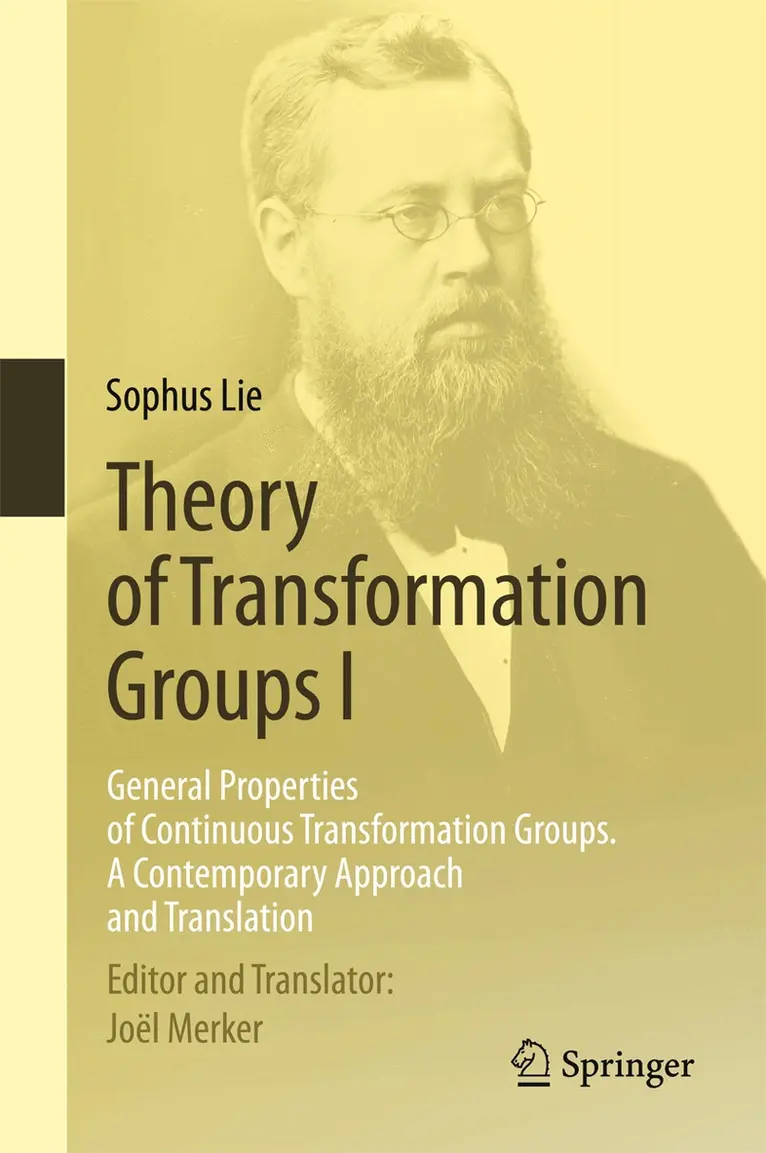
This modern translation of Sophus Lie's and Friedrich Engel's “Theorie der Transformationsgruppen I” will allow readers to discover the striking conceptual clarity and remarkably systematic organizational thought of the original German text. Volume I presents a comprehensive introduction to the theory and is mainly directed towards the generalization of ideas drawn from the study of examples. The major part of the present volume offers an extremely clear translation of the lucid original. The first four chapters provide not only a translation, but also a contemporary approach, which will help present day readers to familiarize themselves with the concepts at the heart of the subject. The editor's main objective was to encourage a renewed interest in the detailed classification of Lie algebras in dimensions 1, 2 and 3, and to offer access to Sophus Lie's monumental Galois theory of continuous transformation groups, established at the end of the 19th Century. Lie groups are widespread in mathematics, playing a role in representation theory, algebraic geometry, Galois theory, the theory of partial differential equations and also in physics, for example in general relativity. This volume is of interest to researchers in Lie theory and exterior differential systems and also to historians of mathematics. The prerequisites are a basic knowledge of differential calculus, ordinary differential equations and differential geometry.
E-bok
PDF, Engelska, 20151 733 kr
Läs direkt efter köp
This modern translation of Sophus Lie''s and Friedrich Engel''s “Theorie der Transformationsgruppen I” will allow readers to discover the striking conceptual clarity and remarkably systematic organizational thought of the original German text. Volume I presents a comprehensive introduction to the theory and is mainly directed towards the generalization of ideas drawn from the study of examples. The major part of the present volume offers an extremely clear translation of the lucid original. The first four chapters provide not only a translation, but also a contemporary approach, which will help present day readers to familiarize themselves with the concepts at the heart of the subject. The editor''s main objective was to encourage a renewed interest in the detailed classification of Lie algebras in dimensions 1, 2 and 3, and to offer access to Sophus Lie''s monumental Galois theory of continuous transformation groups, established at the end of the 19th Century. Lie groups are widespread in mathematics, playing a role in representation theory, algebraic geometry, Galois theory, the theory of partial differential equations and also in physics, for example in general relativity. This volume is of interest to researchers in Lie theory and exterior differential systems and also to historians of mathematics. The prerequisites are a basic knowledge of differential calculus, ordinary differential equations and differential geometry.
Häftad, Engelska, 2016
1 406 kr
Skickas inom 10-15 vardagar
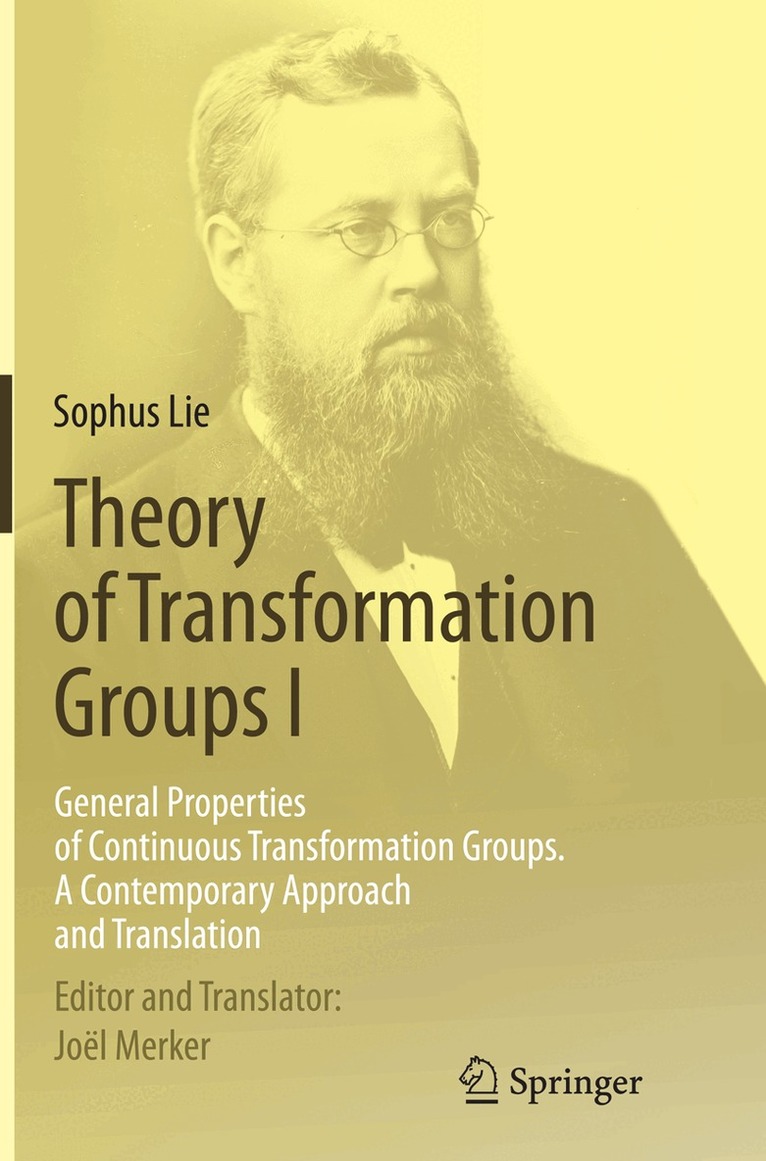
This modern translation of Sophus Lie's and Friedrich Engel's “Theorie der Transformationsgruppen I” will allow readers to discover the striking conceptual clarity and remarkably systematic organizational thought of the original German text. Volume I presents a comprehensive introduction to the theory and is mainly directed towards the generalization of ideas drawn from the study of examples. The major part of the present volume offers an extremely clear translation of the lucid original. The first four chapters provide not only a translation, but also a contemporary approach, which will help present day readers to familiarize themselves with the concepts at the heart of the subject. The editor's main objective was to encourage a renewed interest in the detailed classification of Lie algebras in dimensions 1, 2 and 3, and to offer access to Sophus Lie's monumental Galois theory of continuous transformation groups, established at the end of the 19th Century. Lie groups are widespread in mathematics, playing a role in representation theory, algebraic geometry, Galois theory, the theory of partial differential equations and also in physics, for example in general relativity. This volume is of interest to researchers in Lie theory and exterior differential systems and also to historians of mathematics. The prerequisites are a basic knowledge of differential calculus, ordinary differential equations and differential geometry.