Joel Schechter – författare
603 kr
Skickas inom 10-15 vardagar
1 280 kr
Läs direkt efter köp
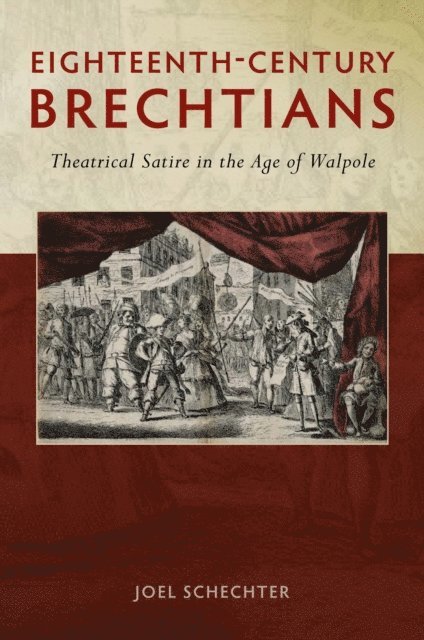
Discussing the actor mutiny of 1733, theatre censorship, controversial plays and Fielding’s forgery of an actor’s biography, the book contends that some subversive Augustan and Georgian artists were early Brechtians. Reconstructions of lost episodes in theatre history include a recounting of Fielding’s last days as a stage satirist before his Little Haymarket theatre was closed, Charlotte Charke’s performances as Macheath and Polly Peachum in The Beggar’s Opera and the 1740 staging of Jonathan Swift’s Polite Conversation on a double bill with Shakespeare’s Merry Wives . . .
Some documents in this collection offer another perspective on theatre history by employing fiction – speculative reconstructions of Georgian theatre events for which historical facts are scarce or missing. Brecht also employed fiction to reconsider history in short stories he wrote about Lucullus and Socrates, and a novel about Julius Caesar. The stories and several new letters attributed to Fielding delve into theatre history and keep some of its controversy alive in new ways, historicizing fiction and theatre somewhat as Brecht did.
It offers an unconventional, new reading of theatre history, Brecht’s tradition and stage satire.
376 kr
Läs direkt efter köp
Discussing the actor mutiny of 1733, theatre censorship, controversial plays and Fielding’s forgery of an actor’s biography, the book contends that some subversive Augustan and Georgian artists were early Brechtians. Reconstructions of lost episodes in theatre history include a recounting of Fielding’s last days as a stage satirist before his Little Haymarket theatre was closed, Charlotte Charke’s performances as Macheath and Polly Peachum in The Beggar’s Opera and the 1740 staging of Jonathan Swift’s Polite Conversation on a double bill with Shakespeare’s Merry Wives . . .
Some documents in this collection offer another perspective on theatre history by employing fiction – speculative reconstructions of Georgian theatre events for which historical facts are scarce or missing. Brecht also employed fiction to reconsider history in short stories he wrote about Lucullus and Socrates, and a novel about Julius Caesar. The stories and several new letters attributed to Fielding delve into theatre history and keep some of its controversy alive in new ways, historicizing fiction and theatre somewhat as Brecht did.
It offers an unconventional, new reading of theatre history, Brecht’s tradition and stage satire.
367 kr
Skickas inom 5-8 vardagar
1 109 kr
Skickas inom 5-8 vardagar
710 kr
Läs direkt efter köp
Bertolt Brecht turned to cabaret; Ariane Mnouchkine went to the circus; Joan Littlewood wanted to open a palace of fun. These were a few of the directors who turned to popular theatre forms in the last century, and this sourcebook accounts for their attraction.Popular theatre forms introduced in this sourcebook include cabaret, circus, puppetry, vaudeville, Indian jatra, political satire, and physical comedy. These entertainments are highly visual, itinerant, and readily understood by audiences. Popular Theatre: A Sourcebook follows them around the world, from the bunraku puppetry of Japan to the masked topeng theatre of Bali to South African political satire, the San Francisco Mime Troupe''s comic melodramas, and a ''Fun Palace'' proposed for London.The book features essays from the archives of The Drama Review and other research. Contributions by Roland Barthes, Hovey Burgess, Marvin Carlson, John Emigh, Dario Fo, Ron Jenkins, Joan Littlewood, Brooks McNamara, Richard Schechner, and others, offer some of the most important, informative, and lively writing available on popular theatre. Introducing both Western and non-Western popular theatre practices, the sourcebook provides access to theatrical forms which have delighted audiences and attracted stage artists around the world.
710 kr
Läs direkt efter köp
Bertolt Brecht turned to cabaret; Ariane Mnouchkine went to the circus; Joan Littlewood wanted to open a palace of fun. These were a few of the directors who turned to popular theatre forms in the last century, and this sourcebook accounts for their attraction.Popular theatre forms introduced in this sourcebook include cabaret, circus, puppetry, vaudeville, Indian jatra, political satire, and physical comedy. These entertainments are highly visual, itinerant, and readily understood by audiences. Popular Theatre: A Sourcebook follows them around the world, from the bunraku puppetry of Japan to the masked topeng theatre of Bali to South African political satire, the San Francisco Mime Troupe''s comic melodramas, and a ''Fun Palace'' proposed for London.The book features essays from the archives of The Drama Review and other research. Contributions by Roland Barthes, Hovey Burgess, Marvin Carlson, John Emigh, Dario Fo, Ron Jenkins, Joan Littlewood, Brooks McNamara, Richard Schechner, and others, offer some of the most important, informative, and lively writing available on popular theatre. Introducing both Western and non-Western popular theatre practices, the sourcebook provides access to theatrical forms which have delighted audiences and attracted stage artists around the world.
296 kr
Skickas inom 10-15 vardagar
321 kr
Skickas
313 kr
Läs direkt efter köp
313 kr
Läs direkt efter köp