John E. Stinson – författare
Visar alla böcker från författaren John E. Stinson. Handla med fri frakt och snabb leverans.
6 produkter
6 produkter
E-bok
PDF, Engelska, 20051 922 kr
Läs direkt efter köp
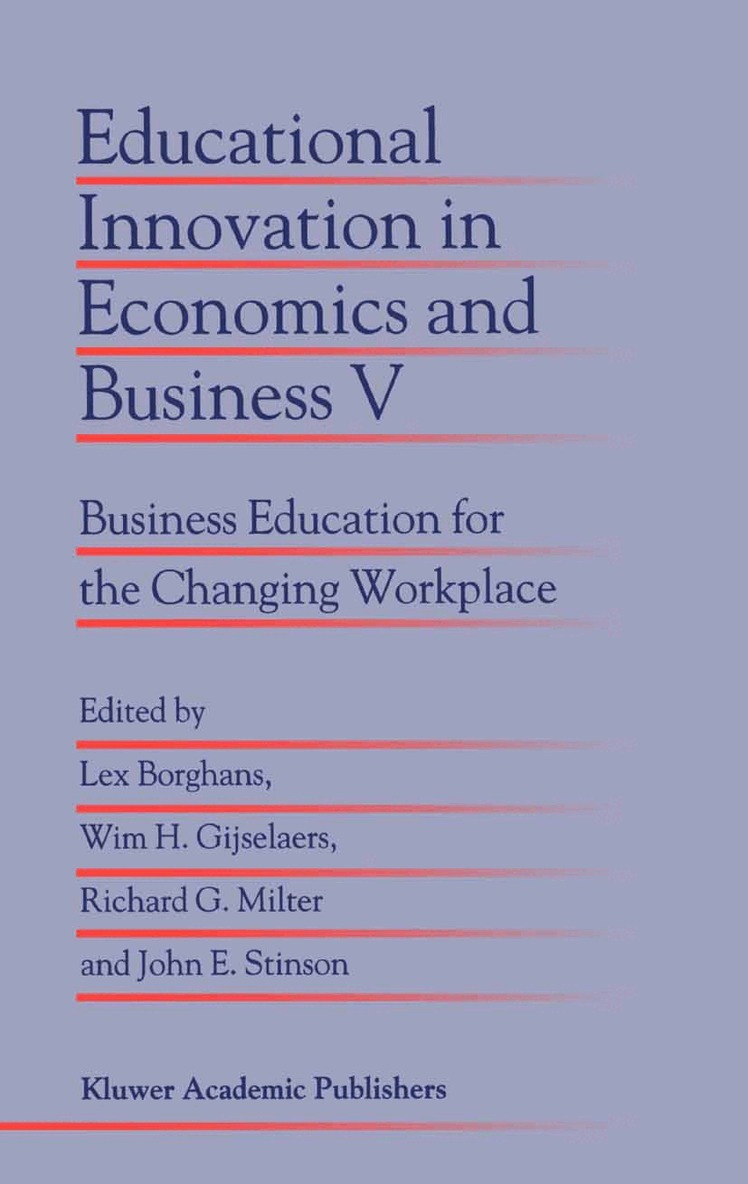
The workplace is changing drastically these days. As a consequence of the Information and Communication Technology (ICT) revolution, new economic activities emerge, the production process changes, people use different communication tools, and organizational structures are adjusted. All these changes relate to the heart of business and economics, and there is no doubt that they will also influence education in these areas. Of course ICT provides new technologies to facilitate learning, but a changing workplace also requires a renewed focus within the curriculum of economics and business education. If ICT is leading to profound change in the workplace, is innovation then only a matter of introducing more technology in education? Unfortunately, this is not necessarily true. The translation of changes in the workplace into an improved curriculum requires serious analysis of the essence of the changes at the work place, and the way technology may enable student learning. For example, relevant knowledge is changing faster and faster. Does this mean that we have to adopt the curriculum faster and faster? Perhaps not, as students will have a labor market career of 30 or 40 years. Focusing on today’s knowledge – even if it is very up-to-date – loses more and more value if the life cycle of knowledge becomes shorter. Increased speed of change also implies a decrease in the value of knowing all these things.
Inbunden, Engelska, 1998
1 585 kr
Skickas inom 10-15 vardagar
Almost thirty years ago a friend involved in the education profession told me that in his estimation much more was "caught" by students outside of classrooms than was "taught" within those hallowed walls. This statement has stuck with me through years of personal schooling, working as a high school teacher, working in management, serving as a management consultant and trainer, and facilitating learning on university campuses across the US, eastern Europe, and Asia. Learning by doing is certainly something most people have experienced. But the fact that there is more opportunity to learn more things today as never before (with knowledge doubling every 20 months) makes learning by doing more complicated. As organizations move to respond to the rapid changes in their environments, people within those organizations must face the uncertainty and ambiguity that comes with such conditions. The one thing most futurists agree on is that the future will be very different than the present. Exponential change has become commonplace. Companies used to worry about redefining their goals and specific describing their place in an industry. Today, in order to survive, they must be constantly addressing the issues inherent in redefining their industries.
Inbunden, Engelska, 2000
1 585 kr
Skickas inom 10-15 vardagar
The information and communication technology revolution results in profound changes to the heart of business and economics. Changes in the workplace, new communication technology, new organizational structures, and new production technologies force business educators to renew their focus on the curricula of business schools. There is no doubt these changes influence business education and instructional technology. But change will go far beyond the mere introduction of technology in the classroom. Alliances between the corporate world and business education are no longer fictitious but are necessary to establish stronger bonds between educational systems and the workplace. This volume contains a selection of articles addressing various issues on how business education should adapt to the changing needs of the corporate world.
Häftad, Engelska, 2010
1 585 kr
Skickas inom 10-15 vardagar
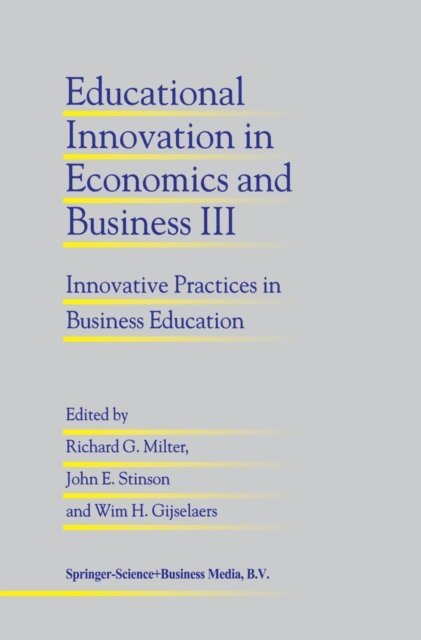
The third volume in the series Educational Innovation in Economics and Business contains a unique selection of articles describing different aspects of the development of innovative platforms for business education. It is a comprehensive examination of how business educators may develop innovative learning platforms. It describes new educational technologies like action-based learning, problem-based learning, student-centred education, partnerships between education and business and computer-based education. The focus of this edited volume is not only business education as such, but it also examines the influence of other disciplines on business education. Audience: Teachers in higher and further education, trainers at corporate education centers, and educational psychologists, as well as university or faculty administrators involved in innovative practices in business education.
Häftad, Engelska, 2010
1 585 kr
Skickas inom 10-15 vardagar
The workplace is changing drastically these days. As a consequence of the Information and Communication Technology (ICT) revolution, new economic activities emerge, the production process changes, people use different communication tools, and organizational structures are adjusted. All these changes relate to the heart of business and economics, and there is no doubt that they will also influence education in these areas. Of course ICT provides new technologies to facilitate learning, but a changing workplace also requires a renewed focus within the curriculum of economics and business education. If ICT is leading to profound change in the workplace, is innovation then only a matter of introducing more technology in education? Unfortunately, this is not necessarily true. The translation of changes in the workplace into an improved curriculum requires serious analysis of the essence of the changes at the work place, and the way technology may enable student learning. For example, relevant knowledge is changing faster and faster. Does this mean that we have to adopt the curriculum faster and faster? Perhaps not, as students will have a labor market career of 30 or 40 years. Focusing on today’s knowledge – even if it is very up-to-date – loses more and more value if the life cycle of knowledge becomes shorter. Increased speed of change also implies a decrease in the value of knowing all these things.
E-bok
PDF, Engelska, 20131 922 kr
Läs direkt efter köp
Almost thirty years ago a friend involved in the education profession told me that in his estimation much more was "caught" by students outside of classrooms than was "taught" within those hallowed walls. This statement has stuck with me through years of personal schooling, working as a high school teacher, working in management, serving as a management consultant and trainer, and facilitating learning on university campuses across the US, eastern Europe, and Asia. Learning by doing is certainly something most people have experienced. But the fact that there is more opportunity to learn more things today as never before (with knowledge doubling every 20 months) makes learning by doing more complicated. As organizations move to respond to the rapid changes in their environments, people within those organizations must face the uncertainty and ambiguity that comes with such conditions. The one thing most futurists agree on is that the future will be very different than the present. Exponential change has become commonplace. Companies used to worry about redefining their goals and specific describing their place in an industry. Today, in order to survive, they must be constantly addressing the issues inherent in redefining their industries.