John H. Lawton – författare
Visar alla böcker från författaren . Handla med fri frakt och snabb leverans.
4 produkter
4 produkter
Häftad, Engelska, 1995
1 599 kr
Skickas inom 5-8 vardagar
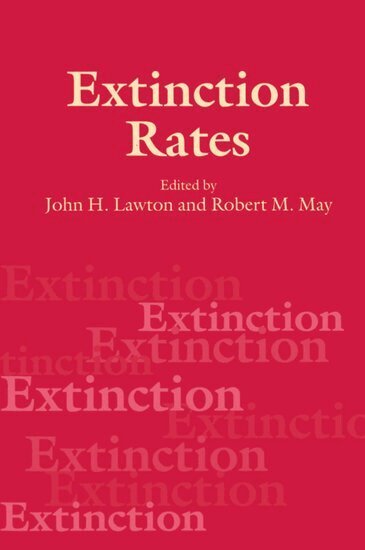
This useful new book answers the need for data-driven estimates of recent (1600 onwards) extinction rates as a basis for more accurate projections of extinction rates for the centuries to come. This book provides a more wide-ranging and data-driven treatment of present and likely future rates of extinction than any text currently available. It is directed broadly at senior undergraduates, postgraduate students and research workers in the fields of ecology, conservation biology and the environmental sciences. The authors highlight apparent differences in extinction rates among taxonomic groups and places, aiming to identify unresolved issues and important questions.
Inbunden, Engelska, 1994
1 619 kr
Skickas inom 10-15 vardagar
I was asked to introduce this volume by examining "why a knowledge of ecosys tem functioning can contribute to understanding species activities, dynamics, and assemblages." I have found it surprisingly difficult to address this topic. On the one hand, the answer is very simple and general: because all species live in ecosystems, they are part of and dependent on ecosystem processes. It is impossible to understand the abundance and distribution of populations and the species diversity and composition of communities without a knowledge of their abiotic and biotic environments and of the fluxes of energy and mat ter through the ecosystems of which they are a part. But everyone knows this. It is what ecology is all about (e.g., Likens, 1992). It is why the discipline has retained its integrity and thrived, despite a sometimes distressing degree of bickering and chauvinism among its various subdisciplines: physiological, be havioral, population, community, and ecosystem ecology.
Häftad, Engelska, 2012
1 620 kr
Skickas inom 10-15 vardagar
I was asked to introduce this volume by examining "why a knowledge of ecosys tem functioning can contribute to understanding species activities, dynamics, and assemblages." I have found it surprisingly difficult to address this topic. On the one hand, the answer is very simple and general: because all species live in ecosystems, they are part of and dependent on ecosystem processes. It is impossible to understand the abundance and distribution of populations and the species diversity and composition of communities without a knowledge of their abiotic and biotic environments and of the fluxes of energy and mat ter through the ecosystems of which they are a part. But everyone knows this. It is what ecology is all about (e.g., Likens, 1992). It is why the discipline has retained its integrity and thrived, despite a sometimes distressing degree of bickering and chauvinism among its various subdisciplines: physiological, be havioral, population, community, and ecosystem ecology.
E-bok
PDF, Engelska, 20122 049 kr
Läs direkt efter köp
I was asked to introduce this volume by examining "why a knowledge of ecosys tem functioning can contribute to understanding species activities, dynamics, and assemblages." I have found it surprisingly difficult to address this topic. On the one hand, the answer is very simple and general: because all species live in ecosystems, they are part of and dependent on ecosystem processes. It is impossible to understand the abundance and distribution of populations and the species diversity and composition of communities without a knowledge of their abiotic and biotic environments and of the fluxes of energy and mat ter through the ecosystems of which they are a part. But everyone knows this. It is what ecology is all about (e.g., Likens, 1992). It is why the discipline has retained its integrity and thrived, despite a sometimes distressing degree of bickering and chauvinism among its various subdisciplines: physiological, be havioral, population, community, and ecosystem ecology.