John H. Maurer – författare
Visar alla böcker från författaren John H. Maurer. Handla med fri frakt och snabb leverans.
8 produkter
8 produkter
Inbunden, Engelska, 1995
937 kr
Skickas inom 10-15 vardagar
This study examines what led the leaders of Austria-Hungary and Germany to launch major military offensives at the beginning of the First World War. The focus is on understanding why these two countries adopted high-risk offensive strategies during an international confrontation rather than a defensive military stance. The decision to attack or defend did not occur in a political vacuum. The leaders of Austria-Hungary and Germany adopted offensive strategies as a way to achieve their political ambitions. The offensives undertaken by Austria-Hungary and Germany in 1914 thus reflected their political goals as well as the strategic doctrines of war planners. The concluding chapter of this study explores why deterrence failed in 1914.
Häftad, Engelska, 2014
530 kr
Skickas inom 10-15 vardagar
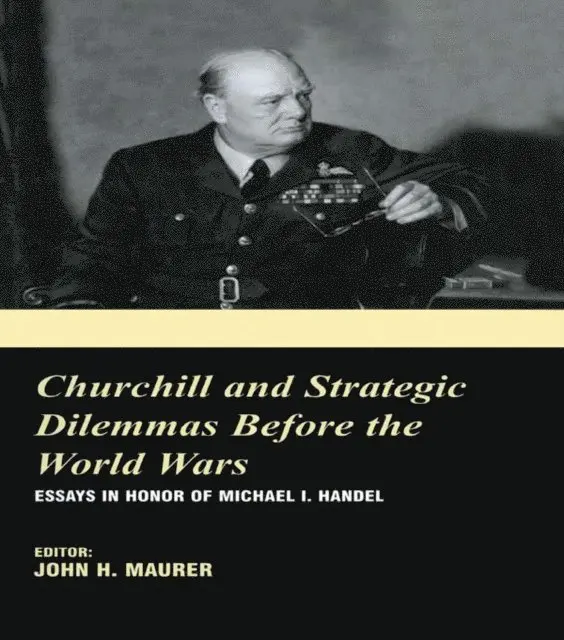
Before Michael I. Handel died his colleagues and students compiled this collection of essays that were written for a conference on strategy held during 2001. The papers address Churchill's views and ideas on war, strategy and realpolitik.
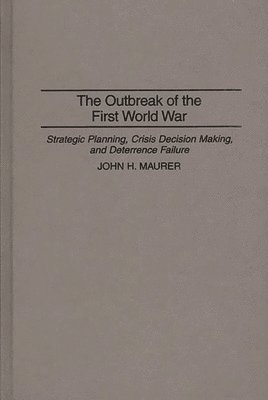
E-bok
PDF, Engelska, 2014605 kr
Läs direkt efter köp
Before Michael I. Handel died his colleagues and students compiled this collection of essays that were written for a conference on strategy held during 2001. The papers address Churchill''s views and ideas on war, strategy and realpolitik.
E-bok
Engelska, 2014605 kr
Läs direkt efter köp
Before Michael I. Handel died his colleagues and students compiled this collection of essays that were written for a conference on strategy held during 2001. The papers address Churchill''s views and ideas on war, strategy and realpolitik.
Häftad, Engelska, 2011
243 kr
Skickas inom 5-8 vardagar
E-bok
Engelska, 2013821 kr
Läs direkt efter köp
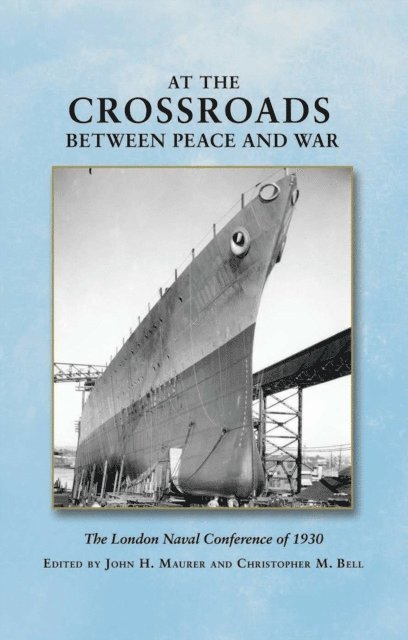
A great power arms race in naval weaponry and platforms, rising challengers seeking to overturn the existing international order in Asia, an economic slump that put immense pressure on politicians in democracies to trim defense budgets, and diplomatic efforts by statesmen to find ways to promote mutual security and avoid rivalries that could lead to war—all these features mark the current-day strategic environment. These features also marked in the era between the two world wars. To prevent the naval rivalries that augured international conflict, statesmen and naval leaders sought to negotiate arms control agreement. Their efforts to avert a great power naval arms race were crowned with achievement at the London Conference of 1930.What was accomplished at London, of course, did not prove lasting; nor did it lead to additional meaningful arms control and prevent future wars. Instead, London proved a dead end in the evolution of interwar international relations. The London Treaty marked the high point of interwar arms control. When measured against the magnitude of the international catastrophe that would unfold over the next decade, this achievement in arms control now appears practically meaningless at best and dangerous at worst. Critics of interwar arms control argue that, by weakening of American and British naval power, as well as stirring up extremist nationalism in Japanese internal politics, the London agreement represents a case study in political folly that contributed to the awful events leading to the war. The London Conference of 1930 thus represents a watershed, a turning point in the history of the interwar period.In this volume, leading naval historians tackle the question of how to assess the role played by naval arms control in the history of the interwar period. In addressing this important question, the authors uncover new evidence about the role of intelligence and behind-the-scenes political deal making that adds much to our knowledge of the international and naval history of this important era. This volume’s authors provide the first complete account of the strategic calculations and negotiations that shaped the outcome at the London Conference. No one interested in twentieth-century naval history, international relations and the rivalries of rising and declining great powers, and the origins of the Second World War can afford to miss this important new history.
E-bok
Engelska, 2022511 kr
Läs direkt efter köp
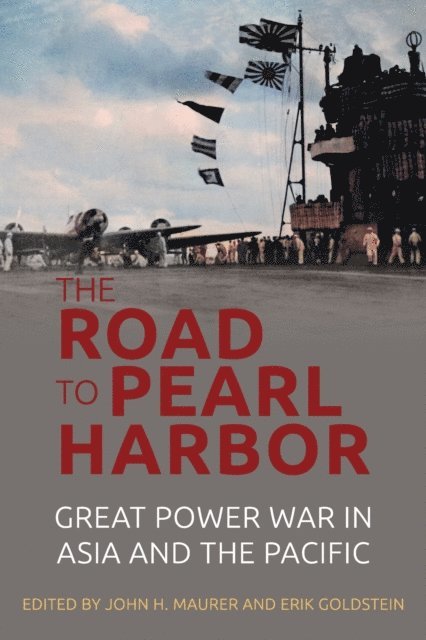
The Road to Pearl Harbor offers a timely examination of the conflict in the Pacific prior to the attacks on Pearl Harbor and offers lessons applicable to understanding contemporary Great Power flash points between Asia and the West. This volume brings together renowned historians and analysts of grand strategy to map out the fateful decisions that culminated in war. The contributors take a pragmatic view of the policy and strategy options, as well as the decisions made by the leaders of the great powers. This important history underscores that the choices made by political, military, and naval leaders mattered in determining questions of war and peace. Highlighting Japan''s war against China and the protracted resistance of Chiang-Kai-shek''s Nationalist regime, The Road to Pearl Harbor provides historical context for understanding the struggle for mastery in Asia and decisions for war. The book also makes an important contribution to interwar naval history by examining the views of the Japanese Navy''s leaders, who wanted to build up their navy to defeat Britain and the United States at sea. This history is certainly relevant, as the concluding chapter demonstrates in an eye-opening examination of the current views held by Chinese naval officers about how to fight a future war in the Pacific.
Inbunden, Engelska, 2003
1 524 kr
Tillfälligt slut
Before Michael I. Handel died his colleagues and students compiled this collection of essays that were written for a conference on strategy held during 2001. The papers address Churchill's views and ideas on war, strategy and realpolitik.