John Johnston – författare
Visar alla böcker från författaren John Johnston. Handla med fri frakt och snabb leverans.
30 produkter
Allure of Machinic Life
Cybernetics, Artificial Life, and the New AI
Häftad, 2010
907 kr
Lägg i varukorg
5,000 Years of Chinese Jade
Featuring Selections from the National Museum of History, Taiwan, and the Arthur M. Sackler Gallery, Smithsonian Institution
Av John Johnston, Chan Lai Pik
Häftad, 2011
444 kr
Kommande
5,000 Years of Chinese Jade is a concise visual survey of art-historically important jade spanning the Neolithic period to the 19th century, offering a stunning visual journey through themes and time periods important in the history of jade in China. The book is arranged chronologically in five …
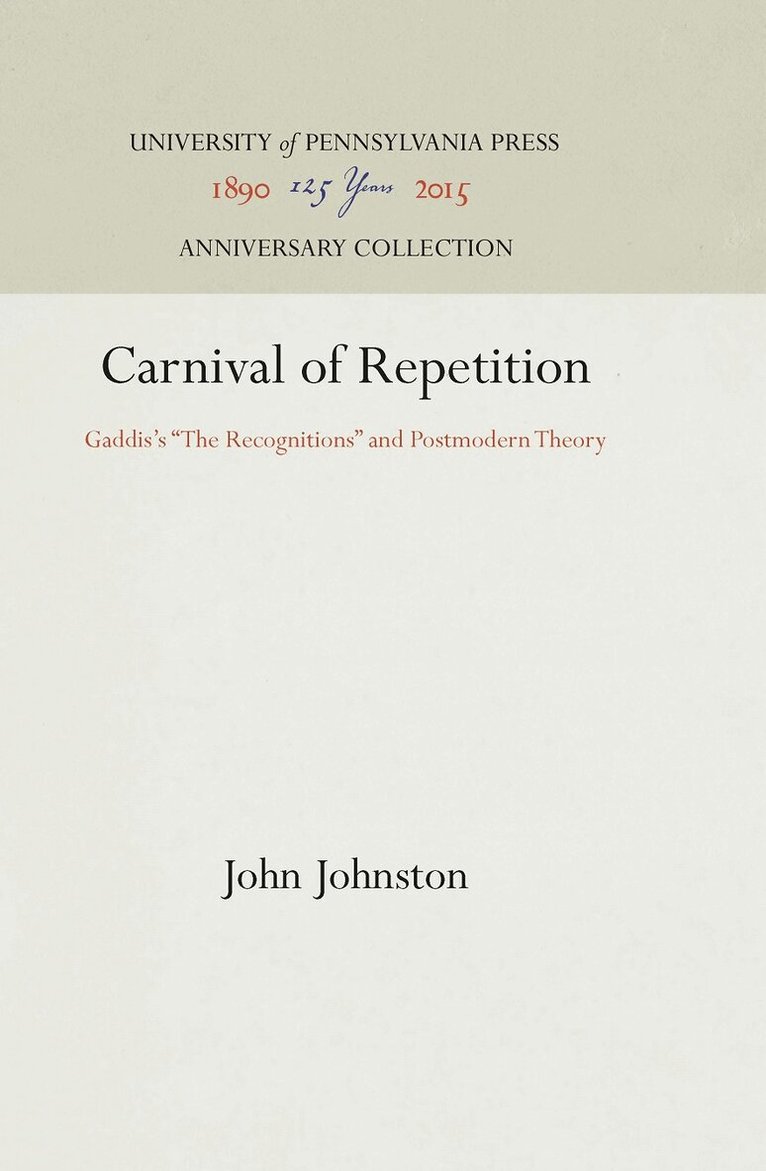
Carnival of Repetition
Gaddis's "the Recognitions" and Postmodern Theory
Inbunden, 1990
1242 kr
Lägg i varukorg
Although published many decades ago, William Gaddis's The Recognitions is only now beginning to receive the critical attention it deserves. Carnival of Repetition, the first full-length study of the novel, is a sophisticated analysis that places it in a new literary and cultural context .This novel …
Education for Democracy
Essays and Addresses
Häftad, 1934
528 kr
Lägg i varukorg
Education for Democracy was first published in 1934. Minnesota Archive Editions uses digital technology to make long-unavailable books once again accessible, and are published unaltered from the original University of Minnesota Press editions."The Greek ideal of the citizen realizing himself in the …
History Of The Towns Of Bristol And Bremen In The State Of Maine, Including The Pemaquid Settlement; Volume 2
Inbunden, 2022
398 kr
Lägg i varukorg
History Of The Towns Of Bristol And Bremen In The State Of Maine, Including The Pemaquid Settlement; Volume 2
Häftad, 2022
273 kr
Lägg i varukorg
Diary Notes of a Visit to Walt Whitman and Some of his Friends, in 1890
With a Series of Original Photographs
Inbunden, 2022
385 kr
Lägg i varukorg
Diary Notes of a Visit to Walt Whitman and Some of his Friends, in 1890
With a Series of Original Photographs
Häftad, 2022
227 kr
Lägg i varukorg
History Of The Towns Of Bristol And Bremen In The State Of Maine, Including The Pemaquid Settlement; Volume 1
Inbunden, 2023
402 kr
Lägg i varukorg
History Of The Towns Of Bristol And Bremen In The State Of Maine, Including The Pemaquid Settlement; Volume 1
Häftad, 2023
294 kr
Lägg i varukorg
Autobiography and Ministerial Life of the Rev. John Johnston, D. D
Av James Carnahan, John Johnston
Inbunden, 2025
409 kr
Lägg i varukorg
Autobiography and Ministerial Life of the Rev. John Johnston, D. D
Av James Carnahan, John Johnston
Häftad, 2025
257 kr
Lägg i varukorg
Development of the Sciences
Av Ernest William Brown, Henry Andrews Bumstead m. fl.
Inbunden, 2026
413 kr
Lägg i varukorg
Development of the Sciences
Av Ernest William Brown, Henry Andrews Bumstead m. fl.
Häftad, 2026
293 kr
Lägg i varukorg
Qualitative Research with Artificial Intelligence
Responsible Methods for Research Design, Analysis, and Teaching
Häftad, 2027
620 kr
Kommande
Qualitative Research with Artificial Intelligence offers a comprehensive, accessible, and pedagogically rich guide to conducting qualitative research in an era shaped by generative AI, automated analysis, and human–AI collaboration. The book argues that AI can extend analytic visibility, but …
Qualitative Research with Artificial Intelligence
Responsible Methods for Research Design, Analysis, and Teaching
Inbunden, 2027
2405 kr
Kommande
Qualitative Research with Artificial Intelligence offers a comprehensive, accessible, and pedagogically rich guide to conducting qualitative research in an era shaped by generative AI, automated analysis, and human–AI collaboration. The book argues that AI can extend analytic visibility, but …
Autobiography and Ministerial Life of the Rev. John Johnston, D. D.
Häftad, 2006
324 kr
Lägg i varukorg
Recollections of Sixty Years by John Johnston, Indian Agent for the U.S. Government (1915)
Av John Johnston, Charlotte Reeve Conover
Häftad
384 kr
Lägg i varukorg
Carnival of Repetition
Gaddis's "the Recognitions" and Postmodern Theory
E-bok, 2016
1537 kr
Lägg i varukorg
Although published many decades ago, William Gaddis''s The Recognitions is only now beginning to receive the critical attention it deserves. Carnival of Repetition , the first full-length study of the novel, is a sophisticated analysis that places it in a new literary and cultural context . This …
Diary Notes of a Visit to Walt Whitman and Some of His Friends, in 1890
With a series of original photographs
Häftad, 2017
326 kr
Lägg i varukorg
manual of chemistry, on the basis of Turner's Elements of chemistry; containing, in a condensed form, all the most important facts and principles of the science
Designed for a text book for colleges and other seminaries of learning. Sixth Edition
Av John Johnston, Edward Turner
Häftad, 2017
581 kr
Lägg i varukorg
Information Multiplicity
American Fiction in the Age of Media Saturation
Häftad, 1998
352 kr
Tillfälligt slut
"With the birth of information theory and cybernetics in the late 1940s and early 1950s," writes John Johnston, "a decisive step was taken toward the immense techno-scientific transformation of the world into coded bits of 'information' and machinic assemblages." Beginning with Thomas Pynchon's The …