John L. Vossen – författare
Visar alla böcker från författaren John L. Vossen. Handla med fri frakt och snabb leverans.
4 produkter
4 produkter
E-bok
PDF, Engelska, 2012672 kr
Läs direkt efter köp
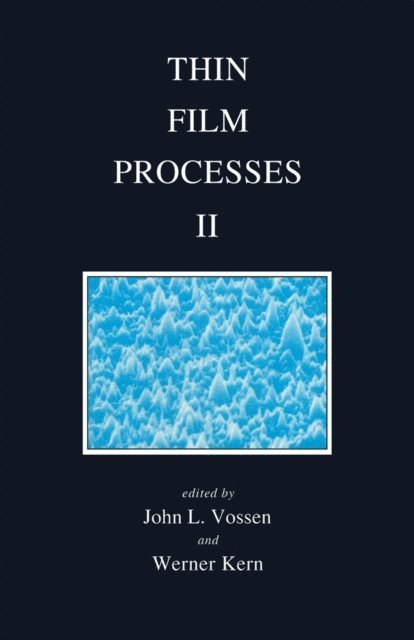
This sequel to the 1978 classic, Thin Film Processes, gives a clear, practical exposition of important thin film deposition and etching processes that have not yet been adequately reviewed. It discusses selected processes in tutorial overviews with implementation guide lines and an introduction to the literature. Though edited to stand alone, when taken together, Thin Film Processes II and its predecessor present a thorough grounding in modern thin film techniques.- Provides an all-new sequel to the 1978 classic, Thin Film Processes- Introduces new topics, and several key topics presented in the original volume are updated- Emphasizes practical applications of major thin film deposition and etching processes- Helps readers find the appropriate technology for a particular application
E-bok
PDF, Engelska, 2012696 kr
Läs direkt efter köp
Remarkable advances have been made in recent years in the science and technology of thin film processes for deposition and etching. It is the purpose of this book to bring together tutorial reviews of selected filmdeposition and etching processes from a process viewpoint. Emphasis is placed on the practical use of the processes to provide working guidelines for their implementation, a guide to the literature, and an overview of each process.
E-bok
PDF, Engelska, 2013756 kr
Läs direkt efter köp
Physics of Thin Films: Advances in Research and Development primarily deals with the influence of ions or optical energy on the deposition, properties, and etching on thin films. The book is a collection of five articles, with one article per chapter. Chapter 1 covers ionized cluster beam deposition; epitaxy; and film-formation mechanism. Chapter 2 discusses the activated reactive evaporation process; the deposition of refractory compounds; the role of plasma in the process; and its applications. Chapter 3 focuses on ion-beam processing of optical thin films; ion sources and ion-surface interactions; and the different kinds of bombardment involved. Chapter 4 deals with laser induced etching - its mechanisms, methods, and applications. Chapter 5 talks about contacts to GaAs devices; Fermi-level pinning; and heterojunction contacts. The book is recommended for physicists and engineers in the field of electronics who would like to know more about thin films and the progresses in the field.
E-bok
PDF, Engelska, 2013756 kr
Läs direkt efter köp
Physics of Thin Films: Advances in Research and Development, Volume 12 reviews advances that have been made in research and development concerning the physics of thin films. This volume covers a wide range of preparative approaches, physics phenomena, and applications related to thin films. This book is comprised of four chapters and begins with a discussion on metal coatings and protective layers for front surface mirrors used at various angles of incidence from the ultraviolet to the far infrared. Thin-film materials and deposition conditions suitable for minimizing reflectance changes with angle of incidence are described, along with novel oxide protective coatings with enhanced chemical stability and mechanical durability. The next chapter offers a comprehensive treatment of photoemissive materials. After giving a rather detailed review of the physics of photoemission, the main classes of thin-film photoemitters, including Ag-O-Cs, alkali antimonides, and negative-electron affinity photocathodes, are considered. A description of field-assisted cathodes potentially suitable for wavelengths beyond 1.1 micrometers, such as transferred-electron structures and field-emission arrays, is also given. The reader is then introduced to spray pyrolysis and the solution growth technique for chemical solution deposition of inorganic films. This text concludes with a chapter on plasma-enhanced chemical vapor deposition of thin films, paying particular attention to the experimental conditions required for a range of element and compound materials as well as some of the unusual film properties and structures achieved by this approach. This monograph will be useful to students and practitioners of physics, especially those interested in thin films.