
John McHale – författare
Visar alla böcker från författaren . Handla med fri frakt och snabb leverans.
6 produkter
6 produkter
Inbunden, Engelska, 2019
2 429 kr
Skickas inom 10-15 vardagar
A revolution has occurred during our lifetime in the collection, storage, and communication of information, a revolution whose full significance is scarcely understood even by those responsible for its development. At the core of this revolution, and its most visible component, is electronic data processing via the computer. The computer has shown an impressive ability to handle increasing complexity at greater speeds while decreasing its use of power, cost, and space. In this book, however, John McHale shows how the impact of the information revolution stretches far beyond these specific developments. It lies (1) in the expansion and interlinkage of computer-based systems and their extension into larger areas of automated control; (2) in the convergence and relationship of such systems with concurrently developing communications technologies; and (3) in the ways in which these combine together to create a radically new information environment, whose major impacts will be felt most critically within the next ten to twenty years. Mr McHale believes that the emergence of information and knowledge as our basic resources signifies profound consequences that will affect the structure of society itself and the institutional and value premises upon which it operates: The increased dependence upon information as key societal resource will move society, within the next ten to twenty years, from industrially based forms to post-industrial forms whose possible configurations of institutions, governance and value systems are still open to conjecture. In society in general, with the new social wealth generated by information and communications technologies, the whole character of the survival game is being changed. It is now more clearly a non-zero-sum game in which success or gain is predicated on all winning. For the individual, large-scale development of the new technologies–radio, copying machine, television, telep
Häftad, Engelska, 2020
669 kr
Skickas inom 10-15 vardagar
This book shows how the impact of the information revolution stretches far beyond specific developments of computer-based systems and communications technologies. It provides the introduction to a new area of the interrelationship between technology and society.
E-bok
PDF, Engelska, 2019757 kr
Läs direkt efter köp
A revolution has occurred during our lifetime in the collection, storage, and communication of information, a revolution whose full significance is scarcely understood even by those responsible for its development. At the core of this revolution, and its most visible component, is electronic data processing via the computer. The computer has shown an impressive ability to handle increasing complexity at greater speeds while decreasing its use of power, cost, and space. In this book, however, John McHale shows how the impact of the information revolution stretches far beyond these specific developments. It lies (1) in the expansion and interlinkage of computer-based systems and their extension into larger areas of automated control; (2) in the convergence and relationship of such systems with concurrently developing communications technologies; and (3) in the ways in which these combine together to create a radically new information environment, whose major impacts will be felt most critically within the next ten to twenty years. Mr McHale believes that the emergence of information and knowledge as our basic resources signifies profound consequences that will affect the structure of society itself and the institutional and value premises upon which it operates: The increased dependence upon information as key societal resource will move society, within the next ten to twenty years, from industrially based forms to post-industrial forms whose possible configurations of institutions, governance and value systems are still open to conjecture. In society in general, with the new social wealth generated by information and communications technologies, the whole character of the survival game is being changed. It is now more clearly a non-zero-sum game in which success or gain is predicated on all winning.
E-bok
Engelska, 2019730 kr
Läs direkt efter köp
A revolution has occurred during our lifetime in the collection, storage, and communication of information, a revolution whose full significance is scarcely understood even by those responsible for its development. At the core of this revolution, and its most visible component, is electronic data processing via the computer. The computer has shown an impressive ability to handle increasing complexity at greater speeds while decreasing its use of power, cost, and space. In this book, however, John McHale shows how the impact of the information revolution stretches far beyond these specific developments. It lies (1) in the expansion and interlinkage of computer-based systems and their extension into larger areas of automated control; (2) in the convergence and relationship of such systems with concurrently developing communications technologies; and (3) in the ways in which these combine together to create a radically new information environment, whose major impacts will be felt most critically within the next ten to twenty years. Mr McHale believes that the emergence of information and knowledge as our basic resources signifies profound consequences that will affect the structure of society itself and the institutional and value premises upon which it operates: The increased dependence upon information as key societal resource will move society, within the next ten to twenty years, from industrially based forms to post-industrial forms whose possible configurations of institutions, governance and value systems are still open to conjecture. In society in general, with the new social wealth generated by information and communications technologies, the whole character of the survival game is being changed. It is now more clearly a non-zero-sum game in which success or gain is predicated on all winning.
Häftad, Engelska, 2020
681 kr
Skickas inom 10-15 vardagar
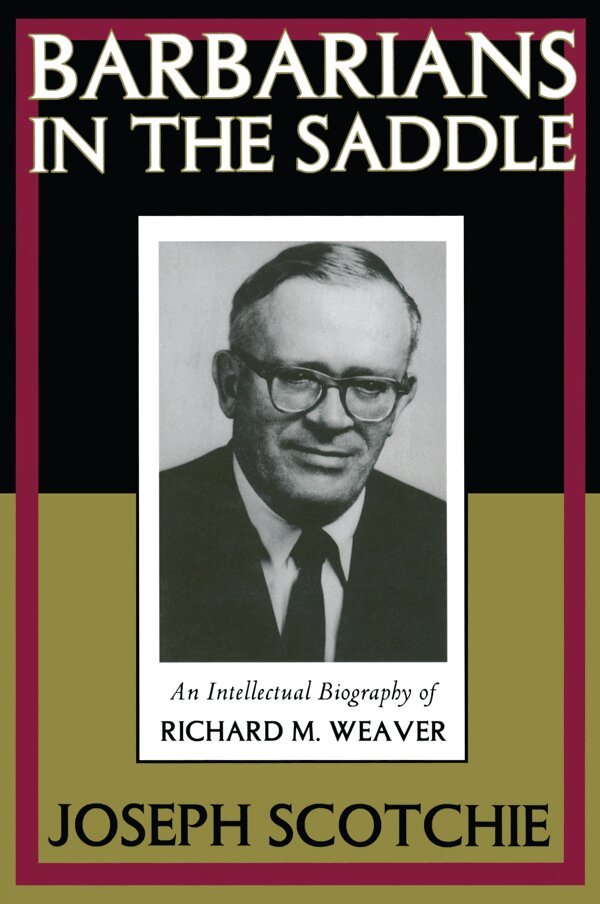
Richard M. Weaver was one of the founders of modern conservatism and an enduring intellectual figure of twentieth-century America. He was dedicated to examining the dual nature of human beings and the quest for civilized communities in a corrupted age that believed in the religion of science and in the "natural goodness" of man. Weaver's Ideas Have Consequences sowed the seeds for the traditionalist wing of modern American conservatism. On the brink of the twenty-first century, the triumph of science and technology looms larger than ever. Weaver's prophetic writings on post-World War II Western decline and his visionary talents, however bleak, can easily extend into many facets of modern life: high divorce rates, a declining standard of living, the dehumanizing aspects of a corporate economy, and the destruction of civil communities.Barbarians in the Saddle is Joseph Scotchie's intellectual biography of Richard M. Weaver. It is an in-depth study of each of Weaver's published works and an examination of the significant influence he had on the formation of conservative America. Ideas Have Consequences and Visions of Order examine the problem of life in "megalopolis" where the best of everything is promised to the restless masses by their leaders and a cradle-to-grave social security state results in dangerous levels of decadence, resentment, and the loss of civility and culture. In The Southern Tradition at Bay and other essays on the American South, Weaver expresses his preference for the nonmaterialistic, virtuous ethos of the Old South. Finally, The Ethics of Rhetoric highlights Weaver's devotion to a discipline increasingly out of favor with academia.Thirty years after his untimely death, Richard Weaver remains a heroic figure to many concerned about the state of American culture and its alienated, rootless conditions. Now a new generation of leaders can understand the importance of this pioneer of thought. Barbarians in the Saddle will be of significant value to political theorists, philosophers, and students of American civilization.
Inbunden, Engelska, 1997
1 184 kr
Tillfälligt slut
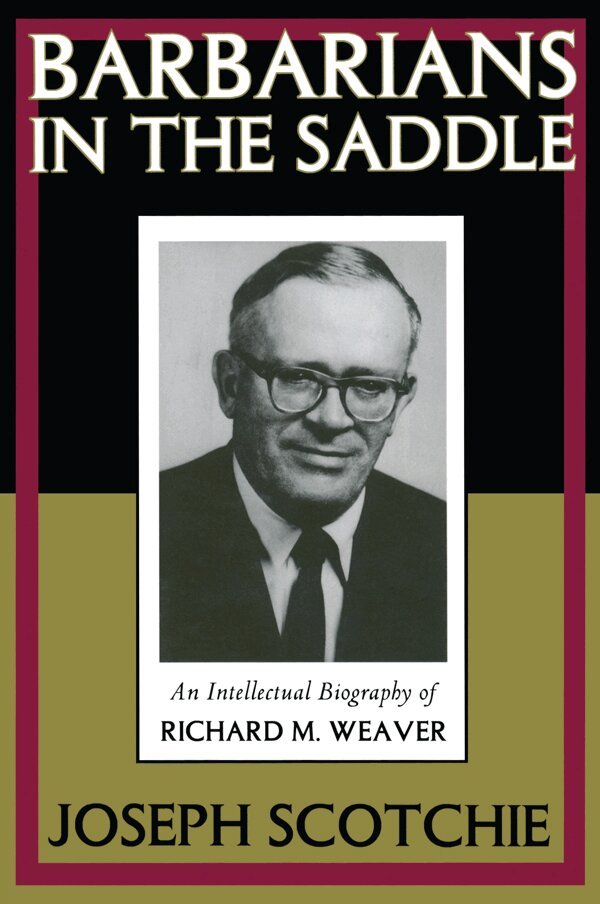
Richard M. Weaver was one of the founders of modern conservatism and an enduring intellectual figure of twentieth-century America. He was dedicated to examining the dual nature of human beings and the quest for civilized communities in a corrupted age that believed in the religion of science and in the "natural goodness" of man. Weaver's Ideas Have Consequences sowed the seeds for the traditionalist wing of modern American conservatism. On the brink of the twenty-first century, the triumph of science and technology looms larger than ever. Weaver's prophetic writings on post-World War II Western decline and his visionary talents, however bleak, can easily extend into many facets of modern life: high divorce rates, a declining standard of living, the dehumanizing aspects of a corporate economy, and the destruction of civil communities.Barbarians in the Saddle is Joseph Scotchie's intellectual biography of Richard M. Weaver. It is an in-depth study of each of Weaver's published works and an examination of the significant influence he had on the formation of conservative America. Ideas Have Consequences and Visions of Order examine the problem of life in "megalopolis" where the best of everything is promised to the restless masses by their leaders and a cradle-to-grave social security state results in dangerous levels of decadence, resentment, and the loss of civility and culture. In The Southern Tradition at Bay and other essays on the American South, Weaver expresses his preference for the nonmaterialistic, virtuous ethos of the Old South. Finally, The Ethics of Rhetoric highlights Weaver's devotion to a discipline increasingly out of favor with academia.Thirty years after his untimely death, Richard Weaver remains a heroic figure to many concerned about the state of American culture and its alienated, rootless conditions. Now a new generation of leaders can understand the importance of this pioneer of thought. Barbarians in the Saddle will be of significant value to political theorists, philosophers, and students of American civilization.