Jorg Bucker – författare
1 913 kr
Läs direkt efter köp
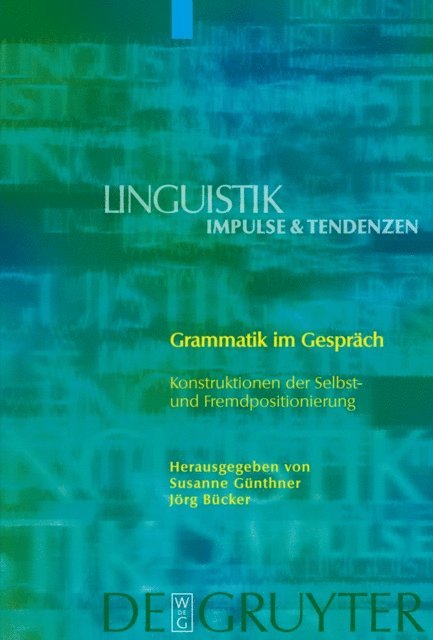
The papers in this volume study linguistic structures in the context of their interactive functions and usages; they concentrate on grammatical constructions for the positioning of self and others. Using empirical analyses of positioning constructions, the authors show that forms and functions of grammatical structures in everyday interactions are closely interwoven with the conditions for the production and reception of spoken language. This leads to the methodological conclusion that linguistic phenomena - understood as constructions of varying complexity - cannot be decontextualised but are to be examined in their particular interactional contexts. In the present analyses, therefore, attention is paid both to the mediality and actional reference of linguistic phenomena and to the dialogicity, sequentiality and temporality of the development of linguistic constructions.
In order to take account of the tension between the stabilisation of grammatical constructions and the process of their actualisation in interactions, the authors combine methods from Interactional Linguistics with insights from usage-based positions of both Construction Grammar and Cognitive Grammar.
2 283 kr
Läs direkt efter köp
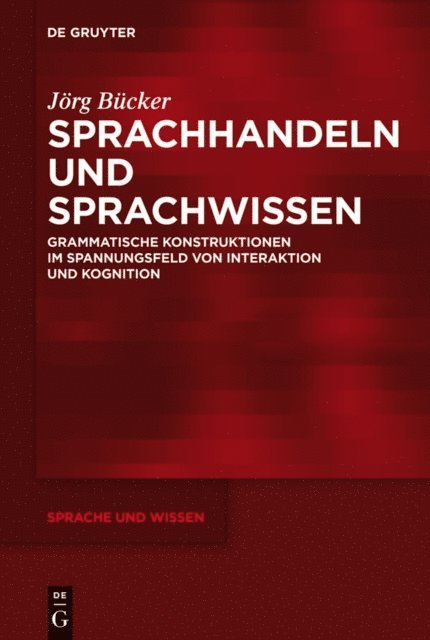
Am Beispiel der „Nicht-finiten Prädikationskonstruktion“ (z.B. „Ich und aufgeben?“) wird der Versuch unternommen, ausgehend von den alltagssprachlichen Formen und Funktionen einer grammatischen Konstruktion zu einem Modell ihrer Repräsentation im Sprachgebrauchswissen zu gelangen. Die Hauptdatengrundlage der Untersuchung bilden alltagssprachliche Beispiele aus dem Usenet und aus Foren. Im Anschluss an die Diskussion des Forschungsstands werden in Auseinandersetzung mit kognitions- und interaktionslinguistischen, aber auch zeichentheoretischen Positionen die theoretischen und methodologischen Konzepte herausgearbeitet, die für die Untersuchung der „Nicht-finiten Prädikationskonstruktion“ erforderlich sind. Die empirische Untersuchung der Konstruktion mündet dann wiederum in einen Vorschlag für ein Modell ihrer kognitiven Repräsentation im Sprachgebrauchswissen. Nach einem Ausblick auf einige Charakteristika der „Nicht-finiten Prädikationskonstruktion“, die in sprachvergleichender Hinsicht und im Hinblick auf den Problembereich Mündlichkeit und Schriftlichkeit aufschlussreich sind, schließt die Untersuchung mit einem Plädoyer dafür, Konstruktionen als Phänomene alltäglicher kommunikativer Praxis zu begreifen.
1 913 kr
Läs direkt efter köp
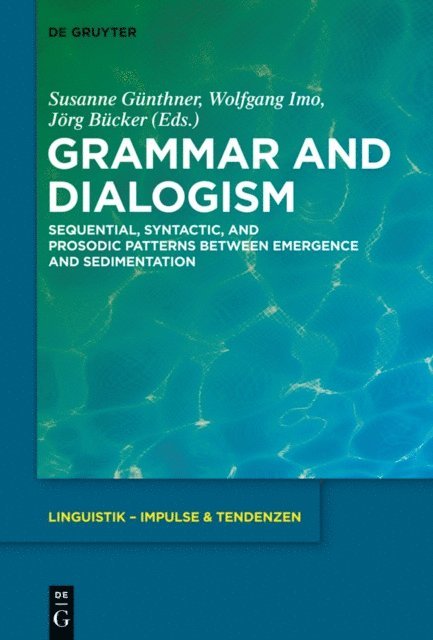
This volume aims at analyzing the relationship between the dialogical accomplishment of spoken talk-in-interaction on the one hand and entrenched patterns of linguistic and socio-cultural knowledge (constructions, frames, and communicative genres) on the other. The contributions analyze linguistic patterns in different languages such as English, French, German, and Swedish. Methodologically, they take up the usage-based position that structural and functional aspects of language use need to be studied empirically and "bottom-up": Since grammatical structure arises as the entrenched result of recurrent language use, its study should start with the local organization of natural talk-in-interaction before moving on to more complex and abstract relationships between linguistic structure, linguistic meaning, and socio-cultural activity/event patterns. Furthermore, they argue that Dialogism provides a promising starting point for a usage-based approach to linguistic patterns as both emerging (i.e. constructed in response to the situational circumstances of talk-in-interaction) and emergent (i.e. constructed with regard to symbolic units as parts of socially and culturally shared knowledge).
1 913 kr
Läs direkt efter köp
This volume aims at analyzing the relationship between the dialogical accomplishment of spoken talk-in-interaction on the one hand and entrenched patterns of linguistic and socio-cultural knowledge (constructions, frames, and communicative genres) on the other. The contributions analyze linguistic patterns in different languages such as English, French, German, and Swedish. Methodologically, they take up the usage-based position that structural and functional aspects of language use need to be studied empirically and "bottom-up": Since grammatical structure arises as the entrenched result of recurrent language use, its study should start with the local organization of natural talk-in-interaction before moving on to more complex and abstract relationships between linguistic structure, linguistic meaning, and socio-cultural activity/event patterns. Furthermore, they argue that Dialogism provides a promising starting point for a usage-based approach to linguistic patterns as both emerging (i.e. constructed in response to the situational circumstances of talk-in-interaction) and emergent (i.e. constructed with regard to symbolic units as parts of socially and culturally shared knowledge).