Jose L. Rodrigo – författare
Visar alla böcker från författaren Jose L. Rodrigo. Handla med fri frakt och snabb leverans.
4 produkter
4 produkter
E-bok
Engelska, 20181 222 kr
Läs direkt efter köp
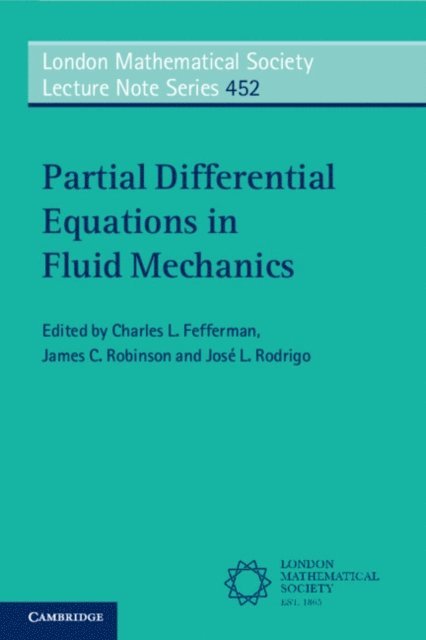
The Euler and Navier–Stokes equations are the fundamental mathematical models of fluid mechanics, and their study remains central in the modern theory of partial differential equations. This volume of articles, derived from the workshop ''PDEs in Fluid Mechanics'' held at the University of Warwick in 2016, serves to consolidate, survey and further advance research in this area. It contains reviews of recent progress and classical results, as well as cutting-edge research articles. Topics include Onsager''s conjecture for energy conservation in the Euler equations, weak-strong uniqueness in fluid models and several chapters address the Navier–Stokes equations directly; in particular, a retelling of Leray''s formative 1934 paper in modern mathematical language. The book also covers more general PDE methods with applications in fluid mechanics and beyond. This collection will serve as a helpful overview of current research for graduate students new to the area and for more established researchers.
E-bok
Engelska, 20161 145 kr
Läs direkt efter köp
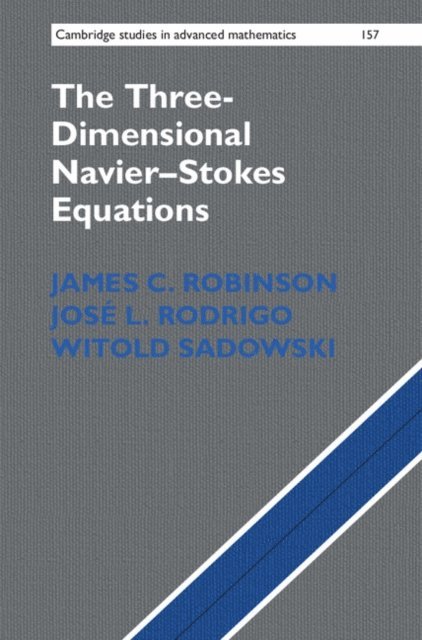
A rigorous but accessible introduction to the mathematical theory of the three-dimensional Navier–Stokes equations, this book provides self-contained proofs of some of the most significant results in the area, many of which can only be found in research papers. Highlights include the existence of global-in-time Leray–Hopf weak solutions and the local existence of strong solutions; the conditional local regularity results of Serrin and others; and the partial regularity results of Caffarelli, Kohn, and Nirenberg. Appendices provide background material and proofs of some ''standard results'' that are hard to find in the literature. A substantial number of exercises are included, with full solutions given at the end of the book. As the only introductory text on the topic to treat all of the mainstream results in detail, this book is an ideal text for a graduate course of one or two semesters. It is also a useful resource for anyone working in mathematical fluid dynamics.
E-bok
PDF, Engelska, 20161 145 kr
Läs direkt efter köp
A rigorous but accessible introduction to the mathematical theory of the three-dimensional Navier–Stokes equations, this book provides self-contained proofs of some of the most significant results in the area, many of which can only be found in research papers. Highlights include the existence of global-in-time Leray–Hopf weak solutions and the local existence of strong solutions; the conditional local regularity results of Serrin and others; and the partial regularity results of Caffarelli, Kohn, and Nirenberg. Appendices provide background material and proofs of some ''standard results'' that are hard to find in the literature. A substantial number of exercises are included, with full solutions given at the end of the book. As the only introductory text on the topic to treat all of the mainstream results in detail, this book is an ideal text for a graduate course of one or two semesters. It is also a useful resource for anyone working in mathematical fluid dynamics.
E-bok
PDF, Engelska, 20181 222 kr
Läs direkt efter köp
The Euler and Navier–Stokes equations are the fundamental mathematical models of fluid mechanics, and their study remains central in the modern theory of partial differential equations. This volume of articles, derived from the workshop ''PDEs in Fluid Mechanics'' held at the University of Warwick in 2016, serves to consolidate, survey and further advance research in this area. It contains reviews of recent progress and classical results, as well as cutting-edge research articles. Topics include Onsager''s conjecture for energy conservation in the Euler equations, weak-strong uniqueness in fluid models and several chapters address the Navier–Stokes equations directly; in particular, a retelling of Leray''s formative 1934 paper in modern mathematical language. The book also covers more general PDE methods with applications in fluid mechanics and beyond. This collection will serve as a helpful overview of current research for graduate students new to the area and for more established researchers.