Joseph J. Kockelmans - Böcker
Visar alla böcker från författaren Joseph J. Kockelmans. Handla med fri frakt och snabb leverans.
4 produkter
4 produkter
435 kr
Skickas inom 10-15 vardagar
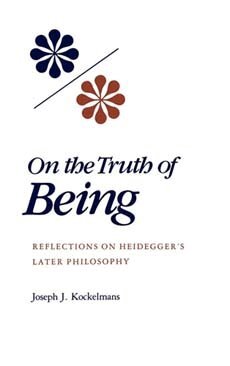
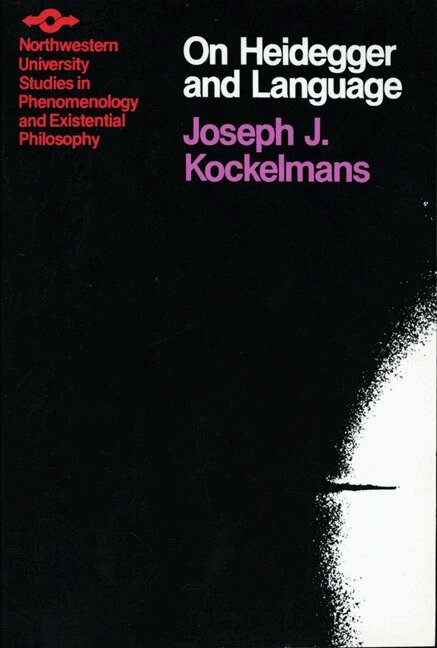
Joseph J. Kockelmans provides a clear and systematic treatment of the central themes and topics of Heidegger's later writings, focusing on the all-important question of the relationship of truth and Being. If we are to understand Heidegger's thought, Kockelmans explains, we must conceive it as a path or way, rather than as a finished system. Adopting this approach himself, Kockelmans leads us with scholarly care through the wide range of issues that Heidegger wrote about between roughly 1935 and 1965. After a discussion of Heidegger's own effort to learn to think, subsequent chapters present Heidegger's views on such matters as the meaning of Being; the ontological difference; heaven and earth; gods and mortals; and language, art, science, technology, ethics, and politics. In conclusion, Kockelmans reflects on the task of thinking in an age when classical philosophy has reached its logical end.
657 kr
Skickas inom 5-8 vardagar
Clarification of the aims and problems of interdisciplinarity, as this book demonstrates, not only will help reveal the movement's probable impact on university teaching and research but also will shed light on the overall future of the university. This book therefore speaks to faculty members and administrators in general, as well as to teachers and students whose specialty is the study of higher education. A recurring theme is that every academic specialty can be justified for purposes of research, provided it does not lead to overspecialization in education. The proviso is a formidable one, challenging the intellect, the will, and the good faith of all concerned. Yet interdisciplinarity has a fundamental historical sanction: disciplinary domains are not immutable but rather are constantly evolving through fission and fusion. (Examples of fission are the division of medieval grammar and rhetoric into modern lingustic and literary studies, or of 19th-century biology into today's life sciences. Fusion is exemplified in a range of fields from astrophysics through biochemistry to psycholinguists and social psychology.) A general perspective on the continuing debate about interdisciplinary is presented in the first four chapters, followed by six chapters on specific problems and prospects. The introduction reviews well-founded as well as misdirected objections to interdisciplinarity, contrasting "natural" interactions as in geophysics (arising from intrinsic developments) with "artificial" ones as in general education courses (arising from curriculum design) —but holding that the latter can be as legitimate as the former if responsive to genuine educational needs. Chapters 1 to 4 give the historical and philosophical background of interdisciplinarity from Plato's Academy to the Center for Educational Research and Innovation. Chapters 5 to 7 consider specific challenges in the respective domains of natural science, social science, and the humanities—cautioning against incompetent borrowings of paradigms. Chapters 8 and 9 treat the methodological, institutional, and personal problems arising from boundary-crossing. Chapter 10 critically analyzes three cases of interdisciplinary innovation in the United States and gives summary descriptions of programs in a dozen countries.
686 kr
Skickas inom 10-15 vardagar
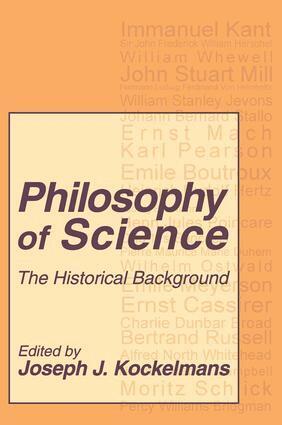
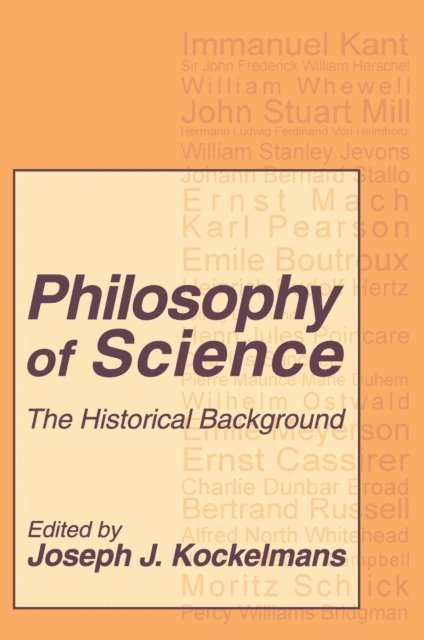
This anthology of selections from the works of noted philosophers affords the student an immediate contact with the unique historical background of the philosophy of science. The selections, many of which have not been readily accessible, follow the development of the philosophy of science from 1786 to 1927. Each selection is preceded by a brief introduction by the editor designed to familiarize the reader with a particular philosopher and provide insights into his work.Joseph J. Kockelmans divides the selections into several sections. Part 1, from 17861850, includes chapters by Immanuel Kant, on the metaphysical foundations of natural science, John Frederick William Herschel, on experience and the analysis of phenomena, William Whewell, on the nature and conditions of inductive science, and John Stuart Mill, on induction and the law of universal causation; part 2, from 18701899, includes chapters by Hermann Von Helmholtz, on the origin and significance of geometrical axioms, William Stanley Jevons, on the philosophy of inductive inference, John Bernard Stallo, on the kinetic theory of gasses and the conditions of the validity of scientific hypotheses, Ernst Mach, on the economical nature of physical inquiry, Karl Pearson, on perceptual and conceptual space, Emile Boutroux, on mechanical laws, Heinrich Hertz, on the appropriateness, correctness, and permissibility of scientific theories, and Ludwig Boltzmann, on the fundamental principles and basic equations of mechanics.The third part, covering the first decade of the twentieth century, includes chapters by Henri Jules Poincare, on science and reality, Charles Peirce, on Induction, Pierre Marie Duhem, on the laws of physics, William Ostwald, on energetism and mechanics, Emile Meyerson, on identity of thought and nature as the final goal of science, Ernst Cassirer, on functional concepts of natural science; part 4, from 19101927, includes chapters by Charles Dunbar Broad, on phenomenalism, Alfred North Whitehead, on time, space, and material, Bertrand Russell, on the world of physics and the world of sense, Norman Robert Cambbell, on the meaning of science, Moritz Schlick, on basic issues of the philosophy of natural science, and Percy Williams Bridgman, on the concepts of space, time, and causality.Philosophy of Science provides a concise single volume text to the discipline and enables students to understand and evaluate the various trends in our contemporary philosophy of science.Joseph J. Kockelmans is professor emeritus of philosophy at the Pennsylvania State Univers
2 113 kr
Skickas inom 10-15 vardagar
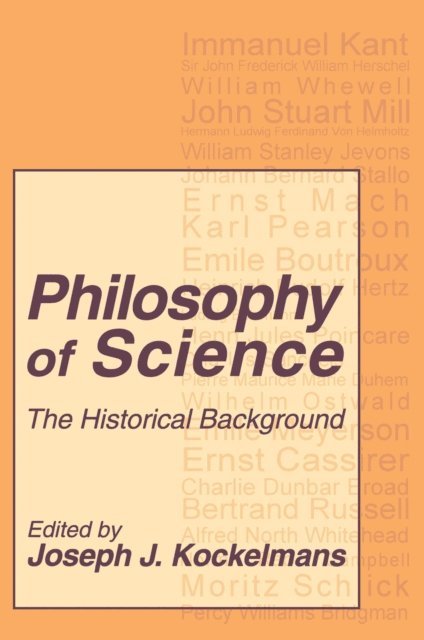
This anthology of selections from the works of noted philosophers affords the student an immediate contact with the unique historical background of the philosophy of science. The selections, many of which have not been readily accessible, follow the development of the philosophy of science from 1786 to 1927. Each selection is preceded by a brief introduction by the editor designed to familiarize the reader with a particular philosopher and provide insights into his work.Joseph J. Kockelmans divides the selections into several sections. Part 1, from 17861850, includes chapters by Immanuel Kant, on the metaphysical foundations of natural science, John Frederick William Herschel, on experience and the analysis of phenomena, William Whewell, on the nature and conditions of inductive science, and John Stuart Mill, on induction and the law of universal causation; part 2, from 18701899, includes chapters by Hermann Von Helmholtz, on the origin and significance of geometrical axioms, William Stanley Jevons, on the philosophy of inductive inference, John Bernard Stallo, on the kinetic theory of gasses and the conditions of the validity of scientific hypotheses, Ernst Mach, on the economical nature of physical inquiry, Karl Pearson, on perceptual and conceptual space, Emile Boutroux, on mechanical laws, Heinrich Hertz, on the appropriateness, correctness, and permissibility of scientific theories, and Ludwig Boltzmann, on the fundamental principles and basic equations of mechanics.The third part, covering the first decade of the twentieth century, includes chapters by Henri Jules Poincare, on science and reality, Charles Peirce, on Induction, Pierre Marie Duhem, on the laws of physics, William Ostwald, on energetism and mechanics, Emile Meyerson, on identity of thought and nature as the final goal of science, Ernst Cassirer, on functional concepts of natural science; part 4, from 19101927, includes chapters by Charles Dunbar Broad, on phenomenalism, Alfred North Whitehead, on time, space, and material, Bertrand Russell, on the world of physics and the world of sense, Norman Robert Cambbell, on the meaning of science, Moritz Schlick, on basic issues of the philosophy of natural science, and Percy Williams Bridgman, on the concepts of space, time, and causality.Philosophy of Science provides a concise single volume text to the discipline and enables students to understand and evaluate the various trends in our contemporary philosophy of science.Joseph J. Kockelmans is professor emeritus of philosophy at the Pennsylvania State Univers