Joshua Armstrong – författare
Visar alla böcker från författaren Joshua Armstrong. Handla med fri frakt och snabb leverans.
4 produkter
4 produkter
Häftad, Engelska, 2015
296 kr
Skickas inom 5-8 vardagar
E-bok
Engelska, 201557 kr
Läs direkt efter köp
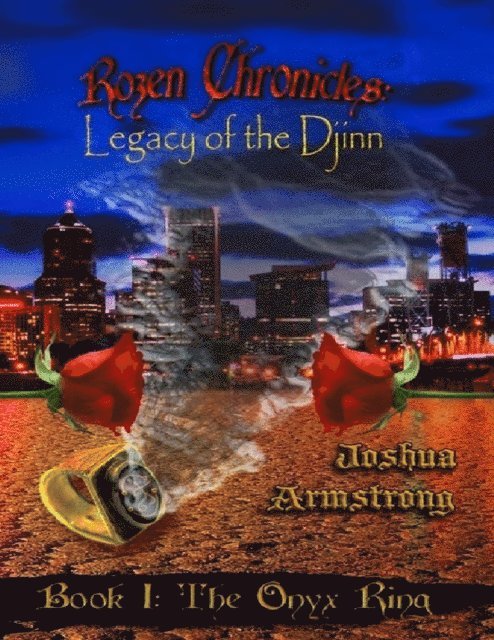
Xellous "Zell" Rozen is a paranormal anthropologist. He spends his nights studying the strange and unusual things that go bump in the night. With his new assistant, Calanyx at the ready, Zell finds himself escaping hellhounds, destroying life-stealing thought forms, and working with a temperamental Djinni whose quest is to find others of his tribe. All this while dealing with what has become a love quadrangle. But it''s all in a day''s work for Zell. Not literally, of course. This was over a course of a few days. Ah''Mahn and his clan of Djinn fled their realm and entered into the world of humans to escape persecution and start a new life. But when slavers captured the clan and bound each one to an item so that they would be forced to serve their masters, the tribe was again in danger, even more so than before. After centuries of imprisonment, Ah''Mahn has vowed to recover his brethren that have been scattered across the globe and break the bonds placed upon them. Or at least, he''ll destroy himself trying.
Del 61 - Contemporary French and Francophone Cultures
Maps and Territories
Global Positioning in the Contemporary French Novel
Inbunden, Engelska, 2019
2 226 kr
Skickas inom 5-8 vardagar
The rapidity of postwar globalization and the structural changes it has brought to both social and spatial aspects of everyday life has meant, in France as elsewhere, the destabilizing of senses of place, identity, and belonging, as once familiar, local environments are increasingly de-localized and made porous to global trends and planetary preoccupations. Maps and Territories identifies such preoccupations as a fundamental underlying impetus for the contemporary French novel. Indeed, like France itself, the protagonists of its best fiction are constantly called upon to renegotiate their identity in order to maintain any sense of belonging within the troubled territories they call home. Maps and Territories reads today’s French novel for how it re-maps such territories, and for how it positions its protagonists vis-à-vis the pressures of globalization, uncovering previously unseen affinities amongst, and offering fresh readings of—and offering exciting new perspectives on—a diverse set of authors: namely, Michel Houellebecq, Chloé Delaume, Lydie Salvayre, Jean-Philippe Toussaint, Virginie Despentes, Philippe Vasset, Jean Rolin, and Marie Darrieussecq. In the process, it sets the literary works into dialogue with a range of today’s most influential theorists of postmodernity and globalization, including Paul Virilio, Marc Augé, Peter Sloterdijk, Bruno Latour, Fredric Jameson, Edward Casey, David Harvey, and Ursula K. Heise.

Del 61 - Contemporary French and Francophone Cultures
Maps and Territories
Global Positioning in the Contemporary French Novel
Häftad, Engelska, 2022
559 kr
Skickas inom 5-8 vardagar
The rapidity of postwar globalization and the structural changes it has brought to both social and spatial aspects of everyday life has meant, in France as elsewhere, the destabilizing of senses of place, identity, and belonging, as once familiar, local environments are increasingly de-localized and made porous to global trends and planetary preoccupations. Maps and Territories identifies such preoccupations as a fundamental underlying impetus for the contemporary French novel. Indeed, like France itself, the protagonists of its best fiction are constantly called upon to renegotiate their identity in order to maintain any sense of belonging within the troubled territories they call home. Maps and Territories reads today’s French novel for how it re-maps such territories, and for how it positions its protagonists vis-à-vis the pressures of globalization, uncovering previously unseen affinities amongst, and offering fresh readings of—and offering exciting new perspectives on—a diverse set of authors: namely, Michel Houellebecq, Chloé Delaume, Lydie Salvayre, Jean-Philippe Toussaint, Virginie Despentes, Philippe Vasset, Jean Rolin, and Marie Darrieussecq. In the process, it sets the literary works into dialogue with a range of today’s most influential theorists of postmodernity and globalization, including Paul Virilio, Marc Augé, Peter Sloterdijk, Bruno Latour, Fredric Jameson, Edward Casey, David Harvey, and Ursula K. Heise.