
Jotham Parsons – författare
Visar alla böcker från författaren . Handla med fri frakt och snabb leverans.
2 produkter
2 produkter
Inbunden, Engelska, 2014
842 kr
Skickas inom 5-8 vardagar
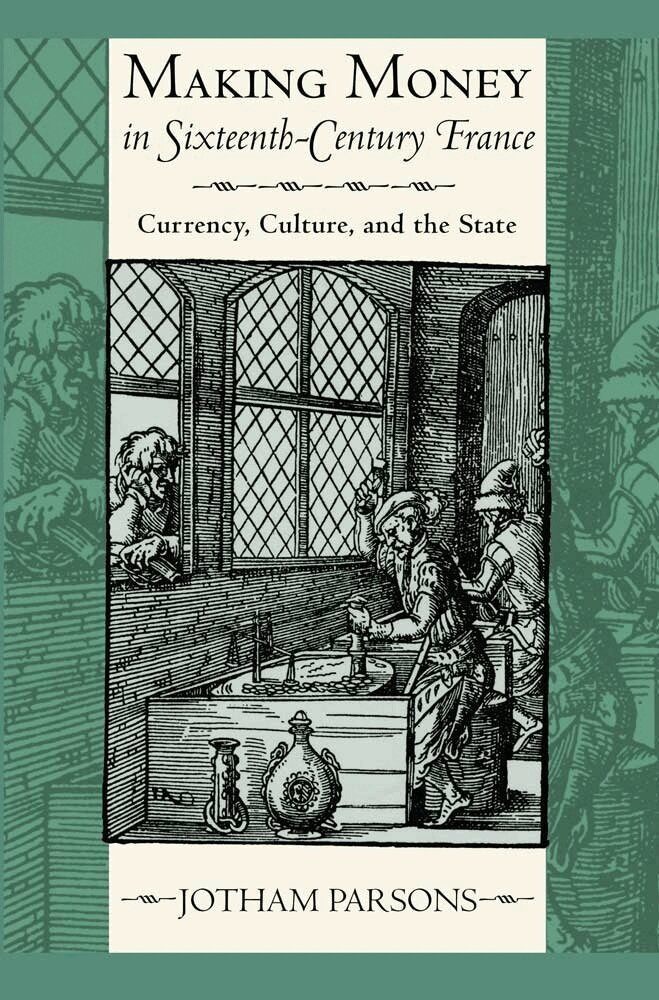
Coinage and currency—abstract and socially created units of value and power—were basic to early modern society. By controlling money, the people sought to understand and control their complex, expanding, and interdependent world. In Making Money in Sixteenth-Century France, Jotham Parsons investigates the creation and circulation of currency in France. The royal Cour des Monnaies centralized monetary administration, expanding its role in the emerging modern state during the sixteenth century and assuming new powers as an often controversial repository of theoretical and administrative expertise. The Cour des Monnaies, Parsons shows, played an important role in developing the contemporary understanding of money, as a source of both danger and opportunity at the center of economic and political life. More practically, the Monnaies led generally successful responses to the endemic inflation of the era and the monetary chaos of a period of civil war. Its work investigating and prosecuting counterfeiters shone light into a picaresque world of those who used the abstract and artificial nature of money for their own ends. Parsons's broad, multidimensional portrait of money in early modern France also encompasses the literature of the age, in which money's arbitrary and dangerous power was a major theme.
Häftad, Engelska, 2020
383 kr
Skickas inom 10-15 vardagar
The Church in the Republic offers a new interpretation of the relationship between religion and politics in Europe at the dawn of the modern age. Its main subject, the theoretical and political contest over the liberties of the Gallican Church, was one of the great political issues of early modern France. This debate raised basic questions on the nature and origins of authority within human institutions. It shaped the way French Catholic magistrates, laypeople, and clergy understood the state and their own places within it, and was followed closely in England, Italy, and beyond. The conflict over Gallicanism revealed the assumptions underlying the political thought of two of its most influential participants: the lawyers and judges of the French sovereign courts, and the bishops and other prelates of the Catholic clergy. Jotham Parsons shows that the Gallican controversy began with an attempt by humanists to understand society as based on contingent, historical custom rather than immutable divine justice. Under the pressures of political and religious conflict, this theoretical commitment developed into a powerful political ideology. At the same time, the Tridentine Reform was reinvigorating France's Catholic clergy intellectually and organizationally. French bishops could thus counter what they saw as an attack on their proper jurisdiction with a vigorous and successful bid for increased authority within the royal state. These two alternative visions, Gallican and clericalist, provided a framework for politics for the remainder of the Old Regime and were highly influential around Europe. This book presents an enlightening examination of the ways in which Renaissance humanism and the Catholic and Protestant Reformations interacted to create the modern state.