J.S.R. Chisholm – författare
Visar alla böcker från författaren J.S.R. Chisholm. Handla med fri frakt och snabb leverans.
6 produkter
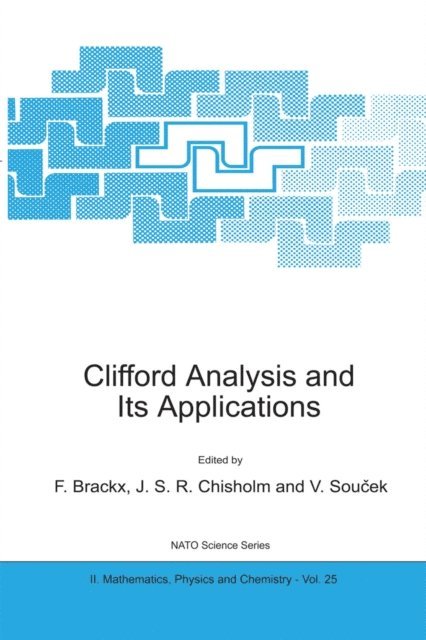
Clifford Analysis and Its Applications
Av F. Brackx, J.S.R. Chisholm m. fl.
Inbunden, 2001
1098 kr
Lägg i varukorg
In its traditional form, Clifford analysis provides the function theory for solutions of the Dirac equation. From the beginning, however, the theory was used and applied to problems in other fields of mathematics, numerical analysis, and mathematical physics. It has enlarged its scope considerably …
Clifford Analysis and Its Applications
Av F. Brackx, J.S.R. Chisholm m. fl.
Häftad, 2001
1098 kr
Lägg i varukorg
In its traditional form, Clifford analysis provides the function theory for solutions of the Dirac equation. From the beginning, however, the theory was used and applied to problems in other fields of mathematics, numerical analysis, and mathematical physics. recently, the theory has enlarged its …
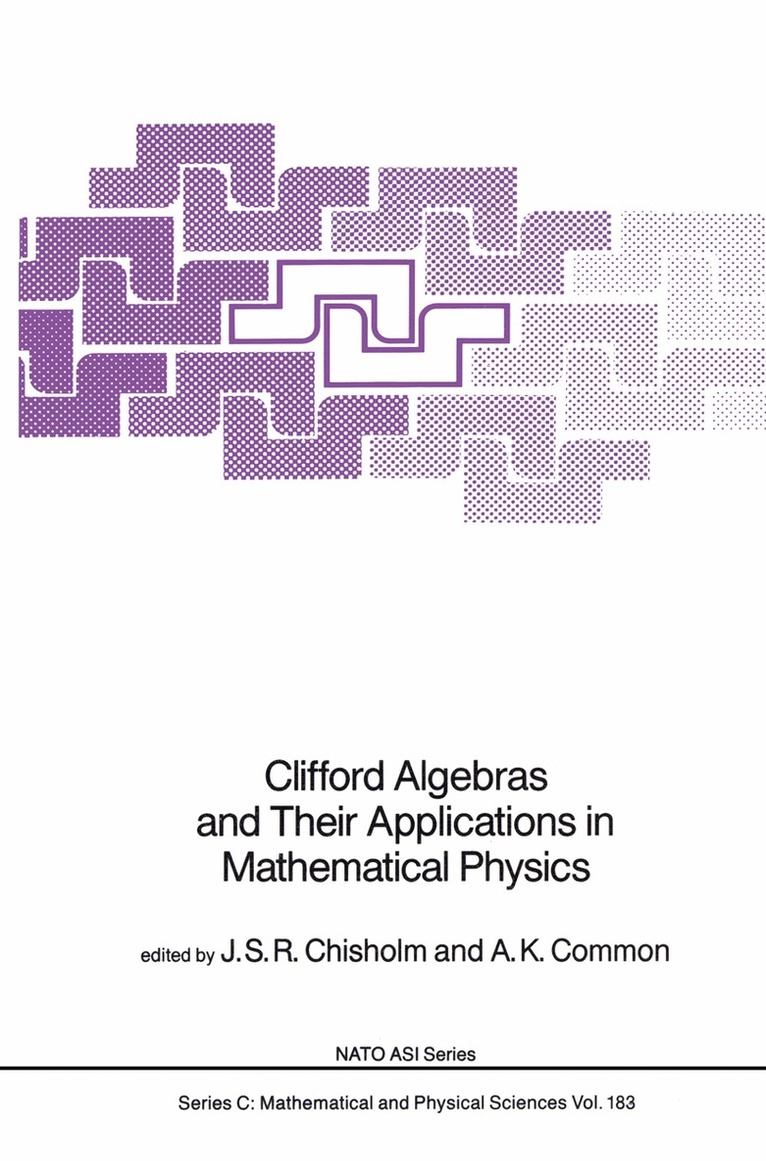
Clifford Algebras and Their Applications in Mathematical Physics
Av J.S.R. Chisholm, A.K. Common
Inbunden, 1986
2188 kr
Lägg i varukorg
William Kingdon Clifford published the paper defining his "geometric algebras" in 1878, the year before his death. Clifford algebra is a generalisation to n-dimensional space of quaternions, which Hamilton used to represent scalars and vectors in real three-space: it is also a development of …
Clifford Algebras and Their Applications in Mathematical Physics
Av A.K. Common, J.S.R. Chisholm
E-bok, 2012
2925 kr
Lägg i varukorg
William Kingdon Clifford published the paper defining his "geometric algebras" in 1878, the year before his death. Clifford algebra is a generalisation to n-dimensional space of quaternions, which Hamilton used to represent scalars and vectors in real three-space: it is also a development of …
Clifford Analysis and Its Applications
Av V. Soucek, J.S.R. Chisholm m. fl.
E-bok, 2012
1459 kr
Lägg i varukorg
In its traditional form, Clifford analysis provides the function theory for solutions of the Dirac equation. From the beginning, however, the theory was used and applied to problems in other fields of mathematics, numerical analysis, and mathematical physics. recently, the theory has enlarged its …
Clifford Algebras and Their Applications in Mathematical Physics
Av J.S.R. Chisholm, A.K. Common
Häftad, 2012
2188 kr
Lägg i varukorg
William Kingdon Clifford published the paper defining his "geometric algebras" in 1878, the year before his death. Clifford algebra is a generalisation to n-dimensional space of quaternions, which Hamilton used to represent scalars and vectors in real three-space: it is also a development of …