
Juan Manuel Vázquez – författare
Visar alla böcker från författaren . Handla med fri frakt och snabb leverans.
5 produkter
5 produkter
Inbunden, Engelska, 2025
2 986 kr
Skickas inom 5-8 vardagar
E-bok
Engelska, 20252 543 kr
Läs direkt efter köp
DAC7 Rules for Digital Platforms: Comparing EU Member States' ImplementationEdited by Juan Manuel Vazquez & Felix Desmyttere Council Directive 2021/514 of the European Union (DAC7) introduces, among other measures, a standardized tax reporting requirement for digital platform operators. Under this requirement, platform operators must collect, validate, keep records, and report to the tax authorities of Member States specific personal and transactional data concerning their sellers. The reported information is then automatically exchanged between tax authorities. This book provides a comprehensive and systematic assessment of how DAC7 rules for digital platforms have been implemented by Member States in their national laws, and examines whether common or divergent approaches and interpretations of specific provisions have emerged. A systematic exploration and comparative analysis of the implementation of DAC7 rules is essential for several reasons, including the following: certain key definitions within DAC7 lack clarity and precision; interpretative and practical guidelines on DAC7 issued by competent Member State authorities are not always aligned; the definitions of some elements of DAC7 rules (e.g., penalties and enforcement) remain a competence of Member States and therefore vary significantly across jurisdictions; and DAC7 rules interact with existing similar legislation and reporting requirements in Member States domestic tax regimes, adding additional layers of complexity. These issues are covered in depth by experts who contribute national reports from 19 EU Member States, combining legal analysis with practical implementation insights. Two introductory chapters provide an overview of DAC7 rules at the EU level and offer a comparative analysis of key differences and similarities in implementation across EU Member States. Visual tools simplify the complex application of DAC7 definitions in practice and facilitate cross-jurisdictional comparison of the Directive s implementation. This book is the result of a conference organized by the Amsterdam Centre for Tax Law (ACTL) of the University of Amsterdam (UvA) in November 2023, under the umbrella of the research project Designing the Tax System for a Cashless, Platform-based and Technology-driven Society (CPT project). The book will be of significant value to a wide range of stakeholders impacted by DAC7. In particular, it will assist businesses operating digital platform (including non-EU-based) in assessing DAC7 related risks and compliance obligations across the European Union, legislators and tax authorities of EU Member States in identifying areas that require further harmonization or clarification, tax lawyers and professionals in managing legal challenges related to DAC7, businesses and individuals selling via digital platforms who may be affected by DAC7 reporting requirements, and academics and researchers interested in tax transparency frameworks and the interaction between tax law, EU law, and platform regulation.
E-bok
PDF, Engelska, 20252 543 kr
Läs direkt efter köp
DAC7 Rules for Digital Platforms: Comparing EU Member States' ImplementationEdited by Juan Manuel Vazquez & Felix Desmyttere Council Directive 2021/514 of the European Union (DAC7) introduces, among other measures, a standardized tax reporting requirement for digital platform operators. Under this requirement, platform operators must collect, validate, keep records, and report to the tax authorities of Member States specific personal and transactional data concerning their sellers. The reported information is then automatically exchanged between tax authorities. This book provides a comprehensive and systematic assessment of how DAC7 rules for digital platforms have been implemented by Member States in their national laws, and examines whether common or divergent approaches and interpretations of specific provisions have emerged. A systematic exploration and comparative analysis of the implementation of DAC7 rules is essential for several reasons, including the following: certain key definitions within DAC7 lack clarity and precision; interpretative and practical guidelines on DAC7 issued by competent Member State authorities are not always aligned; the definitions of some elements of DAC7 rules (e.g., penalties and enforcement) remain a competence of Member States and therefore vary significantly across jurisdictions; and DAC7 rules interact with existing similar legislation and reporting requirements in Member States domestic tax regimes, adding additional layers of complexity. These issues are covered in depth by experts who contribute national reports from 19 EU Member States, combining legal analysis with practical implementation insights. Two introductory chapters provide an overview of DAC7 rules at the EU level and offer a comparative analysis of key differences and similarities in implementation across EU Member States. Visual tools simplify the complex application of DAC7 definitions in practice and facilitate cross-jurisdictional comparison of the Directive s implementation. This book is the result of a conference organized by the Amsterdam Centre for Tax Law (ACTL) of the University of Amsterdam (UvA) in November 2023, under the umbrella of the research project Designing the Tax System for a Cashless, Platform-based and Technology-driven Society (CPT project). The book will be of significant value to a wide range of stakeholders impacted by DAC7. In particular, it will assist businesses operating digital platform (including non-EU-based) in assessing DAC7 related risks and compliance obligations across the European Union, legislators and tax authorities of EU Member States in identifying areas that require further harmonization or clarification, tax lawyers and professionals in managing legal challenges related to DAC7, businesses and individuals selling via digital platforms who may be affected by DAC7 reporting requirements, and academics and researchers interested in tax transparency frameworks and the interaction between tax law, EU law, and platform regulation.
E-bok
Engelska, 20252 362 kr
Läs direkt efter köp
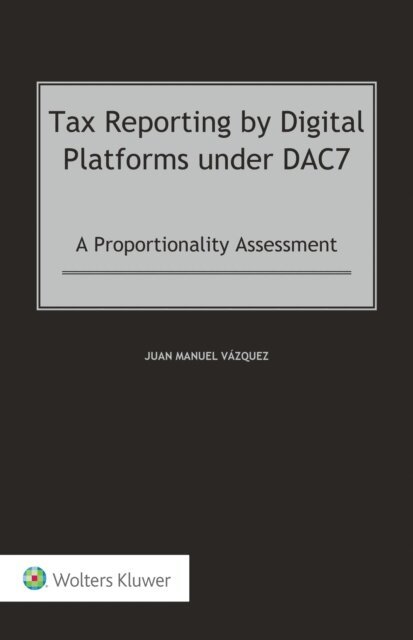
In early 2021, the European Union (EU) introduced a standardized tax reporting requirement for digital platforms through a Council Directive known as DAC7. The rules introduced by this Directive require third-party operators of digital platforms to systematically collect, verify, store, and report specific personal and transactional data about platform sellers to the tax authorities of the Member States. This data is then automatically exchanged between tax authorities. While DAC7 rules for digital platforms pursue a worthy goal (e.g., combating tax evasion) which, at first glance, would justify a public intrusion into the private sphere of both platform sellers and third-party platform operators, a key question that arises is whether such intrusion does not exceed what is necessary in the public interest. This essentially concerns a matter of 'means' and 'ends' or, in other words, of proportionality.This book provides a comprehensive and in-depth assessment of the proportionality of DAC7 rules for digital platforms. It examines whether these rules are aligned with the general EU law principle of proportionality from both a policy and legal perspective and, when this is not the case, it identifies potential improvements that could be made to ensure such alignment.Issues and topics covered by the book include the following: an overview of the platform economy, its EU regulatory landscape and its tax compliance implications; an explanation of the tax information reporting rules for digital platforms under DAC7 and the OECD Model Rules, with practical examples; an analysis of the EU law principle of proportionality and its requirements, both at the policy and legal levels; an assessment of DAC7 s consistency with the proportionality principle; and recommendations for improving DAC7 rules for digital platforms. In its comprehensive, systematic, and in-depth proportionality assessment of DAC7 rules for digital platforms, this book will help policymakers, and citizens navigate these rules, their practical application, and their policy and legal implications.
E-bok
PDF, Engelska, 20252 285 kr
Läs direkt efter köp
In early 2021, the European Union (EU) introduced a standardized tax reporting requirement for digital platforms through a Council Directive known as DAC7. The rules introduced by this Directive require third-party operators of digital platforms to systematically collect, verify, store, and report specific personal and transactional data about platform sellers to the tax authorities of the Member States. This data is then automatically exchanged between tax authorities. While DAC7 rules for digital platforms pursue a worthy goal (e.g., combating tax evasion) which, at first glance, would justify a public intrusion into the private sphere of both platform sellers and third-party platform operators, a key question that arises is whether such intrusion does not exceed what is necessary in the public interest. This essentially concerns a matter of 'means' and 'ends' or, in other words, of proportionality.This book provides a comprehensive and in-depth assessment of the proportionality of DAC7 rules for digital platforms. It examines whether these rules are aligned with the general EU law principle of proportionality from both a policy and legal perspective and, when this is not the case, it identifies potential improvements that could be made to ensure such alignment.Issues and topics covered by the book include the following: an overview of the platform economy, its EU regulatory landscape and its tax compliance implications; an explanation of the tax information reporting rules for digital platforms under DAC7 and the OECD Model Rules, with practical examples; an analysis of the EU law principle of proportionality and its requirements, both at the policy and legal levels; an assessment of DAC7 s consistency with the proportionality principle; and recommendations for improving DAC7 rules for digital platforms. In its comprehensive, systematic, and in-depth proportionality assessment of DAC7 rules for digital platforms, this book will help policymakers, and citizens navigate these rules, their practical application, and their policy and legal implications.