K. E. Bullen – författare
Visar alla böcker från författaren K. E. Bullen. Handla med fri frakt och snabb leverans.
2 produkter
2 produkter
1 216 kr
Skickas inom 5-8 vardagar
This radical revision of Professor Bullen's acclaimed and widely used text provides an introduction to modern seismological theory, with emphasis on both the physical models and the mathematical descriptions of earthquakes and their sources. The essential core of the earlier editions has been retained, particularly the tensor treatment of elasticity, seismic wave travel-time analysis and density in the Earth, although these parts of the text have been brought up to date and expanded. The new part of the book reflects on how the study of earthquakes, seismic waves and seismic risk has been broadened in the past two decades. Thus, this edition includes introductory theory of earthquake sources, seismic wave travel through complex geological zones and viscous and anisotropic media, vibrations of the whole Earth, strong-motion seismology and earthquake prediction and risk. There is an emphasis on statistical and numerical procedures and problems of resolution in inverse theory. Modern class exercises are to be found throughout. The book assumes some background in classical physics and mathematics, including simple differential equations, linear algebra and probability theory. It will be suitable for use in undergraduate courses in geophysics, applied mechanics and geotechnology and for graduate courses in seismology and earthquake engineering. In addition, it will serve as a reference text on seismological problems for professionals concerned with earthquakes, Earth structure and wave motion.
535 kr
Skickas inom 10-15 vardagar
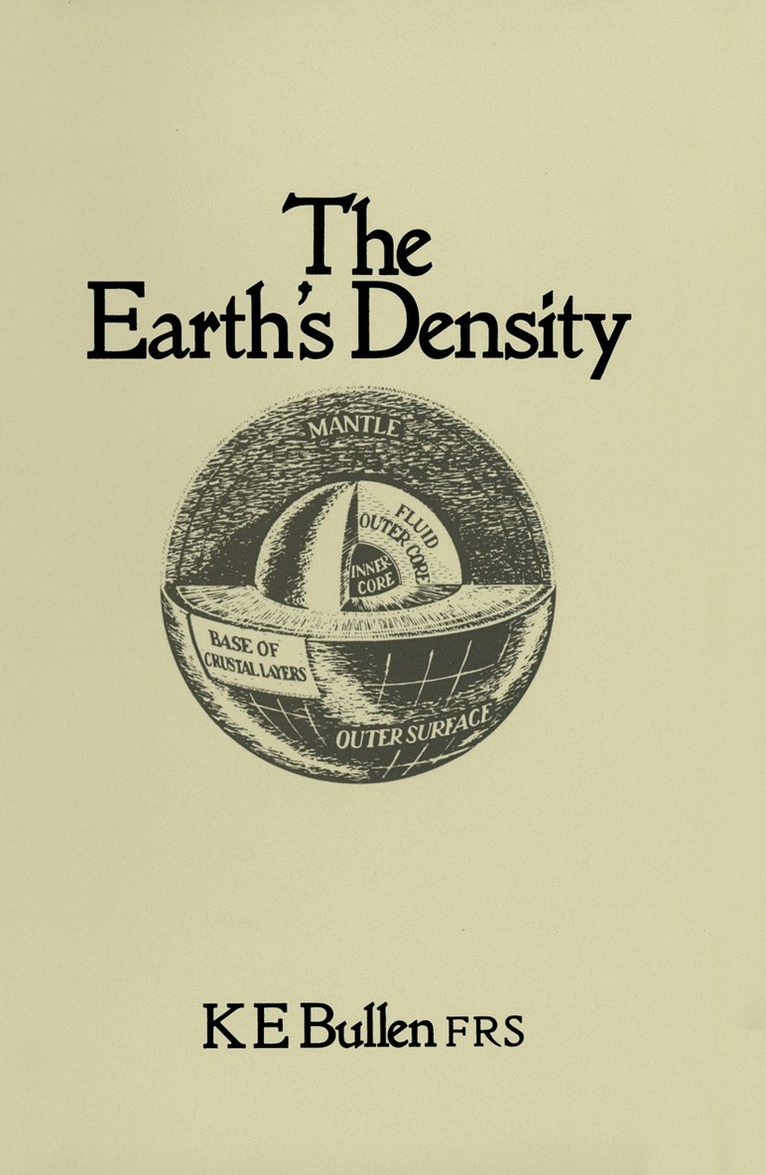
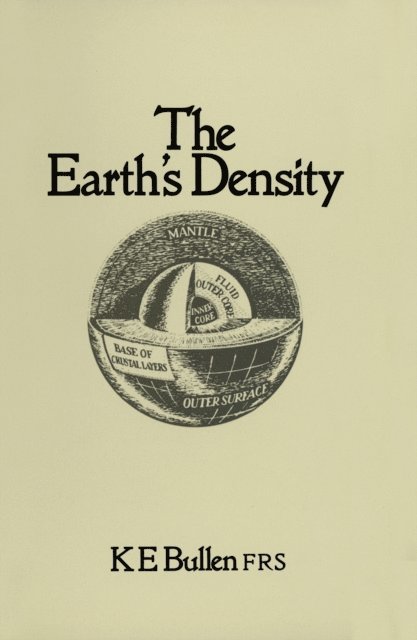
The book attempts to draw together the various strands of evidence that have led to present knowledge of the distribution of density throughout the interior of the Earth. Details are also given of other properties with which the density is closely linked, including pressure, compressibility and compression, rigidity, seismic velocities, Poisson's ratio and gravitational intensity. Questions of thermodynamics and chemical composition and phase enter discussions where they bear more or less sharply on the density determination; but the book does not purport to be a comprehensive text on the Earth's internal tem perature distribution and composition. The density distributions of other planets are discussed. The quest for clues on the Earth's internal densities has long been an exciting one, and an aim of the book is to present a developing story which has fascinated the author over much of his worl(ing life. The early chapters refer to key developments from ancient times to around 1930. The later chapters recount, in greater detail, develop ments since 1930. The stage has now been reached where numerous published papers bearing on the Earth's density seem to do little more than fidget around the resolving power of long accumulated observational data. So the present seems an appropriate time to try to put some perspec tive into the story. Of course, the story will never be quite finished: in describing the interior of the Earth, there will always be extra decimal places to add as further significant evidence arises.