K. Ritter – författare
Visar alla böcker från författaren K. Ritter. Handla med fri frakt och snabb leverans.
3 produkter
3 produkter
E-bok
PDF, Engelska, 20141 015 kr
Läs direkt efter köp
Nonlinear Programming contains the proceedings of a Symposium on Nonlinear Programming held in Madison, Wisconsin on May 4-6, 1970. This book emphasizes algorithms and related theories that lead to efficient computational methods for solving nonlinear programming problems. This compilation consists of 17 chapters. Chapters 1 to 9 are concerned primarily with computational algorithms, while Chapters 10 to 13 are devoted to theoretical aspects of nonlinear programming. Certain applications of nonlinear programming are considered in Chapters 14 to 17. The algorithms for nonlinear constraint problems, investigation of convergence rates, and use of nonlinear programming for approximation are also covered in this text. This publication is a good source for students and researchers concerned with nonlinear programming.
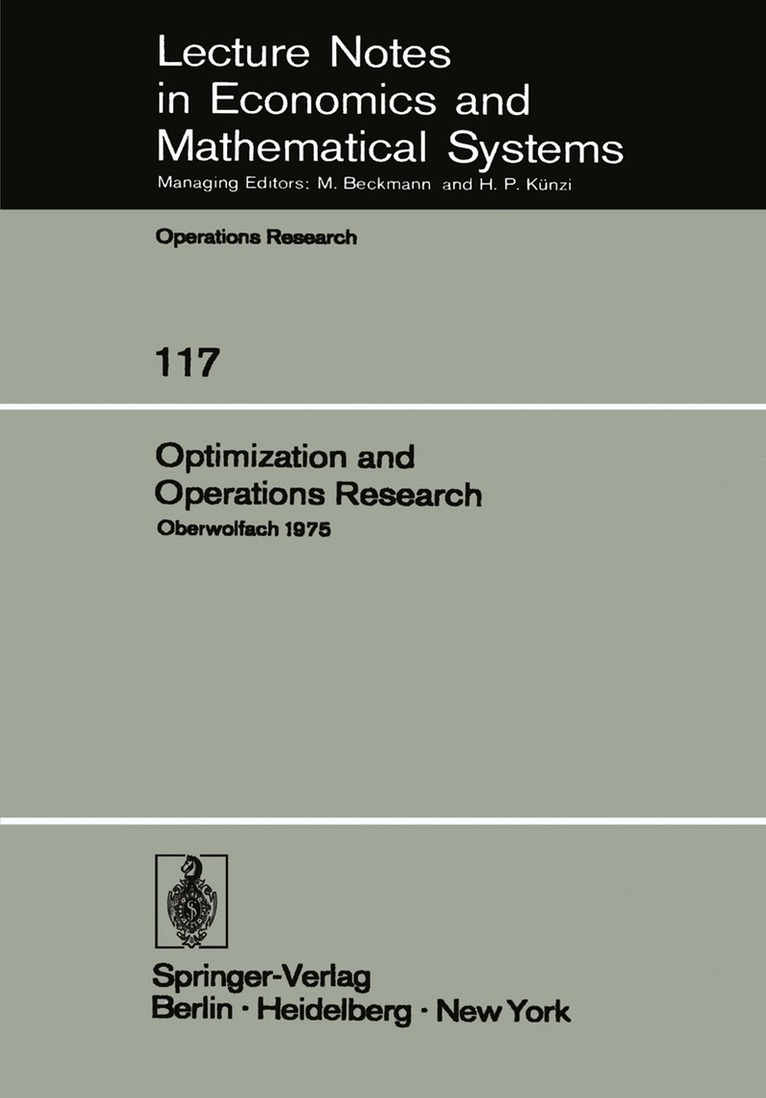
Del 117 - Lecture Notes in Economics and Mathematical Systems
Optimization and Operations Research
Proceedings of a Conference Held at Oberwolfach, July 27–August 2, 1975
Häftad, Engelska, 1976
559 kr
Skickas inom 10-15 vardagar
The variable metric algorithm is widely recognised as one of the most efficient ways of solving the following problem:- Locate x* a local minimum point n ( 1) of f(x) x E R Considerable attention has been given to the study of the convergence prop- ties of this algorithm especially for the case where analytic expressions are avai- ble for the derivatives g. = af/ax. i 1 ••• n • (2) ~ ~ In particular we shall mention the results of Wolfe (1969) and Powell (1972), (1975). Wolfe established general conditions under which a descent algorithm will converge to a stationary point and Powell showed that two particular very efficient algorithms that cannot be shown to satisfy \,olfe's conditions do in fact converge to the minimum of convex functions under certain conditions. These results will be st- ed more completely in Section 2. In most practical problems analytic expressions for the gradient vector g (Equ. 2) are not available and numerical derivatives are subject to truncation error. In Section 3 we shall consider the effects of these errors on Wolfe's convergent prop- ties and will discuss possible modifications of the algorithms to make them reliable in these circumstances. The effects of rounding error are considered in Section 4, whilst in Section 5 these thoughts are extended to include the case of on-line fu- tion minimisation where each function evaluation is subject to random noise.
E-bok
PDF, Engelska, 2012734 kr
Läs direkt efter köp
The variable metric algorithm is widely recognised as one of the most efficient ways of solving the following problem:- Locate x* a local minimum point n ( 1) of f(x) x E R Considerable attention has been given to the study of the convergence prop- ties of this algorithm especially for the case where analytic expressions are avai- ble for the derivatives g. = af/ax. i 1 ••• n • (2) ~ ~ In particular we shall mention the results of Wolfe (1969) and Powell (1972), (1975). Wolfe established general conditions under which a descent algorithm will converge to a stationary point and Powell showed that two particular very efficient algorithms that cannot be shown to satisfy \,olfe''s conditions do in fact converge to the minimum of convex functions under certain conditions. These results will be st- ed more completely in Section 2. In most practical problems analytic expressions for the gradient vector g (Equ. 2) are not available and numerical derivatives are subject to truncation error. In Section 3 we shall consider the effects of these errors on Wolfe''s convergent prop- ties and will discuss possible modifications of the algorithms to make them reliable in these circumstances. The effects of rounding error are considered in Section 4, whilst in Section 5 these thoughts are extended to include the case of on-line fu- tion minimisation where each function evaluation is subject to random noise.