Kamran Khan – författare
Visar alla böcker från författaren Kamran Khan. Handla med fri frakt och snabb leverans.
13 produkter
13 produkter
Inbunden, Engelska, 2019
1 668 kr
Skickas
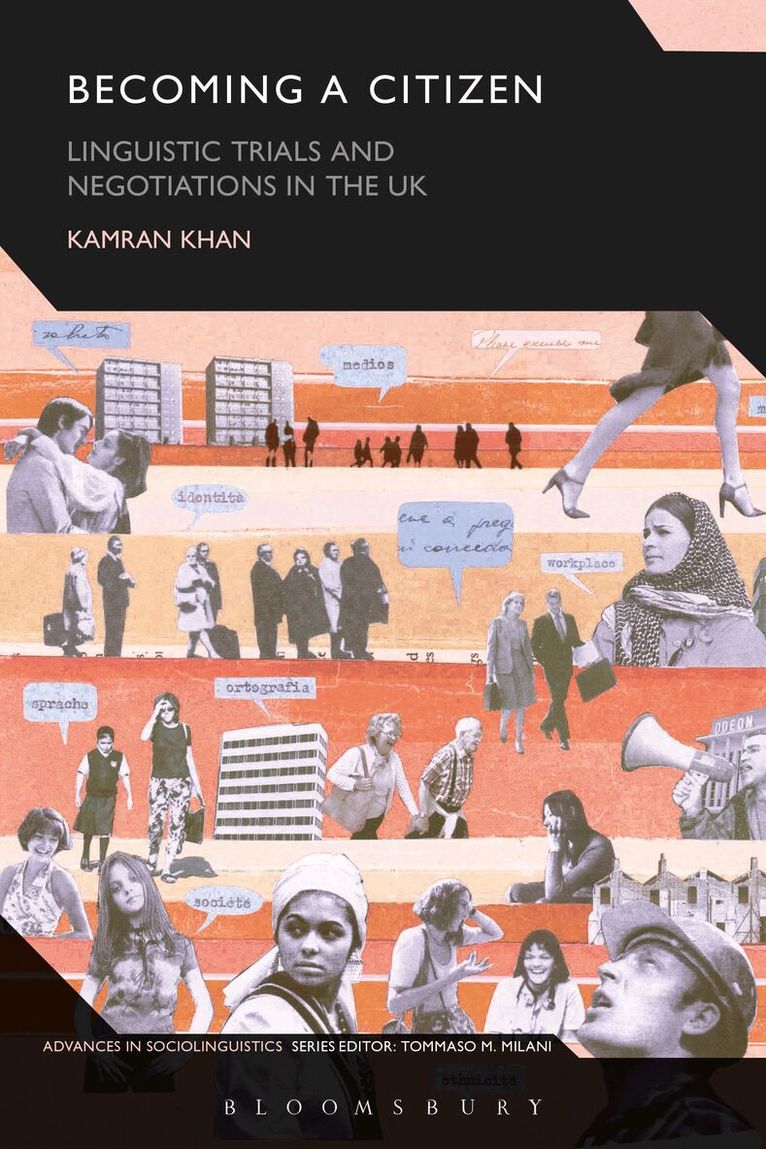
This book explores the process of acquiring UK citizenship and investigates how the naturalisation process is experienced, with an explicit focus on language practices. This ethnographically-informed study focuses on W, a Yemeni immigrant in the UK, during the final phase of the citizenship process. In this time, he encounters linguistic trials and tests involving the Life in the UK citizenship test, community life, ESOL (English for Speakers of Other Languages), adult education and the citizenship ceremony. The richness of linguistic data featured in this book allows for a nuanced portrayal of the complexities of becoming a citizen. This is especially so in the context of the UK’s assimilationist form of citizenship which is reflected in the introduction of a citizenship test within a broader socio-political climate.Becoming a Citizen offers a detailed analysis of the linguistic process of naturalisation in the the UK and is relevant to scholars working in sociolinguistics, language policy, migration studies and ethnographic research.
E-bok
Engelska, 2019515 kr
Läs direkt efter köp
This book explores the process of acquiring UK citizenship and investigates how the naturalisation process is experienced, with an explicit focus on language practices. This ethnographically-informed study focuses on W, a Yemeni immigrant in the UK, during the final phase of the citizenship process. In this time, he encounters linguistic trials and tests involving the Life in the UK citizenship test, community life, ESOL (English for Speakers of Other Languages), adult education and the citizenship ceremony. The richness of linguistic data featured in this book allows for a nuanced portrayal of the complexities of becoming a citizen. This is especially so in the context of the UK''s assimilationist form of citizenship which is reflected in the introduction of a citizenship test within a broader socio-political climate.Becoming a Citizen offers a detailed analysis of the linguistic process of naturalisation in the the UK and is relevant to scholars working in sociolinguistics, language policy, migration studies and ethnographic research.
E-bok
PDF, Engelska, 2019515 kr
Läs direkt efter köp
This book explores the process of acquiring UK citizenship and investigates how the naturalisation process is experienced, with an explicit focus on language practices. This ethnographically-informed study focuses on W, a Yemeni immigrant in the UK, during the final phase of the citizenship process. In this time, he encounters linguistic trials and tests involving the Life in the UK citizenship test, community life, ESOL (English for Speakers of Other Languages), adult education and the citizenship ceremony. The richness of linguistic data featured in this book allows for a nuanced portrayal of the complexities of becoming a citizen. This is especially so in the context of the UK''s assimilationist form of citizenship which is reflected in the introduction of a citizenship test within a broader socio-political climate.Becoming a Citizen offers a detailed analysis of the linguistic process of naturalisation in the the UK and is relevant to scholars working in sociolinguistics, language policy, migration studies and ethnographic research.
Häftad, Engelska, 2020
480 kr
Skickas inom 10-15 vardagar
This book explores the process of acquiring UK citizenship and investigates how the naturalisation process is experienced, with an explicit focus on language practices. This ethnographically-informed study focuses on W, a Yemeni immigrant in the UK, during the final phase of the citizenship process. In this time, he encounters linguistic trials and tests involving the Life in the UK citizenship test, community life, ESOL (English for Speakers of Other Languages), adult education and the citizenship ceremony. The richness of linguistic data featured in this book allows for a nuanced portrayal of the complexities of becoming a citizen. This is especially so in the context of the UK’s assimilationist form of citizenship which is reflected in the introduction of a citizenship test within a broader socio-political climate.Becoming a Citizen offers a detailed analysis of the linguistic process of naturalisation in the the UK and is relevant to scholars working in sociolinguistics, language policy, migration studies and ethnographic research.
Inbunden, Engelska, 2025
493 kr
Skickas inom 7-10 vardagar
Learn how the good guys implement cryptography and how the bad guys exploit it. In Hacking Cryptography you'll find unique guidance for creating strong cryptography that can withstand attempts to exploit it including: DUAL_EC_DRBG random number generator using Go's elliptic curve library Exploiting the RC4 stream cipher, as used in WEP Block ciphers for padding oracle attacks and manipulation of initialization-vectors Exploiting hash functions by using extension and rainbow table attacks Implementing RSA key generation using the Miller-Rabin primality test and exploiting it using the Weiner attack Exploiting PKCS1.5 padding by using Bleichenbacher's chosen-ciphertext attack Implementing Diffie-Hellman Key Exchange and breaking it using a MITM parameter injection attack Theoretically strong cryptography often becomes vulnerable to exploitation as soon as it's built into real applications and networks. Hacking Cryptography details dozens of practical cryptographic implementations and then breaks down the flaws that adversaries use to exploit them. You'll learn just what it takes to write cryptographically secure code, build an intuition for spotting potential vulnerabilities, and master techniques to avoid the pitfalls that leave your systems at risk. About the technology: Everything we do in the digital world is protected by cryptography. It is the final and most reliable defense of our data, and it is often impossible to break in its pure mathematical form. Unfortunately, life is different outside the lab. Implementing cryptography in code and hardware is never perfect, and any crack is an invitation for a would-be attacker's exploitation.
E-bok
Engelska, 2025467 kr
Läs direkt efter köp
Learn how the good guys implement cryptography and how the bad guys exploit it.Everything we do in the digital world is protected by cryptography. But when pure math and algorithms are implemented in code, vulnerabilities emerge and can be exploited by hackers and bad actors. Hacking Cryptography details dozens of practical cryptographic implementations and then breaks down the flaws that adversaries use to exploit them. In Hacking Cryptography you’ll find unique guidance for understanding how cryptography has failed time and again, including: • DUAL_EC_DRBG random number generation using backdoored constants • Exploiting the RC4 stream cipher, as used in WEP • Block ciphers for padding oracle attacks and manipulation of initialization-vectors • Exploiting hash functions by using length extension and rainbow table attacks • Implementing RSA key generation vulnerable to short private exponents and exploiting it using the Weiner attack • Exploiting PKCS1.5 padding by using Bleichenbacher''s signature-forgery attack In Hacking Cryptography you’ll learn the common attack principles used against cryptographic security, and how to spot the implementation errors that make cryptography unsecure. Throughout, you’ll explore historical examples where popular cryptography has failed, such as the root key compromise for Sony PlayStation 3, and see what impact those failures have had on modern cryptography. About the technology Even the strongest cryptographic systems in code and hardware leave cracks and vulnerabilities a would-be attacker can exploit. In this book, you’ll learn to write cryptographically secure code, sidestep common pitfalls, and assess new bugs and vulnerabilities as they are discovered. About the book Hacking Cryptography helps you secure your systems by revealing the “lockpicks” bad actors use to break cryptographic security. It dives deep into each exploit, explaining complex concepts through real-world analogies, annotated examples, and pseudo-code—no advanced mathematical knowledge required. As you read, authors Kamran Khan and Bill Cox demystify opaque cryptography concepts and techniques so you’ll understand the “why” behind each best practice. What''s inside • Random number generator and backdoor constants • RC4 encryption and WiFi security • Rainbow tables for cracking hashed passwords • Length extension and padding oracle exploits About the reader For software and security engineers. Examples in Go. About the author Kamran Khan is a software engineer with more than a decade of experience at Salesforce, Google, and Microsoft. Bill Cox is a software engineer with nearly forty years of experience in securing hardware and software. He conducts the crypto-writing workshop at Google. Table of Contents 1 Introduction 2 Random number generators 3 Implementing and exploiting RNGs 4 Stream ciphers 5 Block ciphers 6 Hash functions 7 Message authentication codes 8 Public-key cryptography 9 Digital signatures 10 Guidelines and common pitfalls for cryptographic implementations
Häftad, Tyska, 2025
510 kr
Skickas inom 5-8 vardagar
Häftad, Franska, 2025
510 kr
Skickas inom 5-8 vardagar
Häftad, Italienska, 2025
510 kr
Skickas inom 5-8 vardagar
Häftad, Polska, 2025
510 kr
Skickas inom 5-8 vardagar
Häftad, Portugisiska, 2025
510 kr
Skickas inom 5-8 vardagar
Häftad, Engelska, 2025
115 kr
Skickas inom 5-8 vardagar
E-bok
Engelska33 kr
Läs direkt efter köp