Karl Brunnholzl – författare
Visar alla böcker från författaren Karl Brunnholzl. Handla med fri frakt och snabb leverans.
12 produkter
12 produkter
E-bok
Engelska, 2012580 kr
Läs direkt efter köp
The Abhisamayalamkara summarizes all the topics in the vast body of the prajñaparamita sutras. Resembling a zip-file, it comes to life only through its Indian and Tibetan commentaries. Together, these texts not only discuss the "hidden meaning" of the prajñaparamita sutras—the paths and bhumis of sravakas, pratyekabuddhas, and bodhisattvas—but also serve as contemplative manuals for the explicit topic of these sutras—emptiness—and how it is to be understood on the progressive levels of realization of bodhisattvas. Thus these texts describe what happens in the mind of a bodhisattva who meditates on emptiness, making it a living experience from the beginner''s stage up through buddhahood. Groundless Paths contains the first in-depth study of the Abhisamayalamkara (the text studied most extensively in higher Tibetan Buddhist education) and its commentaries from the perspective of the Nyingma School of Tibetan Buddhism. This study consists mainly of translations of Maitreya''s famous text and two commentaries on it by Patrul Rinpoche. These are supplemented by three short texts on the paths and bhumis by the same author, as well as extensive excerpts from commentaries by six other Nyingma masters, including Mipham Rinpoche. Thus this book helps close a long-standing gap in the modern scholarship on the prajñaparamita sutras and the literature on paths and bhumis in mahayana Buddhism. Arya Maitreya''s Ornament of Clear Realization, with its Indian and Tibetan commentaries, presents the complex dynamics of the path to liberation as a succession of realizations of the empty nature of all phenomena. This presentation is a powerful antidote to whatever two-dimensional views we might hold about spiritual experience and the journey to enlightenment.
E-bok
Engelska, 2011474 kr
Läs direkt efter köp
The Abhisamayalamkara summarizes all the topics in the vast body of the Prajnaparamita Sutras. Resembling a zip-file, it comes to life only through its Indian and Tibetan commentaries. Together, these texts not only discuss the "hidden meaning" of the Prajnaparamita Sutras—the paths and bhumis of sravakas, pratyekabuddhas, and bodhisattvas—but also serve as contemplative manuals for the explicit topic of these sutras—emptiness—and how it is to be understood on the progressive levels of realization of bodhisattvas. Thus these texts describe what happens in the mind of a bodhisattva who meditates on emptiness, making it a living experience from the beginner''s stage up through buddhahood. Gone Beyond contains the first in-depth study of the Abhisamayalamkara (the text studied most extensively in higher Tibetan Buddhist education) and its commentaries in the Kagyu School. This study (in two volumes) includes translations of Maitreya''s famous text and its commentary by the Fifth Shamarpa Goncho Yenla (the first translation ever of a complete commentary on the Abhisamayalamkara into English), which are supplemented by extensive excerpts from the commentaries by the Third, Seventh, and Eighth Karmapas and others. Thus it closes a long-standing gap in the modern scholarship on the Prajnaparamita Sutras and the literature on paths and bhumis in mahayana Buddhism. The first volume presents an English translation of the first three chapters of the Abhisamayalamkara and its commentary by the Fifth Shamarpa. The second volume presents an English translation of the final five chapters and its commentary by the Fifth Shamarpa.
E-bok
Engelska, 2012474 kr
Läs direkt efter köp
The Abhisamayalamkara summarizes all the topics in the vast body of the Prajnaparamita Sutras. Resembling a zip-file, it comes to life only through its Indian and Tibetan commentaries. Together, these texts not only discuss the "hidden meaning" of the Prajnaparamita Sutras—the paths and bhumis of sravakas, pratyekabuddhas, and bodhisattvas—but also serve as contemplative manuals for the explicit topic of these sutras—emptiness—and how it is to be understood on the progressive levels of realization of bodhisattvas. Thus these texts describe what happens in the mind of a bodhisattva who meditates on emptiness, making it a living experience from the beginner''s stage up through buddhahood. Gone Beyond contains the first in-depth study of the Abhisamayalamkara (the text studied most extensively in higher Tibetan Buddhist education) and its commentaries in the Kagyu School. This study (in two volumes) includes translations of Maitreya''s famous text and its commentary by the Fifth Shamarpa Goncho Yenla (the first translation ever of a complete commentary on the Abhisamayalamkara into English), which are supplemented by extensive excerpts from the commentaries by the Third, Seventh, and Eighth Karmapas and others. Thus it closes a long-standing gap in the modern scholarship on the Prajnaparamita Sutras and the literature on paths and bhumis in mahayana Buddhism. The first volume presents an English translation of the first three chapters of the Abhisamayalamkara and its commentary by the Fifth Shamarpa. The second volume presents an English translation of the final five chapters and its commentary by the Fifth Shamarpa.
E-bok
Engelska, 2013415 kr
Läs direkt efter köp
Maitreya’s Distinction between Phenomena and the Nature of Phenomena distinguishes the illusory phenomenal world of sa?s?ra produced by the confused dualistic mind from the ultimate reality that is mind’s true nature. The transition from the one to the other is the process of "mining for wisdom within delusion." Maitreya’s text calls this "the fundamental change," which refers to the vanishing of delusive appearances through practicing the path, thus revealing the underlying changeless nature of these appearances. In this context, the main part of the text consists of the most detailed explanation of nonconceptual wisdom—the primary driving force of the path as well as its ultimate result—in Buddhist literature. The introduction of the book discusses these two topics (fundamental change and nonconceptual wisdom) at length and shows how they are treated in a number of other Buddhist scriptures. The three translated commentaries, by Vasubandhu, the Third Karmapa, Rangjung Dorje, and Gö Lots?wa, as well as excerpts from all other available commentaries on Maitreya’s text, put it in the larger context of the Indian Yog?c?ra School and further clarify its main themes. They also show how this text is not a mere scholarly document, but an essential foundation for practicing both the s?tray?na and the vajray?na and thus making what it describes a living experience. The book also discusses the remaining four of the five works of Maitreya, their transmission from India to Tibet, and various views about them in the Tibetan tradition.
E-bok
Engelska, 2016225 kr
Läs direkt efter köp
The radical message of the Heart S?tra, one of Buddhism''s most famous texts, is a sweeping attack on everything we hold most dear: our troubles, the world as we know it, even the teachings of the Buddha himself. Several of the Buddha''s followers are said to have suffered heart attacks and died when they first heard its assertion of the basic groundlessness of our existence—hence the title of this book. Overcoming fear, the Buddha teaches, is not to be accomplished by shutting down or building walls around oneself, but instead by opening up to understand the illusory nature of everything we fear—including ourselves. In this book of teachings, Karl Brunnhölzl guides practitioners through this ''crazy'' sutra to the wisdom and compassion that lie at its core.
E-bok
Engelska, 2021334 kr
Läs direkt efter köp
E-bok
Engelska, 2018134 kr
Läs direkt efter köp
A key Dzogchen text—available together with its Tibetan commentaries, including from the fifteenth Karmapa—from a preeminent translator.The Aspiration Prayer of Samantabhadra, one of the most famous and often-recited Dzogchen texts, is at once an entreaty by the primordial buddha, Samantabhadra, that all sentient beings recognize the nature of their minds and thus become buddhas, and also a wake-up call by our own buddha nature itself. This monumental text outlines the profound view of Dzogchen in a nutshell and, at the same time, provides clear instructions on how to discover the wisdom of a buddha in the very midst of afflictions. In this volume, Karl Brunnhölzl offers translations of three versions of the Aspiration Prayer and accompanies them with translations of the commentaries by Jigmé Lingpa, the Fifteenth Karmapa, and Tsültrim Sangpo. He offers further contextualization with his rich annotation and appendices, which include additional translation from Jigmé Lingpa, Longchenpa, and Patrul Rinpoche. This comprehensive, comprehensible book illuminates this profound text and greatly furthers our understanding of Dzogchen—and of our own nature.
E-bok
Engelska, 2021134 kr
Läs direkt efter köp
Lion's Roar says, "This book is a treasure of subtle revelation."The view is the wisdom of being empty Meditation is luminosity without fixation Conduct is a continual flow free of attachment Fruition is nakedness bare of any stain This is the first stanza of Milarepa’s Ultimate View, Meditation, Conduct, and Fruition: pith instructions originally sang to the great yogi Rechungpa, Milarepa’s disciple. These teachings are Milarepa’s direct offering to his disciple of his own profound realization, gained after many years of dedicated practice. Karl Brunnhölzl, acclaimed translator and senior teacher at the Nalandabodhi community of Dzogchen Ponlop Rinpoche, calls this hard-earned understanding “kungfu”: “Gong means ‘skillful work,’ ‘hard training,’ or ‘endeavor,’ and fu means ‘time spent...’ The term refers to Milarepa’s diligent and skillful training in the techniques to realize the nature of his mind and benefit countless sentient beings.” Ultimate View, Meditation, Conduct, and Fruition is a work of remarkable depth and clarity. In just five verses, Milarepa gives incisive instructions for progressing and for avoiding pitfalls in the stages of practice: - View: the basis or ground from which the proper meditation, conduct, and fruition of mahamudra can arise - Meditation: the training in or the familiarization with that view - Conduct: the natural outflow of having familiarized with the view in meditation - Fruition: the final outcome of having fully assimilated and realized the view, whose essence is not different from it
E-bok
Engelska, 2024602 kr
Läs direkt efter köp
The second volume in a historic six-volume series containing many of the first English translations of the classic Mahamudra literature compiled by the Seventh Karmapa.Sounds of Innate Freedom: The Indian Texts of Mahamudra are historic volumes containing many of the first English translations of the classic Mahamudra literature. The texts and songs in these volumes constitute the large compendium called The Indian Texts of the Mahamudra of Definitive Meaning, compiled by the Seventh Karmapa Chötra Gyatso (1456–1539). Translated, introduced, and annotated by Karl Brunnhölzl, acclaimed senior teacher at the Nalandabodhi community of Dzogchen Ponlop Rinpoche, the collection offers a brilliant window into the richness of the vast ocean of Indian Mahamudra texts cherished in all Tibetan lineages, particularly in the Kagyü tradition, giving us a clear view of the sources of one of the world’s great contemplative traditions. This volume 2 (thirty-four texts) contains two long-established sets of Mahamudra works: “The Sixfold Pith Cycle” and short texts of Maitripa’s “Twenty-Five Dharmas of Mental Nonengagement,” which present a blend of Madhyamaka, Mahamudra, and certain tantric principles, as well as two commentaries by Maitripa’s students. The vital focus of this volume is the accomplishment of true reality.
E-bok
Engelska, 2023602 kr
Läs direkt efter köp
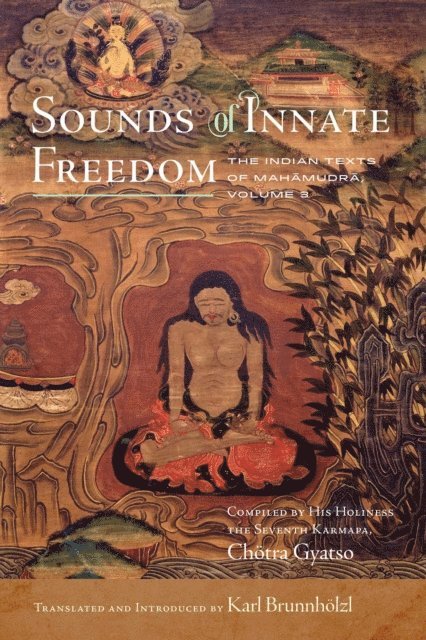
The third volume in a historic six-volume series containing many of the first English translations of the classic mahamudra literature compiled by the Seventh Karmapa.Sounds of Innate Freedom: The Indian Texts of Mahamudra are historic volumes containing many of the first English translations of the classic mahamudra literature. The texts and songs in these volumes constitute the large compendium called The Indian Texts of the Mahamudra of Definitive Meaning, compiled by the Seventh Karmapa Chötra Gyatso (1456–1539). Translated, introduced, and annotated by Karl Brunnhölzl, acclaimed senior teacher at the Nalandabodhi community of Dzogchen Ponlop Rinpoche, the collection offers a brilliant window into the richness of the vast ocean of Indian mahamudra texts cherished in all Tibetan lineages, particularly in the Kagyu tradition, giving us a clear view of the sources of one of the world’s great contemplative traditions. This third volume contains twenty-four texts, the bulk of which are dohas by Saraha and commentaries on them, as well as works by other renowned Indian Buddhist mahasiddhas such as Naropa, Krsna, and Sakyasribhadra. The extensive commentaries brilliantly unravel enigmas and bring clarity to the songs they comment on as well as to many other songs of realization in the series. These expressive songs of the inexpressible offer readers a feast of profound and powerful pith instructions uttered by numerous male and female mahasiddhas, yogis, and dakinis, often in the context of ritual ganacakras and initially kept in their secret treasury. Displaying a vast range of themes, styles, and metaphors, they all point to the single true nature of the mind—mahamudra—in inspiring ways and from different angles, using a dazzling array of skillful means to penetrate the sole vital point of buddhahood being found nowhere but within our own mind. Reading and singing these songs of mystical wonder, bliss, and ecstatic freedom and contemplating their meaning will open doors to spiritual experience for us today just as it has for countless practitioners in the past.
E-bok
Engelska, 2021164 kr
Läs direkt efter köp
The second volume in an historic and noteworthy 6-volume series containing many of the first English translations of the classic mahamudra literature compiled by the Seventh Karmapa as well as extensive commentary that brilliantly unravels enigmas and clarifies cryptic verses.Sounds of Innate Freedom: The Indian Texts of Mahamudra are historic volumes containing many of the first English translations of classic mahamudra literature. The texts and songs in these volumes constitute the large compendium called The Indian Texts of the Mahamudra of Definitive Meaning, compiled by the Seventh Karmapa, Chötra Gyatso (1456–1539). The collection offers a brilliant window into the richness of the vast ocean of Indian mahamudra texts cherished in all Tibetan lineages, particularly in the Kagyü tradition, giving us a clear view of the sources of one of the world’s great contemplative traditions. Besides the individual dohas (couplets), vajragitis (vajra songs), and caryagitis (conduct songs) in this second volume in publication, the three extensive commentaries it contains brilliantly unravel enigmas and bring clarity not only to the specific songs they comment on but to many other, often cryptic, songs of realization in this collection. These expressive songs of the inexpressible offer readers a feast of profound and powerful pith instructions uttered by numerous male and female mahasiddhas, yogis, and dakinis, often in the context of ritual ganacakras and initially kept in their secret treasury. Displaying a vast range of themes, styles, and metaphors, they all point to the single true nature of the mind—mahamudra—in inspiring ways and from different angles, using a dazzling array of skillful means to penetrate the sole vital point of buddhahood being found nowhere but within our own mind. Reading and singing these songs of mystical wonder, bliss, and ecstatic freedom, and contemplating their meaning, will open doors to spiritual experience for us today just as it has for countless practitioners in the past.
E-bok
Tyska, 2014193 kr
Läs direkt efter köp
Die radikale Botschaft des Herz-Sutra, eines der berühmtesten Texte des Buddhismus, ist ein Angriff auf alles, was uns lieb und teuer ist: unsere Schwierigkeiten, die Welt, wie wir sie kennen, und sogar die Lehren des Buddha selbst. In seinen Kommentaren führt Karl Brunnhölzl durch dieses "verrückte" Sutra zu der Weisheit und dem Mitgefühl, die seinen Kern ausmachen.