Kay Owens – författare
Visar alla böcker från författaren Kay Owens. Handla med fri frakt och snabb leverans.
10 produkter
Mathematics Education in a Neocolonial Country: The Case of Papua New Guinea
Av Patricia Paraide, Kay Owens m. fl.
Inbunden, 2023
1423 kr
Lägg i varukorg
Most education research is undertaken in western developed countries. While some research from developing countries does make it into research journals from time to time, but these articles only emphasize the rarity of research in developing countries. The proposed book is unique in that it will …
Mathematics Education in a Neocolonial Country: The Case of Papua New Guinea
Av Christopher Owens, Philip Clarkson m. fl.
E-bok, 2023
1734 kr
Lägg i varukorg
Most education research is undertaken in western developed countries. While some research from developing countries does make it into research journals from time to time, but these articles only emphasize the rarity of research in developing countries. The proposed book is unique in that it will …
Mathematics Education in a Neocolonial Country: The Case of Papua New Guinea
Av Patricia Paraide, Kay Owens
2023
667 kr
Lägg i varukorg
Mathematics Education in a Neocolonial Country: The Case of Papua New Guinea
Av Patricia Paraide, Kay Owens m. fl.
Häftad, 2024
1423 kr
Lägg i varukorg
Most education research is undertaken in western developed countries. While some research from developing countries does make it into research journals from time to time, but these articles only emphasize the rarity of research in developing countries. The proposed book is unique in that it will …
Visuospatial Reasoning
An Ecocultural Perspective for Space, Geometry and Measurement Education
Av Kay Owens
Inbunden, 2014
1096 kr
Lägg i varukorg
This book develops the theoretical perspective on visuospatial reasoning in ecocultural contexts, granting insights on how the language, gestures, and representations of different cultures reflect visuospatial reasoning in context. For a number of years, two themes in the field of mathematics …
Visuospatial Reasoning
An Ecocultural Perspective for Space, Geometry and Measurement Education
Av Kay Owens
E-bok, 2014
1459 kr
Lägg i varukorg
This book develops the theoretical perspective on visuospatial reasoning in ecocultural contexts, granting insights on how the language, gestures, and representations of different cultures reflect visuospatial reasoning in context. For a number of years, two themes in the field of mathematics …
Visuospatial Reasoning
An Ecocultural Perspective for Space, Geometry and Measurement Education
Av Kay Owens
Häftad, 2016
1096 kr
Lägg i varukorg
This book develops the theoretical perspective on visuospatial reasoning in ecocultural contexts, granting insights on how the language, gestures, and representations of different cultures reflect visuospatial reasoning in context. For a number of years, two themes in the field of mathematics …
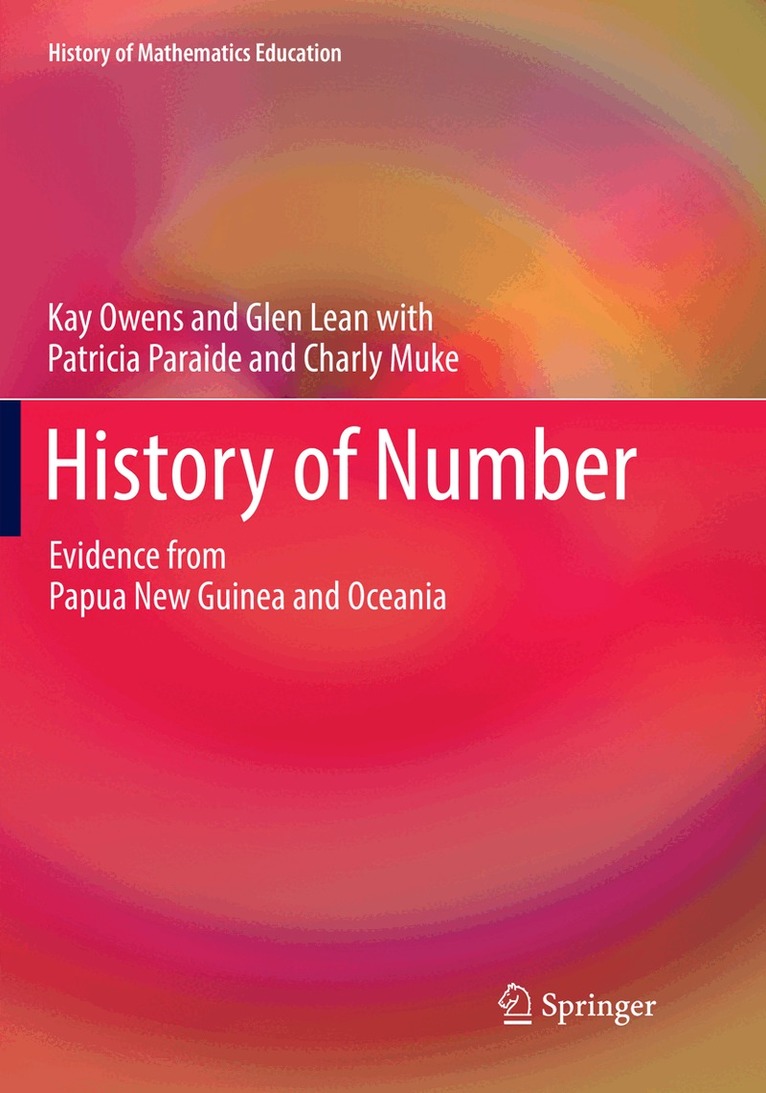
History of Number
Evidence from Papua New Guinea and Oceania
Av Kay Owens, Glen Lean m. fl.
Inbunden, 2017
1423 kr
Lägg i varukorg
This unique volume presents an ecocultural and embodied perspective on understanding numbers and their history in indigenous communities. The book focuses on research carried out in Papua New Guinea and Oceania, and will help educators understand humanity's use of numbers, and their development and …
History of Number
Evidence from Papua New Guinea and Oceania
Av Charly Muke, Patricia Paraide m. fl.
E-bok, 2017
1746 kr
Lägg i varukorg
This unique volume presents an ecocultural and embodied perspective on understanding numbers and their history in indigenous communities. The book focuses on research carried out in Papua New Guinea and Oceania, and will help educators understand humanity''s use of numbers, and their development …
History of Number
Evidence from Papua New Guinea and Oceania
Av Kay Owens, Glen Lean m. fl.
Häftad, 2018
1423 kr
Lägg i varukorg
This unique volume presents an ecocultural and embodied perspective on understanding numbers and their history in indigenous communities. The book focuses on research carried out in Papua New Guinea and Oceania, and will help educators understand humanity's use of numbers, and their development and …