Kazuo Murota – författare
1 277 kr
Skickas inom 10-15 vardagar
2 901 kr
Skickas inom 10-15 vardagar
1 513 kr
Läs direkt efter köp
Bifurcation and Buckling in Structures describes the theory and analysis of bifurcation and buckling in structures. Emphasis is placed on a general procedure for solving nonlinear governing equations and an analysis procedure related to the finite-element method. Simple structural examples using trusses, columns, and frames illustrate the principles.
Part I presents fundamental issues such as the general mathematical framework for bifurcation and buckling, procedures for the buckling load/mode analyses, and numerical analysis procedures to trace the solution curves and switch to bifurcation solutions. Advanced topics include asymptotic theory of bifurcation and bifurcation theory of symmetric systems.
Part II deals with buckling of perfect and imperfect structures. An overview of the member buckling of columns and beams is provided, followed by the buckling analysis of truss and frame structures. The worst and random imperfections are studied as advanced topics. An extensive review of the history of buckling is presented.
This text is ideal for advanced undergraduate and graduate students in engineering and applied mathematics. To assist readers, problems are listed at the end of each chapter, and their answers are given at the end of the book.
Kiyohiro Ikeda is Professor Emeritus at Tohoku University, Japan.
Kazuo Murota is a Project Professor at the Institute of Statistical Mathematics, Japan, as well as Professor Emeritus at the University of Tokyo, Kyoto University, and Tokyo Metropolitan University, Japan.
1 513 kr
Läs direkt efter köp
Bifurcation and Buckling in Structures describes the theory and analysis of bifurcation and buckling in structures. Emphasis is placed on a general procedure for solving nonlinear governing equations and an analysis procedure related to the finite-element method. Simple structural examples using trusses, columns, and frames illustrate the principles.
Part I presents fundamental issues such as the general mathematical framework for bifurcation and buckling, procedures for the buckling load/mode analyses, and numerical analysis procedures to trace the solution curves and switch to bifurcation solutions. Advanced topics include asymptotic theory of bifurcation and bifurcation theory of symmetric systems.
Part II deals with buckling of perfect and imperfect structures. An overview of the member buckling of columns and beams is provided, followed by the buckling analysis of truss and frame structures. The worst and random imperfections are studied as advanced topics. An extensive review of the history of buckling is presented.
This text is ideal for advanced undergraduate and graduate students in engineering and applied mathematics. To assist readers, problems are listed at the end of each chapter, and their answers are given at the end of the book.
Kiyohiro Ikeda is Professor Emeritus at Tohoku University, Japan.
Kazuo Murota is a Project Professor at the Institute of Statistical Mathematics, Japan, as well as Professor Emeritus at the University of Tokyo, Kyoto University, and Tokyo Metropolitan University, Japan.
1 029 kr
Läs direkt efter köp
1 043 kr
Skickas inom 5-8 vardagar
1 140 kr
Läs direkt efter köp
1 899 kr
Skickas inom 5-8 vardagar
Imperfect Bifurcation in Structures and Materials
Engineering Use of Group-Theoretic Bifurcation Theory
815 kr
Skickas inom 10-15 vardagar
712 kr
Läs direkt efter köp
This book provides a modern static imperfect bifurcation theory applicable to bifurcation phenomena of physical and engineering problems and fills the gap between the mathematical theory and engineering practice.
Systematic methods based on asymptotic, probabilistic, and group theoretic standpoints are used to examine experimental and computational data from numerous examples, such as soil, sand, kaolin, honeycomb, and domes. For mathematicians, static bifurcation theory for finite-dimensional systems, as well as its applications for practical problems, is illuminated by numerous examples. Engineers may find this book, with its minimized mathematical formalism, to be a useful introduction to modern bifurcation theory.
This third edition strengthens group representation and group-theoretic bifurcation theory. Several large scale applications have been included in association with the progress of computational powers. Problems and answers have been provided.
Review of First Edition:
"The book is unique in considering the experimental identification of material-dependent bifurcations in structures such as sand, Kaolin (clay), soil and concrete shells. … These are studied statistically. … The book is an excellent source of practical applications for mathematicians working in this field. … A short set of exercises at the end of each chapter makes the book more useful as a text. The book is well organized and quite readable for non-specialists."
Henry W. Haslach, Jr., Mathematical Reviews, 2003
Imperfect Bifurcation in Structures and Materials
Engineering Use of Group-Theoretic Bifurcation Theory
546 kr
Skickas inom 10-15 vardagar
Systems Analysis by Graphs and Matroids
Structural Solvability and Controllability
1 084 kr
Skickas inom 10-15 vardagar
1 945 kr
Skickas inom 10-15 vardagar
1 514 kr
Skickas inom 10-15 vardagar
1 825 kr
Läs direkt efter köp
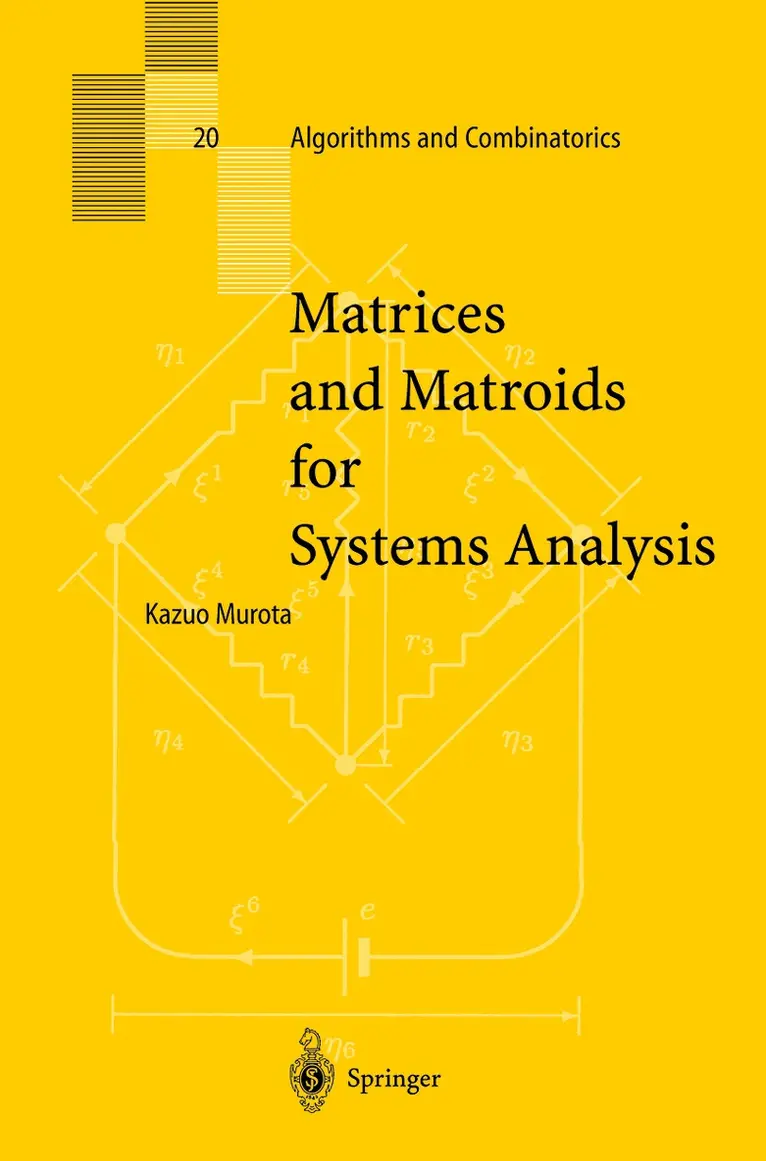
A matroid is an abstract mathematical structure that captures combinatorial properties of matrices. This book offers a unique introduction to matroid theory, emphasizing motivations from matrix theory and applications to systems analysis.
This book serves also as a comprehensive presentation of the theory and application of mixed matrices, developed primarily by the present author in the 1990''s. A mixed matrix is a convenient mathematical tool for systems analysis, compatible with the physical observation that "fixed constants" and "system parameters" are to be distinguished in the description of engineering systems.
This book will be extremely useful to graduate students and researchers in engineering, mathematics and computer science.
From the reviews:
"…The book has been prepared very carefully, contains a lot of interesting results and is highly recommended for graduate and postgraduate students."
András Recski, Mathematical Reviews Clippings 2000m:93006
1 416 kr
Läs direkt efter köp
1 084 kr
Skickas inom 10-15 vardagar
1 416 kr
Läs direkt efter köp
This book contributes to an understanding of how bifurcation theory adapts to the analysis of economic geography. It is easily accessible not only to mathematicians and economists, but also to upper-level undergraduate and graduate students who are interested in nonlinear mathematics. The self-organization of hexagonal agglomeration patterns of industrial regions was first predicted by the central place theory in economic geography based on investigations of southern Germany. The emergence of hexagonal agglomeration in economic geography models was envisaged by Krugman. In this book, after a brief introduction of central place theory and new economic geography, the missing link between them is discovered by elucidating the mechanism of the evolution of bifurcating hexagonal patterns. Pattern formation by such bifurcation is a well-studied topic in nonlinear mathematics, and group-theoretic bifurcation analysis is a well-developed theoretical tool. A finite hexagonal lattice is used to express uniformly distributed places, and the symmetry of this lattice is expressed by a finite group. Several mathematical methodologies indispensable for tackling the present problem are gathered in a self-contained manner. The existence of hexagonal distributions is verified by group-theoretic bifurcation analysis, first by applying the so-called equivariant branching lemma and next by solving the bifurcation equation. This book offers a complete guide for the application of group-theoretic bifurcation analysis to economic agglomeration on the hexagonal lattice.
1 084 kr
Skickas inom 10-15 vardagar
1 400 kr
Skickas inom 3-6 vardagar
1 253 kr
Skickas
769 kr
Skickas
769 kr
Skickas
1 607 kr
Tillfälligt slut