Klaus Frovin Jørgensen - Böcker
Visar alla böcker från författaren Klaus Frovin Jørgensen. Handla med fri frakt och snabb leverans.
8 produkter
8 produkter
1 061 kr
Skickas inom 10-15 vardagar
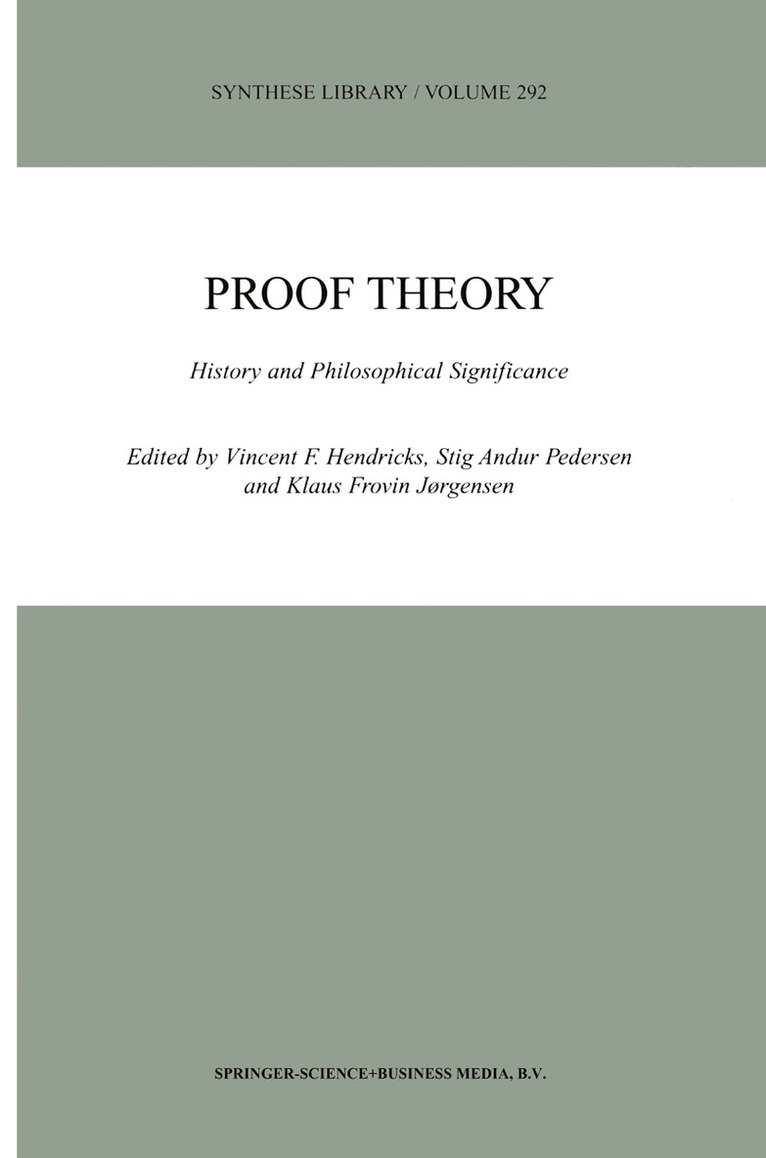
The conference on "Proof Theory: History and Philosophical Significance" held in 1997 at the University of Roskilde, Denmark, tracked the history of proof theory and its role in the analysis of the philosophical foundations of mathematics since Hilbert's original programme to its modern, highly articulated form. This volume is a collection of papers presented at the conference. It should be of interest by philosophers, mathematicians, computer scientists and scholars with no professional training in proof theory, provided they have a general knowledge of foundational issues.
1 061 kr
Skickas inom 10-15 vardagar
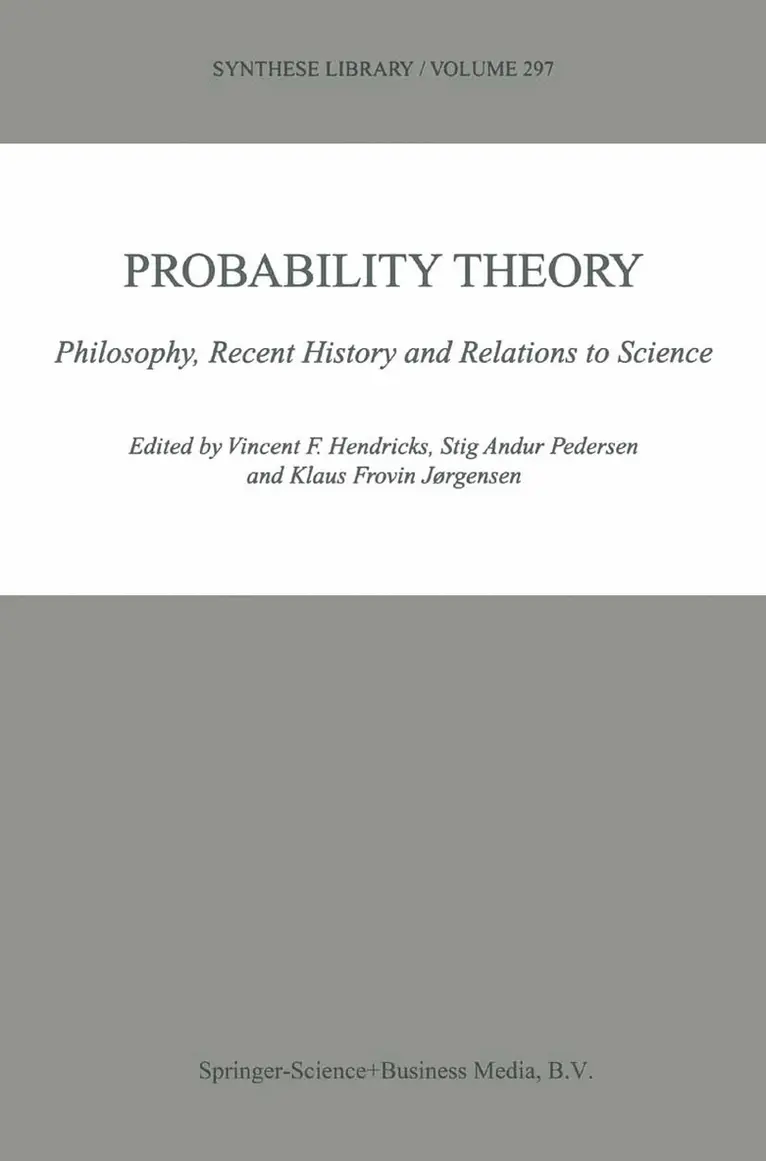
This volume in the Synthese Library Series is the result of a con- ference held at the Roskilde University, Denmark, September 16- 18, 1998. The purpose of this meeting was to shed light on some of the recent issues in probability theory and track their history; to analyze their philosophical and mathematical significance, and to analyze the role of mathematical probability theory in other sciences. Hence the conference was called Probability Theory- Philosophy! Recent History and Relations to Science. The editors would like to thank the invited speakers includ- ing in alphabetical order Prof. N.H. Bingham (BruneI Univer- sity), Prof. Berna KIlmc; (Bogazici University), Prof. Eberhard Knoblock (Techniche Universitat Berlin), Prof. J.B. Paris (Uni- versity of Manchester), Prof. T. Seidenfeld (Carnegie Mellon University), Prof. Glenn Shafer (Rutgers University) and Prof. Volodya Vovk (University of London) for contributing, in the most lucid and encouraging way, to the fulfillment of the con- ference aim. The editors are also grateful to the invited speakers for making their contributions available for publication.The conference was organized by the Danish Network on the History and Philosophy of Mathematics http://mmf.ruc.dkjmathnetj The editors would like to thank the network's organizing com- mittee consisting of Prof. Kirsti Andersen (University of Aarhus), Prof. Jesper Liitzen (University of Copenhagen), Dr. Tinne Hoff Kjeldsen (Roskilde University) and the committee's secretaries Lise Mariane Jeppesen and Jesper Thrane (Roskilde University).
1 061 kr
Skickas inom 10-15 vardagar
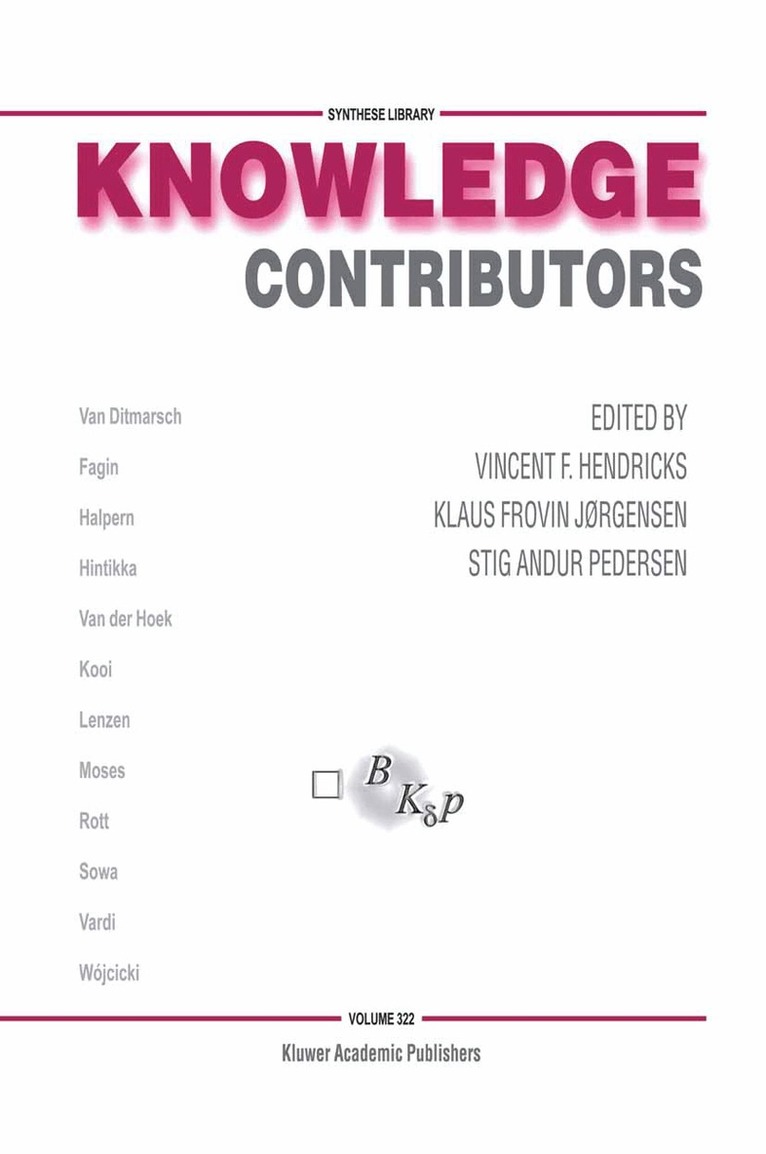
The aim of this thematically unified anthology is to track the history of epistemic logic, to consider some important applications of these logics of knowledge and belief in a variety of fields, and finally to discuss future directions of research with particular emphasis on 'active agenthood' and multi-modal systems. It is accessible to researchers and graduate students in philosophy, computer science, game theory, economics and related disciplines utilizing the means and methods of epistemic logic.
1 061 kr
Skickas inom 10-15 vardagar
The aim of this thematically unified anthology is to track the history of epistemic logic, to consider some important applications of these logics of knowledge and belief in a variety of fields, and finally to discuss future directions of research with particular emphasis on 'active agenthood' and multi-modal systems. It is accessible to researchers and graduate students in philosophy, computer science, game theory, economics and related disciplines utilizing the means and methods of epistemic logic.
Del 327 - Synthese Library
Visualization, Explanation and Reasoning Styles in Mathematics
Inbunden, Engelska, 2005
1 061 kr
Skickas inom 10-15 vardagar
In the 20th century philosophy of mathematics has to a great extent been dominated by views developed during the so-called foundational crisis in the beginning of that century. These views have primarily focused on questions pertaining to the logical structure of mathematics and questions regarding the justi?cation and consistency of mathematics. Paradigmatic in this - spect is Hilbert’s program which inherits from Frege and Russell the project to formalize all areas of ordinary mathematics and then adds the requi- ment of a proof, by epistemically privileged means (?nitistic reasoning), of the consistency of such formalized theories. While interest in modi?ed v- sions of the original foundational programs is still thriving, in the second part of the twentieth century several philosophers and historians of mat- matics have questioned whether such foundational programs could exhaust the realm of important philosophical problems to be raised about the nature of mathematics. Some have done so in open confrontation (and hostility) to the logically based analysis of mathematics which characterized the cl- sical foundational programs, while others (and many of the contributors to this book belong to this tradition) have only called for an extension of the range of questions and problems that should be raised in connection with an understanding of mathematics. The focus has turned thus to a consideration of what mathematicians are actually doing when they produce mathematics. Questions concerning concept-formation, understanding, heuristics, changes instyle of reasoning, the role of analogies and diagrams etc.
1 061 kr
Skickas inom 10-15 vardagar
The conference on Proof Theory: History and Philosophical Significance held in 1997 at the University of Roskilde, Denmark, tracked the history of proof theory and its role in the analysis of the philosophical foundations of mathematics since Hilbert's original program to its modern, highly articulated form. This volume is a collection of papers presented at the conference. It can be read with profit and pleasure by philosophers, mathematicians, computer scientists and scholars with no professional training in proof theory, provided they have a general knowledge of foundational issues.
1 061 kr
Skickas inom 10-15 vardagar
This volume in the Synthese Library Series is the result of a con- ference held at the Roskilde University, Denmark, September 16- 18, 1998. The purpose of this meeting was to shed light on some of the recent issues in probability theory and track their history; to analyze their philosophical and mathematical significance, and to analyze the role of mathematical probability theory in other sciences. Hence the conference was called Probability Theory- Philosophy! Recent History and Relations to Science. The editors would like to thank the invited speakers includ- ing in alphabetical order Prof. N.H. Bingham (BruneI Univer- sity), Prof. Berna KIlmc; (Bogazici University), Prof. Eberhard Knoblock (Techniche Universitat Berlin), Prof. J.B. Paris (Uni- versity of Manchester), Prof. T. Seidenfeld (Carnegie Mellon University), Prof. Glenn Shafer (Rutgers University) and Prof. Volodya Vovk (University of London) for contributing, in the most lucid and encouraging way, to the fulfillment of the con- ference aim. The editors are also grateful to the invited speakers for making their contributions available for publication.The conference was organized by the Danish Network on the History and Philosophy of Mathematics http://mmf.ruc.dkjmathnetj The editors would like to thank the network's organizing com- mittee consisting of Prof. Kirsti Andersen (University of Aarhus), Prof. Jesper Liitzen (University of Copenhagen), Dr. Tinne Hoff Kjeldsen (Roskilde University) and the committee's secretaries Lise Mariane Jeppesen and Jesper Thrane (Roskilde University).
Del 327 - Synthese Library
Visualization, Explanation and Reasoning Styles in Mathematics
Häftad, Engelska, 2010
1 061 kr
Skickas inom 10-15 vardagar
This book contains groundbreaking contributions to the philosophical analysis of mathematical practice. Several philosophers of mathematics have recently called for an approach to philosophy of mathematics that pays more attention to mathematical practice. Questions concerning concept-formation, understanding, heuristics, changes in style of reasoning, the role of analogies and diagrams, etc. have become the subject of intense interest. The historians and philosophers in this book agree that there is more to understanding mathematics than a study of its logical structure. How are mathematical objects and concepts generated? How does the process tie up with justification? What role do visual images and diagrams play in mathematical activity? What are the different epistemic virtues (explanatoriness, understanding, visualizability, etc.) which are pursued and cherished by mathematicians in their work? The reader will find here systematic philosophical analyses as well as a wealth of philosophically informed case studies ranging from Babylonian, Greek, and Chinese mathematics to nineteenth century real and complex analysis.