Krzysztof Maurin – författare
Visar alla böcker från författaren Krzysztof Maurin. Handla med fri frakt och snabb leverans.
6 produkter
6 produkter
Inbunden, Engelska, 1997
1 191 kr
Skickas inom 10-15 vardagar
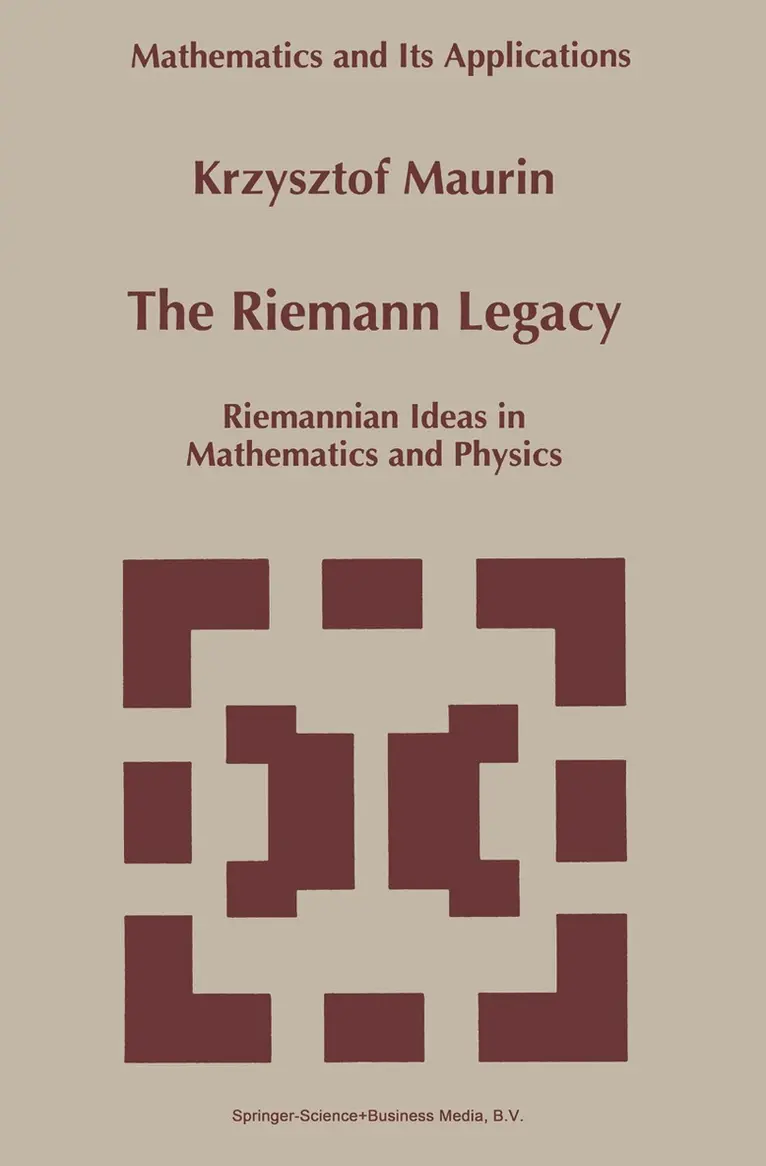
very small domain (environment) affects through analytic continuation the whole of Riemann surface, or analytic manifold . Riemann was a master at applying this principle and also the first who noticed and emphasized that a meromorphic function is determined by its 'singularities'. Therefore he is rightly regarded as the father of the huge 'theory of singularities' which is developing so quickly and whose importance (also for physics) can hardly be overe~timated. Amazing and mysterious for our cognition is the role of Euclidean space. Even today many philosophers believe (following Kant) that 'real space' is Euclidean and other spaces being 'abstract constructs of mathematicians, should not be called spaces'. The thesis is no longer tenable - the whole of physics testifies to that. Nevertheless, there is a grain of truth in the 3 'prejudice': E (three-dimensional Euclidean space) is special in a particular way pleasantly familiar to us - in it we (also we mathematicians!) feel particularly 'confident' and move with a sense of greater 'safety' than in non-Euclidean spaces. For this reason perhaps, Riemann space M stands out among the multitude of 'interesting geometries'. For it is: 1. Locally Euclidean, i. e. , M is a differentiable manifold whose tangent spaces TxM are equipped with Euclidean metric Uxi 2. Every submanifold M of Euclidean space E is equipped with Riemann natural metric (inherited from the metric of E) and it is well known how often such submanifolds are used in mechanics (e. g. , the spherical pendulum).
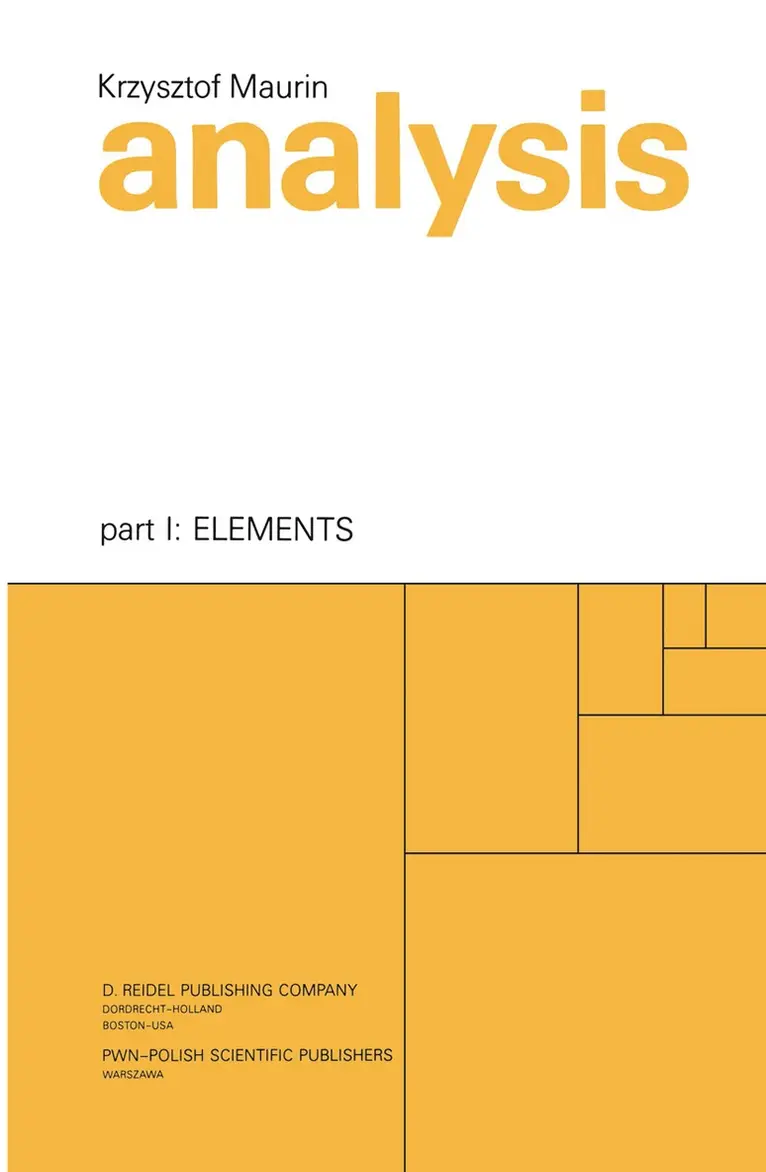
Del 1 - Analysis
Analysis
Part One: Elements
Inbunden, Engelska, 1976
2 176 kr
Skickas inom 10-15 vardagar
Inbunden, Engelska, 1976
1 091 kr
Skickas inom 10-15 vardagar
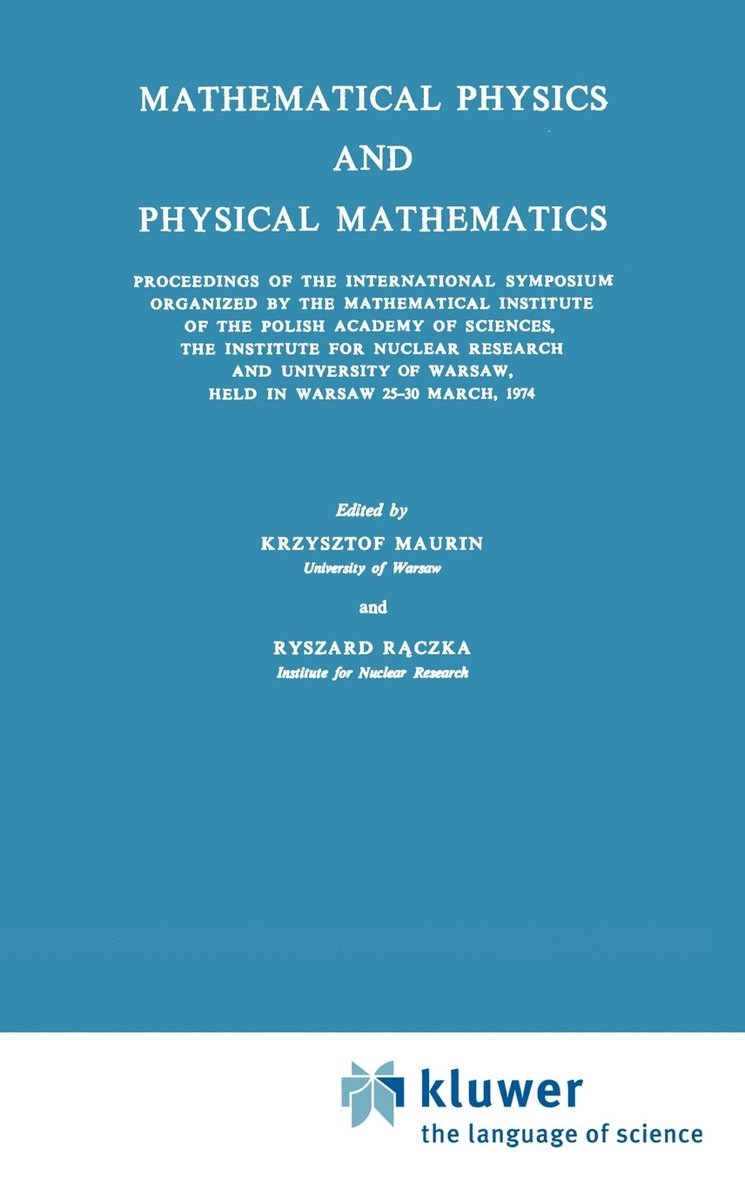
Proceedings of the International Symposium organized by the Mathematical Institute of the Polish Academy of Sciences, The Institute for Nuclear Research, Warsaw, 25-30 March 1974
Inbunden, Engelska, 1980
1 634 kr
Skickas inom 10-15 vardagar
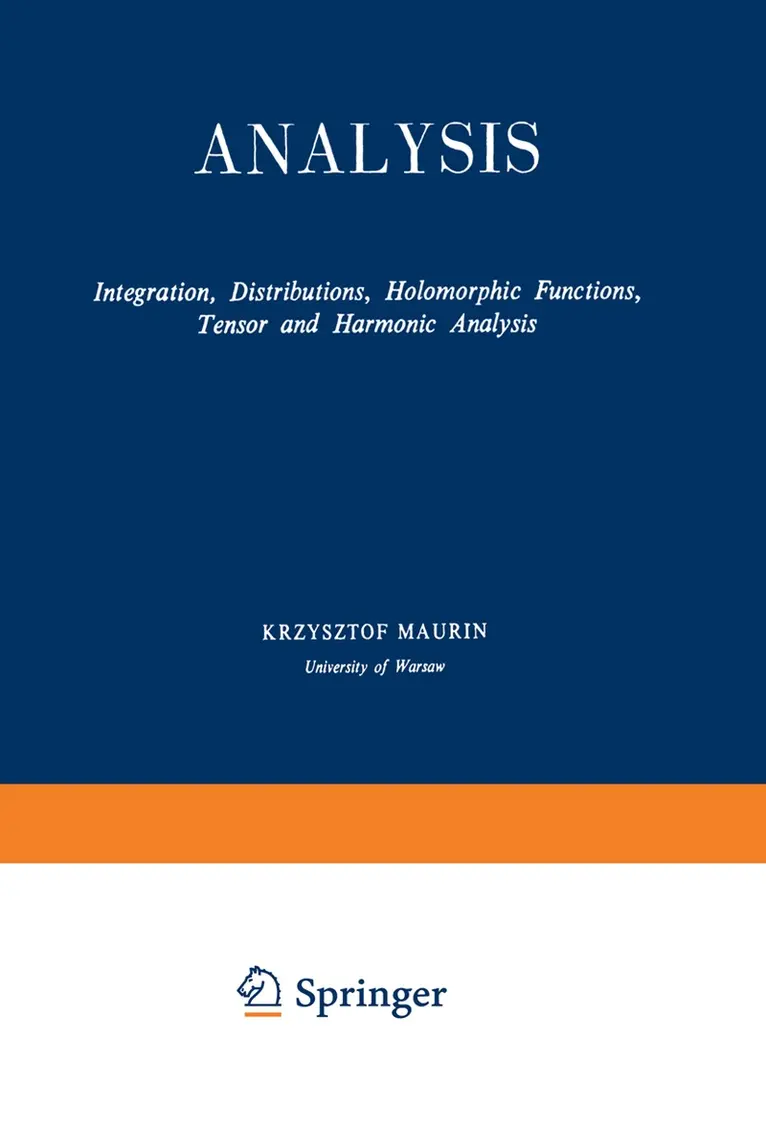
The extraordinarily rapid advances made in mathematics since World War II have resulted in analysis becoming an enormous organism spread ing in all directions. Gone for good surely are the days of the great French "courses of analysis" which embodied the whole of the "ana lytical" knowledge of the times in three volumes-as the classical work of Camille Jordan. Perhaps that is why present-day textbooks of anal ysis are disproportionately modest relative to the present state of the art. More: they have "retreated" to the state before Jordan and Goursat. In recent years the scene has been changing rapidly: Jean Dieudon ne is offering us his monumentel Elements d'Analyse (10 volumes) written in the spirit of the great French Course d'Analyse. To the best of my knowledge, the present book is the only one of its size: starting from scratch-from rational numbers, to be precise-it goes on to the theory of distributions, direct integrals, analysis on com plex manifolds, Kahler manifolds, the theory of sheaves and vector bun dles, etc. My objective has been to show the young reader the beauty and wealth of the unsual world of modern mathematical analysis and to show that it has its roots in the great mathematics of the 19th century and mathematical physics. I do know that the young mind eagerly drinks in beautiful and difficult things, rejoicing in the fact that the world is great and teeming with adventure.
Häftad, Engelska, 2010
1 200 kr
Skickas inom 10-15 vardagar
very small domain (environment) affects through analytic continuation the whole of Riemann surface, or analytic manifold . Riemann was a master at applying this principle and also the first who noticed and emphasized that a meromorphic function is determined by its 'singularities'. Therefore he is rightly regarded as the father of the huge 'theory of singularities' which is developing so quickly and whose importance (also for physics) can hardly be overe~timated. Amazing and mysterious for our cognition is the role of Euclidean space. Even today many philosophers believe (following Kant) that 'real space' is Euclidean and other spaces being 'abstract constructs of mathematicians, should not be called spaces'. The thesis is no longer tenable - the whole of physics testifies to that. Nevertheless, there is a grain of truth in the 3 'prejudice': E (three-dimensional Euclidean space) is special in a particular way pleasantly familiar to us - in it we (also we mathematicians!) feel particularly 'confident' and move with a sense of greater 'safety' than in non-Euclidean spaces. For this reason perhaps, Riemann space M stands out among the multitude of 'interesting geometries'. For it is: 1. Locally Euclidean, i. e. , M is a differentiable manifold whose tangent spaces TxM are equipped with Euclidean metric Uxi 2. Every submanifold M of Euclidean space E is equipped with Riemann natural metric (inherited from the metric of E) and it is well known how often such submanifolds are used in mechanics (e. g. , the spherical pendulum).
E-bok
PDF, Engelska, 20131 487 kr
Läs direkt efter köp
very small domain (environment) affects through analytic continuation the whole of Riemann surface, or analytic manifold . Riemann was a master at applying this principle and also the first who noticed and emphasized that a meromorphic function is determined by its ''singularities''. Therefore he is rightly regarded as the father of the huge ''theory of singularities'' which is developing so quickly and whose importance (also for physics) can hardly be overe~timated. Amazing and mysterious for our cognition is the role of Euclidean space. Even today many philosophers believe (following Kant) that ''real space'' is Euclidean and other spaces being ''abstract constructs of mathematicians, should not be called spaces''. The thesis is no longer tenable - the whole of physics testifies to that. Nevertheless, there is a grain of truth in the 3 ''prejudice'': E (three-dimensional Euclidean space) is special in a particular way pleasantly familiar to us - in it we (also we mathematicians!) feel particularly ''confident'' and move with a sense of greater ''safety'' than in non-Euclidean spaces. For this reason perhaps, Riemann space M stands out among the multitude of ''interesting geometries''. For it is: 1. Locally Euclidean, i. e. , M is a differentiable manifold whose tangent spaces TxM are equipped with Euclidean metric Uxi 2. Every submanifold M of Euclidean space E is equipped with Riemann natural metric (inherited from the metric of E) and it is well known how often such submanifolds are used in mechanics (e. g. , the spherical pendulum).