L L Cavalli-sforza – författare
766 kr
Skickas inom 5-8 vardagar
1 572 kr
Skickas inom 3-6 vardagar
815 kr
Skickas inom 5-8 vardagar
989 kr
Läs direkt efter köp
997 kr
Läs direkt efter köp
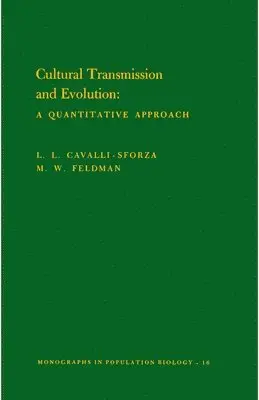
A number of scholars have found that concepts such as mutation, selection, and random drift, which emerged from the theory of biological evolution, may also explain evolutionary phenomena in other disciplines as well. Drawing on these concepts, Professors Cavalli-Sforza and Feldman classify and systematize the various modes of transmitting "culture" and explore their consequences for cultural evolution. In the process, they develop a mathematical theory of the non-genetic transmission of cultural traits that provides a framework for future investigations in quantitative social and anthropological science.The authors use quantitative models that incorporate the various modes of transmission (for example, parent-child, peer-peer, and teacher-student), and evaluate data from sociology, archaeology, and epidemiology in terms of the models. They show that the various modes of transmission in conjunction with cultural and natural selection produce various rates of cultural evolution and various degrees of diversity within and between groups. The same framework can be used for explaining phenomena as apparently unrelated as linguistics, epidemics, social values and customs, and diffusion of innovations. The authors conclude that cultural transmission is an essential factor in the study of cultural change.
370 kr
Skickas inom 5-8 vardagar
1 715 kr
Skickas inom 3-6 vardagar
On Evolutionary Anthropology
Essays in Honor of Harry Hoijer [1983]
420 kr
Skickas inom 5-8 vardagar
On Evolutionary Anthropology
Essays in Honor of Harry Hoijer [1983]
261 kr
Skickas inom 5-8 vardagar
1 136 kr
Läs direkt efter köp
In 1951, the geneticist Luigi Luca Cavalli-Sforza was teaching in Parma when a student--a priest named Antonio Moroni--told him about rich church records of demography and marriages between relatives. After convincing the Church to open its records, Cavalli-Sforza, Moroni, and Gianna Zei embarked on a landmark study that would last fifty years and cover all of Italy. This book assembles and analyzes the team''s research for the first time. Using blood testing as well as church records, the team investigated the frequency of consanguineous marriages and its use for estimating inbreeding and studying the relations between inbreeding and drift. They tested the importance of random genetic drift by studying population structure through demography of the last three centuries, using it to predict the spatial variation of frequencies of genetic markers. The authors find that drift-related genetic variation, including its stabilization by migration, is best predicted by computer simulation. They also analyze the usefulness and limits of the concept of deme for defining Mendelian populations. The genetic effect of consanguineous marriage on recessive genetic diseases and for the detection of dominance in metric characters are also studied. Ultimately bringing together the many strands of their massive project, Cavalli-Sforza, Moroni, and Zei are able to map genetic drift in all of Italy''s approximately 8,000 communes and to demonstrate the relationship between each locality''s drift and various ecological and demographic factors. In terms of both methods and findings, their accomplishment is tremendously important for understanding human social structure and the genetic effects of drift and inbreeding.
393 kr
Läs direkt efter köp