L. Vollrath – författare
Visar alla böcker från författaren L. Vollrath. Handla med fri frakt och snabb leverans.
6 produkter
6 produkter
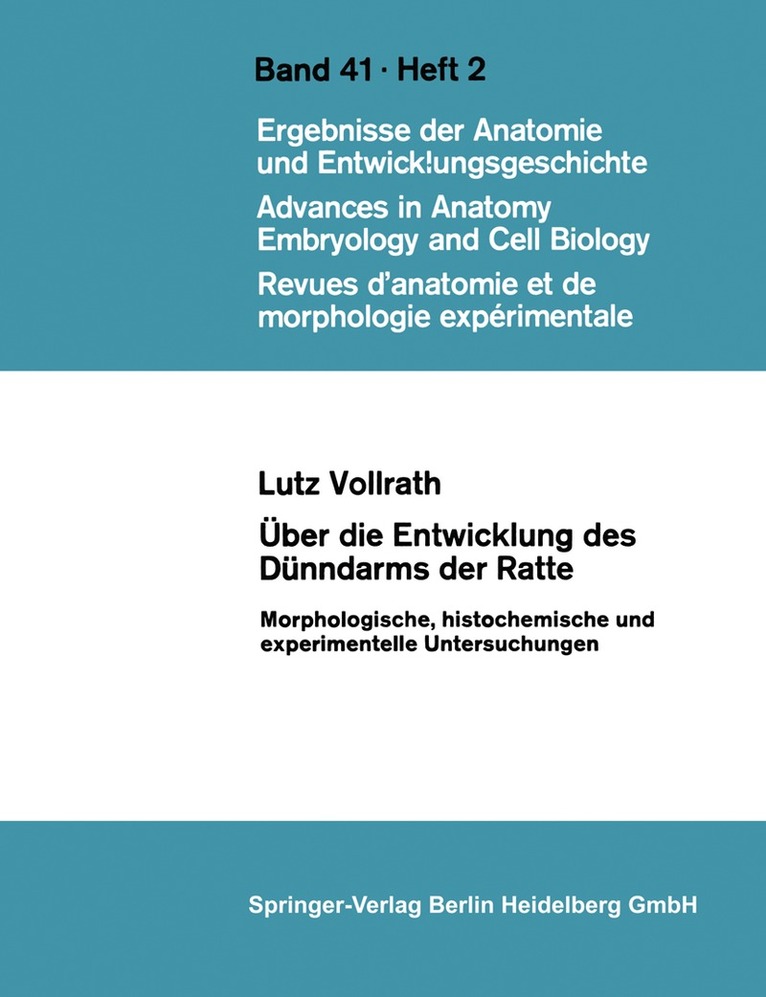
Häftad, Tyska, 1969
576 kr
Skickas inom 10-15 vardagar
E-bok
PDF, Tyska, 2013535 kr
Läs direkt efter köp
In der letzten Auflage des Handbuchs der inneren Medizin aus dem Jahre 1953 wurden im Rahmen der Abhandlung der Verdauungskrankheiten dem Dünn- und Dickdarm von NORBERT HENNING und W. BAUMANN insgesamt 270 Seiten gewidmet. Nach 30 Jahren haben unsere Kenntnisse über Funktion, Pathophysiologie, Ätiologie, Pathogenese, Diagnostik und Therapie von Er krankungen des Dünndarmes so erheblich zugenommen, daß den Erkrankungen des Dünndarmes ein eigener Doppelband gewidmet werden mußte. Der Dünndarm hat eine zentrale Stellung nicht nur in der Assimilation von Nahrungsstoffen, sondern spielt auch eine wichtige Rolle als Immunorgan, ist inzwischen zu einem der größten hormonproduzierenden Organ geworden, Sekretionsmechanismen sind von eminenter Bedeutung bei Diarrhöen, der Dünndarm spielt eine wichtige Rolle im Lipidstoffwechsel. Die Gliederung und Zusammenstellung des Bandes basiert auf zwei Prinzi pien, die vom Herausgeber als wesentlich erachtet werden: 1. Die Qualität der praktischen Medizin ist abhängig vom Verständnis medi zinisch-wissenschaftlicher Grundlagen, denn Fortschritte in der klinischen Medi zin basieren fast immer auf wissenschaftlicher Grundlage. 2. Krankheiten oder Störungen physiologischer Zustände sollten kritisch betrachtet werden, bevor über sie einer professionellen Leser- oder Zuhö rerschaft berichtet wird. Langerwiesene Konzepte der Pathogenese und Therapie müssen immer wie der neu und kritisch auf ihre Gültigkeit geprüft werden. Besonderer Wert wurde deshalb vom Herausgeber auf die profunde Erarbei tung pathophysiologischer Grundlagen gelegt, die Voraussetzung sind für eine rationale Diagnostik und Therapie.
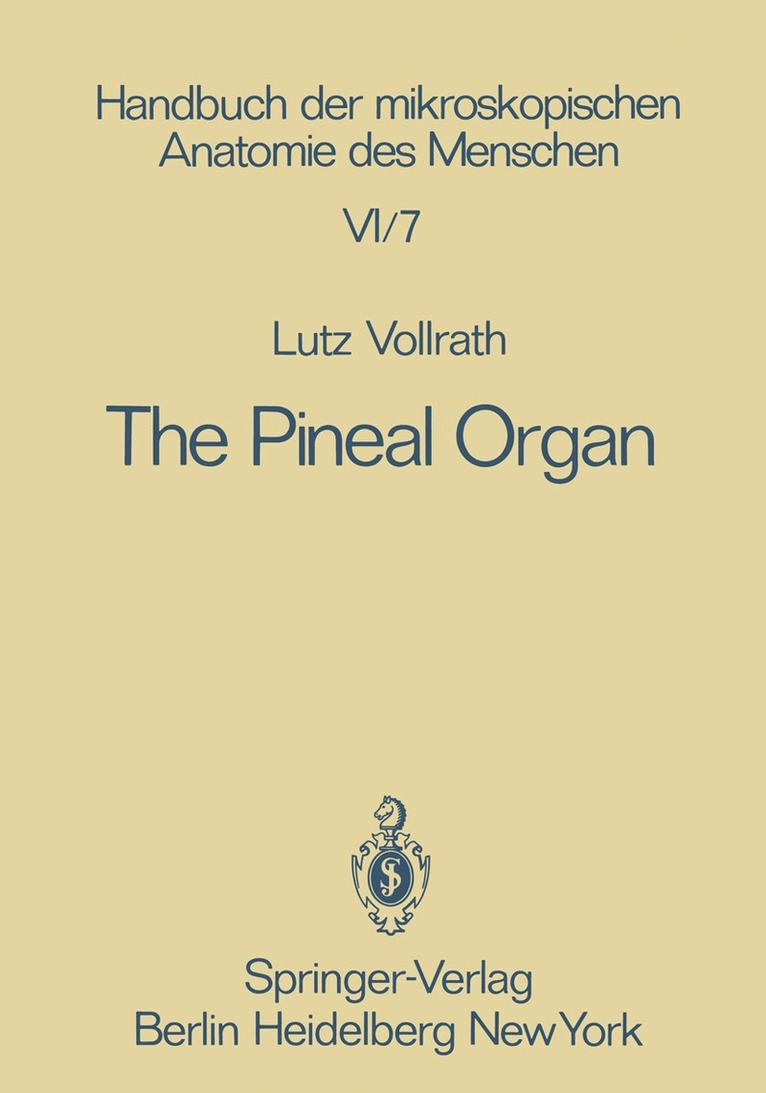
Häftad, Engelska, 2012
1 114 kr
Skickas inom 10-15 vardagar
When I was asked by the late Professor Wolfgang Bargmann in 1973 to write the continuation of his review article on the epiphysis cerebri published in the present Handbuch Series in 1943 I felt greatly flattered and readily agreed, not knowing that it is virtually impossible for a single person to cover comprehensively the vast field of pineal research carried out over the last 35 years. Although I have done my best to include as much of the relevant work as possible (up to July 1979), I am constantly haunted by the references I have missed. I sincerely apologize for these omissions: first, to the authors of these papers, who, in addition to working on one of the most stony grounds of biological research, now may experience the additional frustration of not being quoted; secondly, to my fellow pinealogists or pinealogists-to-be, who may carry out painstaking experiments only to find that they have been done before, or who may be led astray because of lack of information. Nevertheless, I do hope that this monograph will fulfil its aim, namely to show how pineal research has progressed over the last 35 years and where it stands today. It is hoped that it will aid in planning relevant experiments and that it shows which approaches to the pineal problem would be better avoided.
E-bok
PDF, Tyska, 2013566 kr
Läs direkt efter köp
E-bok
PDF, Engelska, 2013708 kr
Läs direkt efter köp
This volume marks the end of twenty years of neurosecretion during which there were five symposia, namely Naples (1953), Lund (1957), Bristol (1961), Strasbourg (1966), and Kiel (1970). In comparison with these symposia an exceptionally large number of papers were read at this the sixth symposium, in London, and for economic reasons it has not been possible to publish all the papers in extenso. The editors have therefore been obliged to undertake the unenviable work of selection, a task made all the more difficult by the excel lence and importance of contributions of the symposium. We felt that it was of the utmost importance at this moment in the history of neurosecretion to present as complete a picture as possible of the present state of the subject in relation to the past and opportunities for the future. We have therefore given some preference to papers with a strong review element, research papers in areas of current importance and contributions which deal with recently developed techniques with promise for the future. We have more over attempted to strike some balance between the different areas of research on neurosecretion so that the volume as a whole may be of interest to the general reader, and that he will find in it a reasonably coherent pattern of thought which demonstrates neurosecretion as the final neuroendocrine pathway. We have attempted a certain degree of uniformity of spelling, symbols, etc.
Häftad, Engelska, 2013
561 kr
Skickas inom 10-15 vardagar
This volume marks the end of twenty years of neurosecretion during which there were five symposia, namely Naples (1953), Lund (1957), Bristol (1961), Strasbourg (1966), and Kiel (1970). In comparison with these symposia an exceptionally large number of papers were read at this the sixth symposium, in London, and for economic reasons it has not been possible to publish all the papers in extenso. The editors have therefore been obliged to undertake the unenviable work of selection, a task made all the more difficult by the excel lence and importance of contributions of the symposium. We felt that it was of the utmost importance at this moment in the history of neurosecretion to present as complete a picture as possible of the present state of the subject in relation to the past and opportunities for the future. We have therefore given some preference to papers with a strong review element, research papers in areas of current importance and contributions which deal with recently developed techniques with promise for the future. We have more over attempted to strike some balance between the different areas of research on neurosecretion so that the volume as a whole may be of interest to the general reader, and that he will find in it a reasonably coherent pattern of thought which demonstrates neurosecretion as the final neuroendocrine pathway. We have attempted a certain degree of uniformity of spelling, symbols, etc.