Lambert Brandsma – författare
Visar alla böcker från författaren Lambert Brandsma. Handla med fri frakt och snabb leverans.
5 produkter
5 produkter
E-bok
PDF, Engelska, 20033 639 kr
Läs direkt efter köp
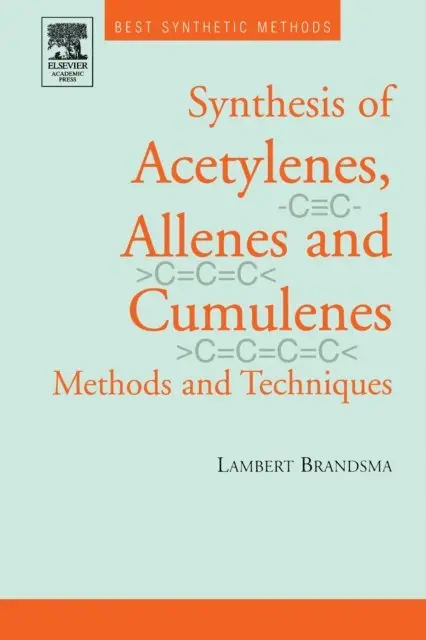
There is a vast and often bewildering array of synthetic methods and reagents available to organic chemists today. The Best Synthetic Methods series allows any scientist who is interested in the chemical transformations of molecules to choose between all the alternatives and assess their real advantages and limitations. With the emphasis on laboratory use, these volumes represent a comprehensive and practical guide to modern synthetic organic chemistry.Best Synthetic Methods: Acetylenes, Allenes and Cumulenes is the product of the author''s many years practical experience and reading of the original literature. It contains a valuable distillation and critical evaluation of the Best Synthetic Methods for the formation and reaction of molecules containing carbon-carbon triple bonds or cumulative carbon-carbon double bonds. A brief review of each area is provided, but the emphasis in all cases is on describing efficient practical methods to effect the transformations described. The reader can therefore use this book to rapidly review and select the best methods of performing a synthetic conversion to create or modify a molecule containing an acetylene, allene or cumulene functionality. In addition, the documentation of a large number of experimental recipes enables the user to synthesise an unsaturated molecule without the need to access to the original literature.- Reviews and evaluates the various methods for the formation and reaction of acetylenes, cumulenes and allenes- Provides detailed practical experimental for many important reactions- General tips and analytical data are provided from the author''s own extensive research in this area
Häftad, Engelska, 1986
546 kr
Skickas inom 10-15 vardagar
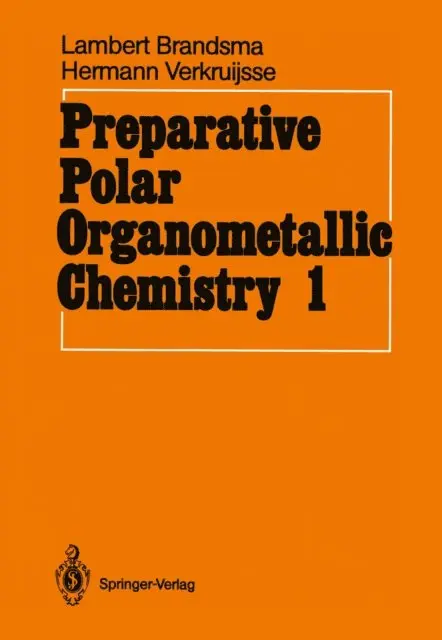
Polar organometallic compounds are indispensable for the synthetic chemist. As this book shows, these almost ideal reagents are easy to prepare with high specificity under mild conditions and yet react quite readily with a great variety of substrates. Many compounds can be metallated directly at positions which would otherwise be difficult to substitute. Functional groups and heteroatoms already present in a molecule direct metallation to sites in their vicinity. The rules which govern polar organometallic chemistry often are not dominated by the usual n-delocalization and inductive effects; dipolar interactions, chelation, polarization, etc. often can be much more important. This affords novel synthetic opportunities. A good example is the development of a basically new type of aromatic substitution chemistry not based on positively charged intermediates. Seebach's injunction, "Thinking of polar organometallic compounds as carbanions is an impoverishment rather than a simplification" (International Symposium, Chemistry of Carbanions, Durham 1984), stresses the need to consider the metal not only as an integral, but perhaps also as the key component of these reagents. Rather than wandering off as solvated cations and acting as uninvolved spectators, the metals, rather than the anion moieties, can initiate and govern the subsequent reactions. To the founders of this field, e. g. Grignard, Ziegler, Gilman, Wittig, and their followers, the metal was critical. The title of Schlosser's book, "Polare Organometalle", certainly was apt.
Häftad, Engelska, 1991
546 kr
Skickas inom 10-15 vardagar
Preparative Polar Organometallic Chemistry is a collection of laboratory procedures for the synthesis and functionalization of organoalkali and Grignard compounds. Both, Vol. 1 and Vol. 2 are intended to be practical bench-top laboratory manuals for working organic chemists, from the student to the advanced scientist.
E-bok
PDF, Engelska, 2012712 kr
Läs direkt efter köp
Preparative Polar Organometallic Chemistry is a collection of laboratory procedures for the synthesis and functionalization of organoalkali and Grignard compounds. Both, Vol. 1 and Vol. 2 are intended to be practical bench-top laboratory manuals for working organic chemists, from the student to the advanced scientist.
E-bok
PDF, Engelska, 2012712 kr
Läs direkt efter köp
Polar organometallic compounds are indispensable for the synthetic chemist. As this book shows, these almost ideal reagents are easy to prepare with high specificity under mild conditions and yet react quite readily with a great variety of substrates. Many compounds can be metallated directly at positions which would otherwise be difficult to substitute. Functional groups and heteroatoms already present in a molecule direct metallation to sites in their vicinity. The rules which govern polar organometallic chemistry often are not dominated by the usual n-delocalization and inductive effects; dipolar interactions, chelation, polarization, etc. often can be much more important. This affords novel synthetic opportunities. A good example is the development of a basically new type of aromatic substitution chemistry not based on positively charged intermediates. Seebach''s injunction, "Thinking of polar organometallic compounds as carbanions is an impoverishment rather than a simplification" (International Symposium, Chemistry of Carbanions, Durham 1984), stresses the need to consider the metal not only as an integral, but perhaps also as the key component of these reagents. Rather than wandering off as solvated cations and acting as uninvolved spectators, the metals, rather than the anion moieties, can initiate and govern the subsequent reactions. To the founders of this field, e. g. Grignard, Ziegler, Gilman, Wittig, and their followers, the metal was critical. The title of Schlosser''s book, "Polare Organometalle", certainly was apt.